Technology & Automation
Claim.MD Reviews: Pros, Cons, Pricing & Best Alternative
Read our Claim.MD review covering features, pricing, pros, cons, and user feedback, plus when VerifyTreatment may be a b...
Read the full article →


Prior authorization software helps providers reduce delays, prevent denials, and streamline approvals. This guide compares 8 tools that cover upfront verification, requirement detection, submission, automation, and workflow management so you can choose the right fit for your process.
| Software | Best For |
| VerifyTreatment | Identifying requirements upfront and preventing denials before submission |
| Waystar | Automating prior authorization within the revenue cycle |
| CoverMyMeds | Medication-based prior authorization workflows |
Prior authorization often feels like a slow and frustrating process. The time you’re supposed to spend caring for patients gets pulled into checking requirements, switching between portals, and chasing approvals. And even then, delays and denials still happen.
Providers who manage this process effectively don’t rely on manual workflows. They use tools that surface requirements early and guide the process from the first step.
To help you avoid these bottlenecks, we’ve compiled a list of 8 prior authorization software solutions that help you identify requirements upfront, reduce manual effort, and speed up approvals.
Let’s get started.
At VerifyTreatment, we work closely with healthcare providers to simplify insurance verification and reduce the bottlenecks that slow down admissions and prior authorization workflows.
One of our clients, Foundation Recovery Network, was able to eliminate admissions delays, reduce staffing needs, and prevent the loss of 1 in 10 patients, while saving over $10,000 per month in lost revenue.
We see these challenges play out every day, which means this guide is grounded in real operational experience.

Great Product, Ease of Use, Added Efficiency for Our Team. Automating and bringing in health insurance verifications to our instance was a game changer. We have instant verifications for all of our prospects, as well as automated verifications for our clients on a weekly basis.
Not all prior authorization software solves the same problem. Some tools focus on submitting requests faster. Others help you manage approvals. But the most effective solutions go a step further by helping you understand what’s required before you even begin.
Here’s what to look for when choosing the right solution:
One of the biggest sources of delays is not knowing what’s required upfront. In fact, 68% of providers say inaccurate or incomplete patient data at intake is a primary driver of denials.
Before choosing any tool, ask:
With the right level of visibility, teams can avoid trial and error, reduce back-and-forth, and improve first-time approval rates.
Some tools only handle submission. Others support more of the process. Ideally, your software should help you:
If your team still has to jump between multiple systems, the efficiency gains will be limited.
Prior authorization sits between admissions, clinical care, and billing. Look for software that integrates with:
This reduces duplicate work and ensures information flows seamlessly across teams.
A major goal of prior authorization software is to eliminate repetitive tasks. Strong solutions should:
The less your team has to re-enter or chase information, the more time they can spend on higher-value work.
Submitting faster doesn’t matter if requests get denied. The right software should help you:
Now that you know what to look for, here are 8 prior authorization software worth considering.
| Software | Best For | Key Strength | Limitation |
| VerifyTreatment | Upfront verification and requirement clarity | Identifies requirements before submission | Does not handle submission directly |
| CoverMyMeds | Medication prior authorizations | Strong pharmacy and ePA workflow | Limited to medication use cases |
| Waystar | Revenue cycle automation | End-to-end authorization automation | More complex setup and integration |
| Surescripts | EHR-integrated prior authorization | Real-time decisions within workflows | Focused on prescribing stage |
| Availity | Multi-payer authorization management | Centralized payer portal access | Varies by payer participation |
| EviCore | Clinical validation and procedure-based approvals | Aligns with medical necessity criteria | Can be complex for non-clinical users |
| Rhyme | Reducing or eliminating prior authorization workload | Touchless workflows and gold carding | Requires payer-provider alignment |
| Experian Health | Automated authorization workflows | Background automation and payer database | Limited intake-level visibility |
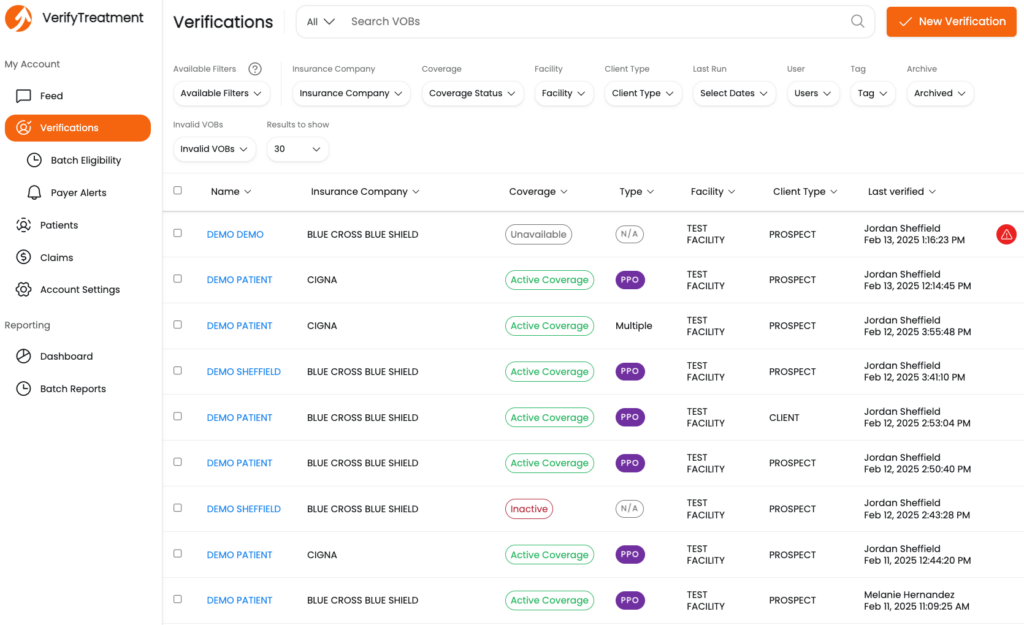
VerifyTreatment is designed to address the root causes of prior authorization delays and denials, including poor intake data, missed requirements, and incomplete insurance verification.
With real-time eligibility and authorization detection, your team can determine if a service requires prior authorization before the first date of service, not weeks later when a claim is denied. It also surfaces critical details such as carve-outs, out-of-network status, deductibles, and exclusions that are often missed during manual checks or phone verifications.
This enables admissions teams to verify benefits accurately the first time, request authorization upfront, and avoid costly post-service denials.
VerifyTreatment is best for providers who need clearer visibility into insurance coverage and authorization requirements before submission, especially behavioral health organizations and high-volume admissions teams.
VerifyTreatment offers tiered plans with core eligibility and verification features, plus advanced automation and integrations on higher tiers. Pricing is not publicly available, so you’ll need to contact sales for a quote.
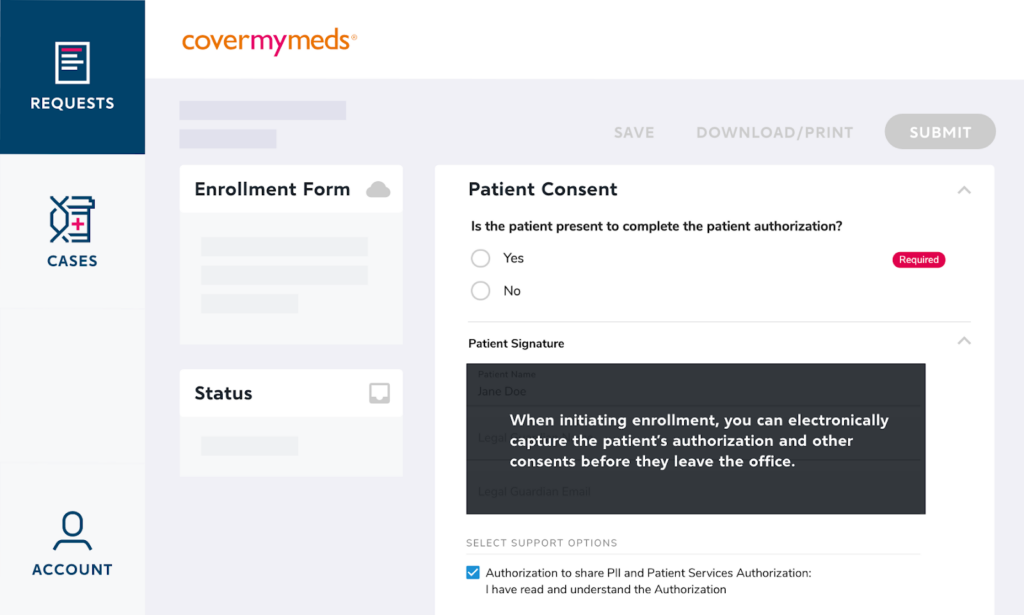
CoverMyMeds focuses on helping providers, pharmacies, and payers complete medication prior authorizations faster.
It streamlines the submission process by connecting providers directly with pharmacies and insurers, allowing prior authorization requests to be initiated, completed, and tracked within a single workflow. This reduces reliance on phone calls and fax, and helps teams move requests forward more efficiently.
The platform is particularly strong for pharmacy-related prior authorizations. Requests can be triggered at the point of prescription or claim rejection, helping keep therapy on track and reducing delays in patient access to medications.
CoverMyMeds is best for providers and pharmacies that need a faster, more efficient way to submit and manage medication prior authorizations, especially within e-prescribing and pharmacy-driven workflows.
Pricing is not publicly available, so you’ll need to contact sales or visit the vendor’s website for details.
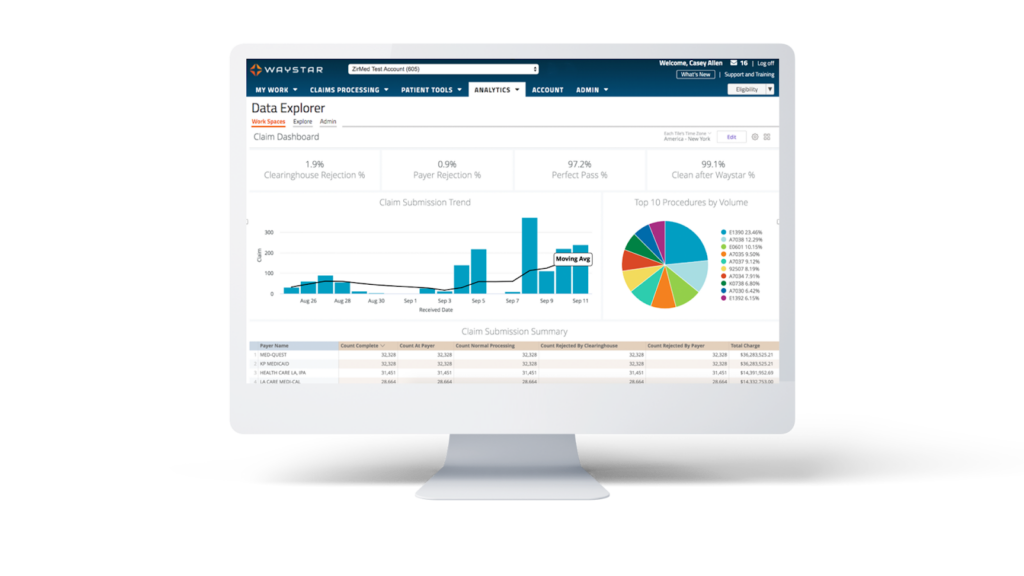
Waystar brings automation into prior authorization workflows, helping providers reduce manual effort, speed up approvals, and improve financial clearance across the revenue cycle.
Its Authorization Manager uses AI-driven rules and automation to determine whether prior authorization is required, initiate requests, and track status—all within a single workflow. This removes the need to navigate payer portals or rely on phone and fax, while helping ensure submissions are accurate from the start.
Waystar is best for health systems, hospitals, and large provider groups looking to automate prior authorization within a broader revenue cycle workflow.
Pricing is not publicly available and depends on organization size, usage, and integrations. You’ll need to contact sales for a custom quote.
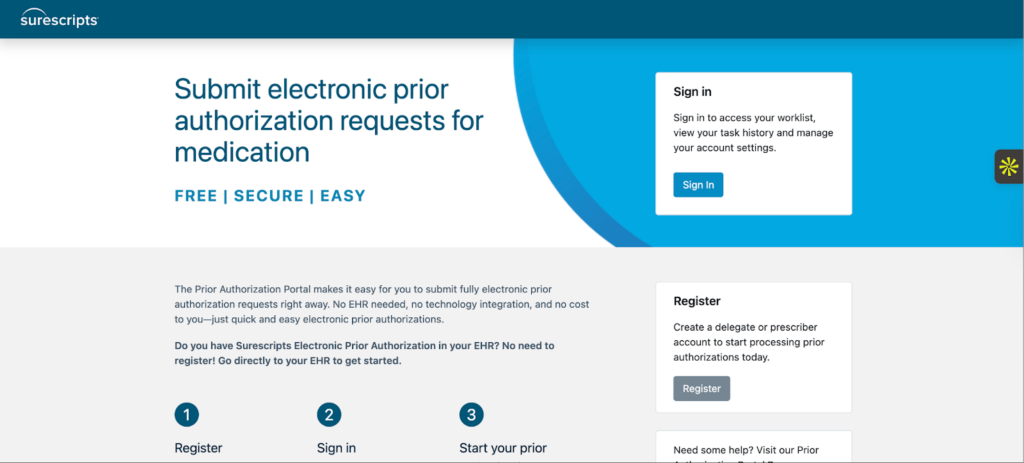
Surescripts streamlines electronic prior authorization within clinical workflows. Its electronic prior authorization (ePA) solution reduces manual work by eliminating redundant steps and guiding users through dynamic question sets based on payer requirements.
Instead of filling out static forms or switching systems, providers can complete only the required information and receive faster determinations.
Surescripts is best for health systems and providers who want to streamline prior authorization within their prescribing workflow and receive faster, real-time decisions for medication requests.
Pricing is not publicly available and depends on integrations and usage. You’ll need to contact Surescripts or your EHR provider for details.
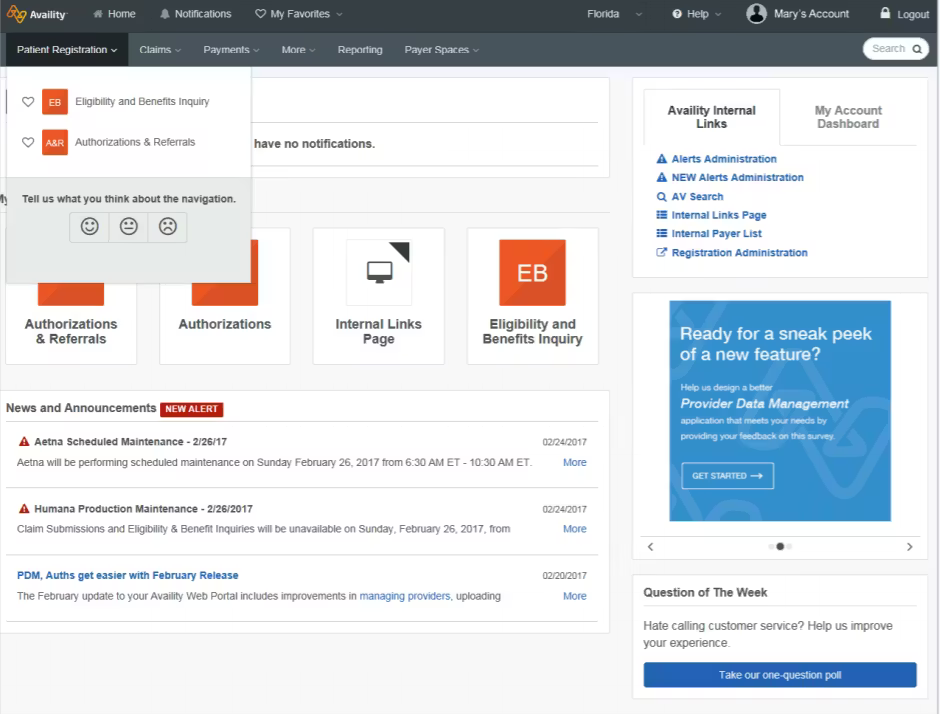
Availity consolidates multiple payer workflows into a single platform. Through the Availity Essentials, teams can check prior authorization requirements, submit requests, attach clinical documentation, and track status across multiple health plans from one dashboard.
This reduces the need for phone calls and manual navigation between payer systems, especially for organizations handling high volumes of authorizations.
Availity is best for provider organizations that work with multiple payers and need a centralized platform to manage prior authorizations, eligibility, and payer communications in one place.
Pricing is not publicly available and varies based on services and usage. You’ll need to contact Availity for a quote.
EviCore intelliPath is built around one key idea: prior authorization decisions should be driven by clinical criteria, not just form submissions.
Instead of relying on static forms, it guides providers through structured clinical questions based on the specific procedure and payer requirements. As responses are entered, the system evaluates medical necessity in real time, often returning a decision without requiring manual review.
EviCore is best for providers and health systems handling complex, procedure-based prior authorizations where clinical validation and medical necessity requirements are critical.
Pricing is not publicly available and depends on payer relationships and integrations. You’ll need to contact EviCore for details.

Rhyme monitors the full prior authorization process from request to decision to pinpoint where time is lost and manual work builds up. It uses that data to automate repetitive steps and reduce the number of touchpoints required to move an authorization forward.
The result is a more “touchless” workflow, where fewer staff are involved and requests move through the system with less friction. It also supports gold carding, allowing qualified providers to bypass prior authorization requirements for certain services.
Rhyme is best for large health systems and payer-provider networks looking to reduce administrative burden, optimize prior authorization workflows, and move toward eliminating unnecessary authorizations altogether.
Pricing is not publicly available and depends on organization size and implementation scope. You’ll need to contact Rhyme for details.
Experian Health automates much of the prior authorization process behind the scenes, reducing how much staff need to manually handle.
Authorization checks run automatically, pulling payer data, verifying requirements, and progressing the request without constant input. Staff are only brought in when something is missing or needs attention, while the rest of the process continues in the background.
Experian Health is best for provider organizations looking to automate prior authorization workflows and reduce manual effort across high-volume operations.
Pricing is not publicly available and depends on organization size and implementation needs. You’ll need to contact Experian Health for a quote.
The tools in this list address different parts of the prior authorization process. Some help you submit requests faster, while others focus on managing approvals, automating workflows, or reducing manual follow-ups. The right choice depends on where your team is losing time and which part of the process needs the most improvement.
In many cases, delays and denials start earlier in the process, when requirements aren’t clear or coverage details are incomplete. This leads to rework and unnecessary back-and-forth. Improving visibility at this stage helps teams move forward with more confidence.
So, if your goal is to reduce delays and prevent denials, VerifyTreatment is the tool that helps you get it right before the process even begins.
Get started with VerifyTreatment here.
It helps ensure that requests are complete, accurate, and aligned with payer requirements before submission, reducing errors that typically lead to denials.
No. While some solutions are designed for enterprise systems, many tools can be used by smaller practices to reduce administrative workload and improve efficiency.
Focusing only on submission speed. Many delays and denials happen because requirements weren’t clear from the start, not because the submission was slow. That’s where VerifyTreatment helps by identifying what’s required upfront before any request is submitted.
Look for tools that provide visibility into requirements before submission, automate repetitive tasks, integrate with your existing systems, and offer real-time status tracking.
Yes. Many prior authorization tools integrate with EHR systems to reduce duplicate data entry, streamline workflows, and ensure information flows across clinical and administrative teams.
Disclaimer: All trademarks, logos, and brand names are the property of their respective owners. The use of any third-party trademarks, logos, or brand names in this article is for informational and comparative purposes only, and constitutes nominative fair use. This article was published by VerifyTreatment, and while we strive for objective comparisons, VerifyTreatment is included as an option within this list.


Samantha is a dynamic marketing professional dedicated to making a difference in the behavioral health industry through her work at VerifyTreatment. With a strong background in digital marketing and brand advocacy, she helps elevate the platform’s presence by fostering authentic connections with treatment centers and healthcare providers. Her expertise in content creation and community engagement ensures that VerifyTreatment’s value is communicated effectively, helping centers streamline operations and improve patient care. Samantha’s focus on building trust and driving awareness positions VerifyTreatment as a key resource in the healthcare landscape.

Nicole is a versatile healthcare professional with a Bachelor’s degree in Health Administration and a solid background in managing healthcare systems and operations. Her experience spans healthcare management, compliance, and regulations, making her adept at navigating complex healthcare environments. In addition to her administrative expertise, Nicole holds certifications in Functional Nutrition and Personal Training, giving her a well-rounded perspective on health and wellness. She is committed to using her skills to improve healthcare settings and ensure effective, patient-centered care.

Tara is a dedicated leader who leverages her Master's degree in Information Technology (Florida Tech) and deep company knowledge (since 2018) to drive our community awareness. She is the central figure for managing social engagement and ensuring the community is immediately and effectively informed of all new product launches and company updates.

JoAnn has a strong background in the mental health and substance abuse industry, with expertise in billing, coding, facility credentialing, and contracting. She is passionate about team education and public speaking, always striving to make a positive impact. With a solid foundation in accounting, JoAnn also holds an Associate of Arts in Biblical Studies from Liberty University, blending her professional skills with her personal values.

For 11+ years, Melanie has been dedicated to helping clients access quality mental health care, with a special focus on grief, loss, and substance abuse. With expertise in healthcare, community outreach, patient advocacy, and leadership development, Melanie is passionate about making a positive impact in the lives of others.

Jordan is a dedicated advocate for behavioral health and is passionate about improving sales strategies and business processes. With a focus on helping businesses, particularly in healthcare, Jordan believes that streamlining operations is a way to positively impact more people indirectly. A strong leader, both personally and professionally, Jordan is committed to making a difference in the world by doing good business and serving a higher purpose.