
Technology & Automation
10 Best Dental Insurance Verification Software in 2026
Quick Summary Verifying coverage and benefits without spending hours on payer calls and portal checks takes the right so...
Read the full article →


RCM denial management goes beyond fixing rejected claims. It focuses on identifying why denials happen, resolving them efficiently, and preventing them from recurring. By improving front-end processes like eligibility verification and authorization, healthcare organizations can reduce rework, improve cash flow, and protect revenue before it’s lost.
The impact of claim denials is hard to notice at first. Your organization keeps submitting claims, correcting errors, and following up on unpaid balances, until one day you realize it has quietly wiped out a significant portion of your expected revenue.
The reality is you are not alone. A recent survey found that claims adjudication alone cost healthcare providers over $25.7 billion, with nearly $18 billion spent reworking claims that were eventually paid anyway.
To prevent this kind of revenue leakage, you need a structured approach to RCM denial management. In this article, we break down where denials actually come from, and how to stop them from draining your revenue.
Improve denial management with VerifyTreatment
Verify coverage, identify authorization requirements, and spot payer-specific risks in real time, so fewer claims are denied and more revenue flows as expected.
Book Your DemoAt VerifyTreatment, we’ve helped healthcare organizations reduce denial rates, improve cash flow, and regain control of their revenue cycle, by identifying root causes of denials and fixing them at the process level.
For example, in our work with Foundation Recovery Network, we eliminated admissions delays, reduced staffing strain, and prevented the loss of 1 in 10 patients, saving over $10,000 per month in lost revenue.
This guide is built from that same hands-on experience, working directly with real systems, real denials, and real revenue challenges.
Here’s what one of our clients had to say:

Great Product, Ease of Use, Added Efficiency for Our Team. Automating and bringing in health insurance verifications to our instance was a game changer. We have instant verifications for all of our prospects, as well as automated verifications for our clients on a weekly basis.
Denial management is the process of handling claims that have been rejected by payers. It involves identifying why they were denied, correcting and resubmitting them, and most importantly, preventing the same issues from happening again.
But in practice, most common causes of claim denials are avoidable, and often originate earlier in the revenue cycle. Here are some of them;
So while correcting and resubmitting claims after they are denied is necessary, it only means you’re reacting to problems that have already occurred. Effective denial management focuses on identifying where these issues originate and addressing them earlier in the process, so fewer denials happen at all.
Related: check our list of the best denial management software.
The tricky part about claim denials is that they don’t always look like a problem at first.
Claims are going out. Patients are being seen. Reports show revenue being generated.
But behind the scenes, something isn’t adding up.
Here’s how one provider described it:
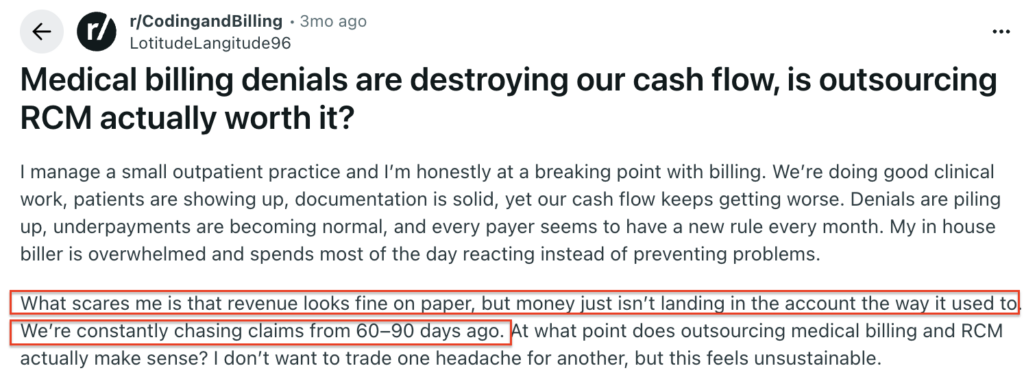
That gap between recorded revenue and actual cash flow is often where denial issues hide. So to properly identify claim denials, you need to know where they actually show up, and what to look for.
This is where denials are formally communicated. Each denied claim comes with a reason code explaining why it wasn’t paid. For example:
These codes explain and point directly to what’s breaking in your process. You can obtain full denial code lists from payers, or refer to standardized sources like X12 claim adjustment reason codes for a broader reference.
Not all denials show up immediately as “denied.” In many cases, they show up as delays.
If you notice a growing number of claims sitting in 30, 60, or 90+ days, it’s a strong signal that something isn’t being resolved and they are often tied to denials, missing documentation, or incomplete follow-up.
So, pay attention to patterns in aging buckets, repeated follow-ups on the same claims, and anything consistently crossing into 60–90+ days.
Many denials are already set in motion before the claim is ever submitted. For instance, coverage may be inactive, an authorization may be required but not obtained, or a payer-specific rule may not have been identified during intake.
The challenge is that without visibility at that stage, these issues don’t show up immediately and later surface as denials.
That’s where tools like VerifyTreatment make a difference. By giving teams real-time visibility into eligibility, authorization requirements, and payer-specific risks during intake, they help catch issues early, before they turn into denied claims.
When claim denials are reduced, the benefits go far beyond fewer rejections. They show up in faster payments, smoother operations, and more predictable revenue.
When claims are submitted correctly the first time, they move through the system faster. Instead of going through multiple review cycles, payments are processed in a single pass. This reduces delays and improves cash flow consistency.
Fewer denials mean less time spent correcting errors, resubmitting claims, and chasing payments. Your team can focus on clean claim submission and higher-value work instead of constantly reacting to issues.
When denials are minimized, revenue becomes easier to track and forecast. A/R stays under control, and payments follow a more consistent pattern, making financial performance more stable over time.
Many denials start at the front end but only show up later in billing. When eligibility, authorization, and payer requirements are handled correctly upfront, both teams operate with the same accurate information—reducing miscommunication and downstream errors.
Minimizing denials also improves how patients move through your system. When coverage is verified accurately and expectations are clear from the start, patients can proceed without delays or confusion.
Resolving claim denials starts with the understanding that not all denials should be handled the same way.
Some can be corrected and resubmitted quickly. Others require appeals, additional documentation, or payer follow-up. And some, if addressed too late, can’t be recovered at all.
The key is having a structured approach.
Every denial comes with a reason code, but that alone isn’t enough. You need to understand what actually caused it:
Without this, you risk resolving the claim but not the problem. Tools like VerifyTreatment help surface eligibility gaps, inactive coverage, and authorization requirements early, making root cause identification clearer.
Before making corrections, it’s important to compare the denied claim against the patient’s verified coverage and payer rules.
For example:
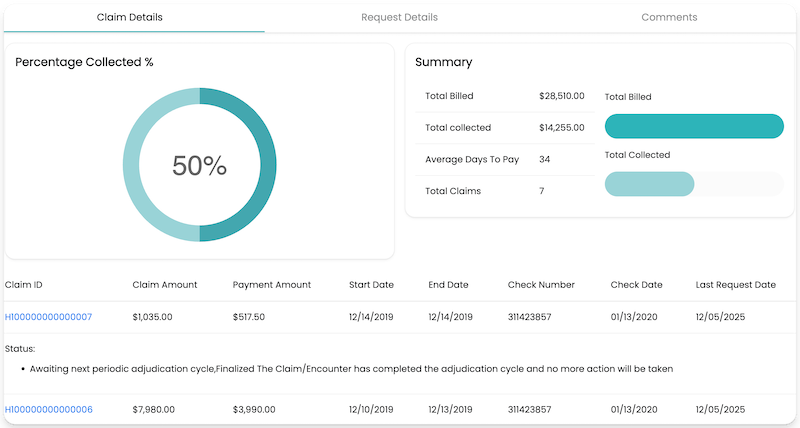
VerifyTreatment surfaces key details like active dates, copays, visit limits, and behavioral health carve-outs in one place. This allows teams to confirm whether the claim aligns with the patient’s actual coverage and identify mismatches that may have caused the denial.
Once the issue is clear, the next step is to correct the claim and resubmit it within the payer’s timeframe.
This may involve:
With clearer visibility into coverage details and payer expectations, teams can make more accurate corrections and reduce the chances of repeated denials.
Some denials require escalation. This includes:
But appeals are resource-intensive and not always successful, especially when the issue could have been prevented earlier.
If the same denial keeps happening, it’s not a one-time issue. Track:
This is where resolution starts turning into improvement. VerifyTreatment supports this by giving teams visibility into claim status, showing whether claims are received, in process, pending information, paid, or denied.
This is where most organizations fall short. Many denials, especially eligibility issues, missing authorizations, and coverage gaps, originate at the front end, during intake and verification. By the time they appear in billing, the damage has already been done.
Resolving denials is necessary. But relying on rework alone keeps your team in a reactive cycle. The real improvement comes from:
When these steps are handled correctly, fewer claims need to be fixed later. Tools like VerifyTreatment help teams catch these issues at the point of intake by providing visibility into eligibility, benefits, and payer requirements. This reduces preventable denials and also makes it easier to identify and address issues when they occur, improving clean claim rates from the start.
Denial management becomes more effective when the focus shifts from fixing claims to preventing issues before they start. Many denials originate during intake, eligibility checks, and authorization.
By improving visibility at the front end, teams can catch errors early, submit cleaner claims, and reduce the need for rework.
That’s where VerifyTreatment makes a difference. It helps teams verify coverage, identify authorization requirements, and spot payer-specific risks in real time, so fewer claims are denied and more revenue flows as expected.
Ready to reduce preventable denials and improve your revenue cycle? Get started with VerifyTreatment here.
Most denials come from preventable issues such as:
Many of these originate at the front end, during intake and verification.
Reducing denials starts with prevention:
The goal is to submit clean claims the first time.
No. While many denied claims can be corrected and resubmitted, some are lost due to missed deadlines, incomplete documentation, or non-covered services. This is why prevention is critical.
Eligibility verification plays a major role. Incorrect or incomplete verification can lead to denials related to coverage, network status, or benefits. When done accurately upfront, it significantly reduces preventable denials.
VerifyTreatment helps teams verify coverage accurately, flag authorization requirements, and catch eligibility issues before claims are submitted. This reduces preventable denials and improves clean claim rates by addressing problems at the front end.
Disclaimer: All trademarks, logos, and brand names are the property of their respective owners. The use of any third-party trademarks, logos, or brand names in this article is for informational and comparative purposes only, and constitutes nominative fair use. This article was published by VerifyTreatment, and while we strive for objective comparisons, VerifyTreatment is included as an option within this list.





Luis Perdomo, Head of Growth, leads go-to-market strategy, demand generation, and growth initiatives at VerifyTreatment. With a background spanning digital marketing, revenue growth, and business strategy, he focuses on connecting the platform’s capabilities to the real operational challenges facing behavioral health providers, helping teams improve admissions, strengthen revenue performance, and make faster, more informed decisions.

Lindsay Morresi, Account Executive, helps healthcare organizations evaluate how VerifyTreatment can improve insurance verification, admissions, and revenue cycle workflows. Bringing a customer-focused approach to the sales process, she works with teams to understand their operational needs, identify opportunities for greater efficiency, and ensure they have the right solutions to make faster, more informed decisions.

Amira Nicol, Account Executive, brings relationship-building, industry knowledge, and a strong connection to the behavioral health community to VerifyTreatment. She works closely with treatment providers to understand the challenges their teams face around insurance verification and access to care, helping organizations identify solutions that reduce administrative barriers and support better operational and financial outcomes.

Matthew Hall, Senior Account Executive, helps behavioral health organizations identify opportunities to simplify insurance verification and protect revenue throughout the patient journey. With a consultative approach and a strong understanding of admissions, billing, and revenue cycle workflows, he works closely with teams to connect their operational challenges with practical solutions inside VerifyTreatment.

Alexander Jones, Product & Integrations Manager, helps translate customer needs into practical product improvements and scalable integrations at VerifyTreatment. With deep experience across Salesforce, APIs, automation, and business operations, he brings a unique ability to connect client workflows with technical execution, helping ensure the platform is both powerful and practical for the teams using it every day.

Nicole is a versatile healthcare professional with a Bachelor’s degree in Health Administration and a solid background in managing healthcare systems and operations. Her experience spans healthcare management, compliance, and regulations, making her adept at navigating complex healthcare environments. In addition to her administrative expertise, Nicole holds certifications in Functional Nutrition and Personal Training, giving her a well-rounded perspective on health and wellness. She is committed to using her skills to improve healthcare settings and ensure effective, patient-centered care.

Tara is a dedicated leader who leverages her Master's degree in Information Technology (Florida Tech) and deep company knowledge (since 2018) to drive our community awareness. She is the central figure for managing social engagement and ensuring the community is immediately and effectively informed of all new product launches and company updates.

JoAnn has a strong background in the mental health and substance abuse industry, with expertise in billing, coding, facility credentialing, and contracting. She is passionate about team education and public speaking, always striving to make a positive impact. With a solid foundation in accounting, JoAnn also holds an Associate of Arts in Biblical Studies from Liberty University, blending her professional skills with her personal values.

For 11+ years, Melanie has been dedicated to helping clients access quality mental health care, with a special focus on grief, loss, and substance abuse. With expertise in healthcare, community outreach, patient advocacy, and leadership development, Melanie is passionate about making a positive impact in the lives of others.