Revenue Cycle
RCM for Small Companies: How Small Healthcare Teams Can Manage RCM Better
Small healthcare teams don’t need an enterprise-sized billing department to fix big revenue cycle problems. Discover how...
Read the full article →


Verifying coverage and benefits without spending hours on payer calls and portal checks takes the right software. So we compared the options, and VerifyTreatment tops the list for bringing eligibility checks and benefit details into one workflow. Other strong options include Claim.MD and Sohar Health, depending on your needs.
| Software | Best For |
| VerifyTreatment | Simplifying eligibility and benefits checks |
| Claim.MD | Managing eligibility alongside claims |
| Sohar Health | High-volume checks |
At VerifyTreatment, we’ve seen firsthand what a better insurance verification process can do for healthcare teams.
For example, Foundations Recovery Network eliminated admissions delays, reduced staffing needs, prevented the loss of 1 in 10 patients, and saved more than $10,000 per month in lost revenue after using VerifyTreatment.
You can also see what another customer had to say below.
“Great Product, Ease of Use, Added Efficiency for Our Team. Automating and bringing in health insurance verifications to our instance was a game changer. We have instant verifications for all of our prospects, as well as automated verifications for our clients on a weekly basis.”

“The product is lightning fast, and so easy to use. In terms of instant verification, there is nothing faster or more comprehensive in my experience. Highly recommend for billing and admissions departments.”

For this piece, we also looked beyond our own platform, comparing each option based on its verification capabilities, workflow, integrations, and who it is best suited for.
The options below cover different needs, from eligibility and benefits checks to claims support, batch verification, and more specialized dental workflows.
| Software | Best For | Standout Feature | |
| 1 | VerifyTreatment | Simplifying eligibility and benefits checks | Detailed VOBs, coverage discovery, and reverification in one workflow |
| 2 | Claim.MD | Managing eligibility alongside claims | Rejected claim correction and resubmission |
| 3 | Sohar Health | High-volume checks | Bulk API for large-scale eligibility verification |
| 4 | Stedi | API-driven workflows | JSON-native APIs for embedding verification into existing systems |
| 5 | eClaimStatus | Simple eligibility and claim status tracking | Real-time eligibility and claim tracking across 900+ payers |
| 6 | Veritable | Batch eligibility checks | Upload and verify hundreds or thousands of patients at once |
| 7 | Approved Admissions | Monitoring coverage changes | Automated alerts when patient coverage changes |
| 8 | CERTIFY Health | Verification during patient intake | Dental benefit checks tied to scheduling and check-in |
| 9 | Zuub | Dental-specific benefit data | Procedure-level dental benefits and standardized payer data |
| 10 | AirPay | Automating front-desk verification | Automatically checks upcoming appointments before the visit |
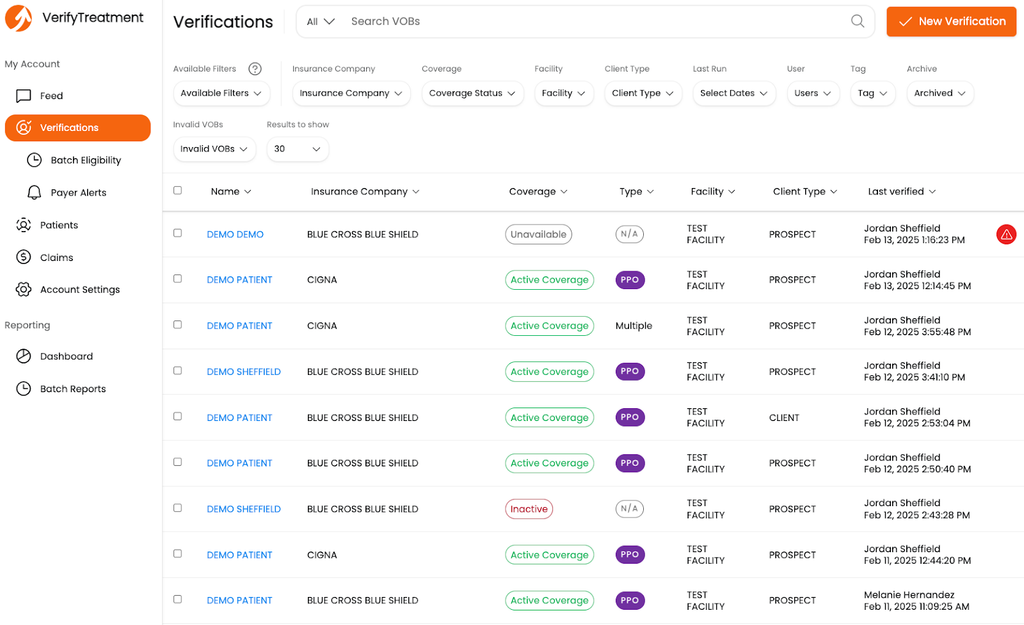
VerifyTreatment tops this list not simply because it is our platform, but because it covers more than a basic eligibility check. You can confirm coverage and review details such as deductibles, copays, coinsurance, plan information, and other available payer data from the same platform.
See it this way: many tools can tell you whether a patient has active coverage. VerifyTreatment goes further with detailed VOBs, coverage discovery, ongoing reverification, and claim status visibility. This gives you more of what you need before and after the initial eligibility check without piecing together separate workflows.
Aside from this, you can run checks in bulk and connect VerifyTreatment with your existing systems through its CRM integrations or API.
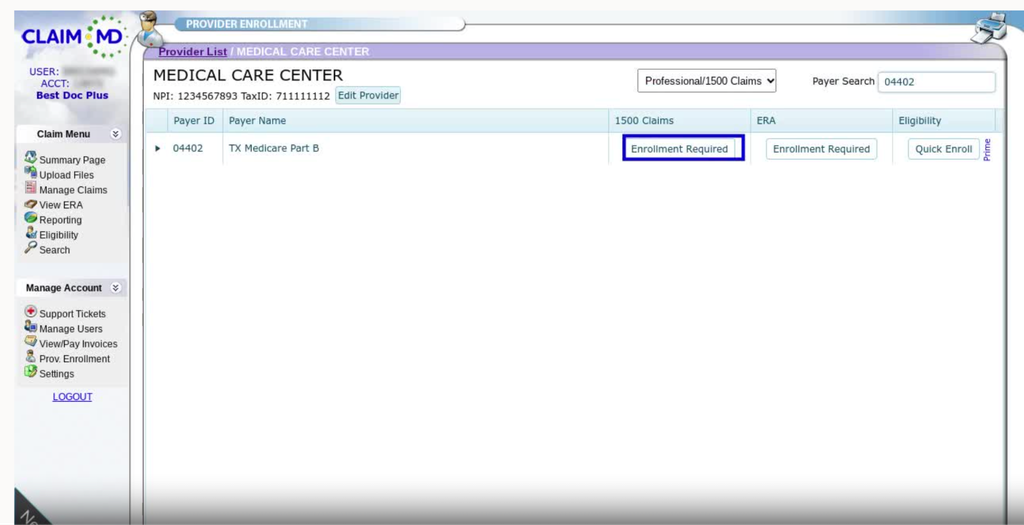
Claim.MD is primarily a medical clearinghouse, but it also supports insurance verification through real-time benefits and eligibility checks. One thing that makes it different is how it handles rejected claims. It sends them back for correction, so you can fix the issue and resubmit without starting the process over. This makes Claim.MD a better fit for practices that want eligibility checks alongside claims and remittance.
For a deeper look at how it works, its pricing, and where it falls short, read our full Claim.MD review.
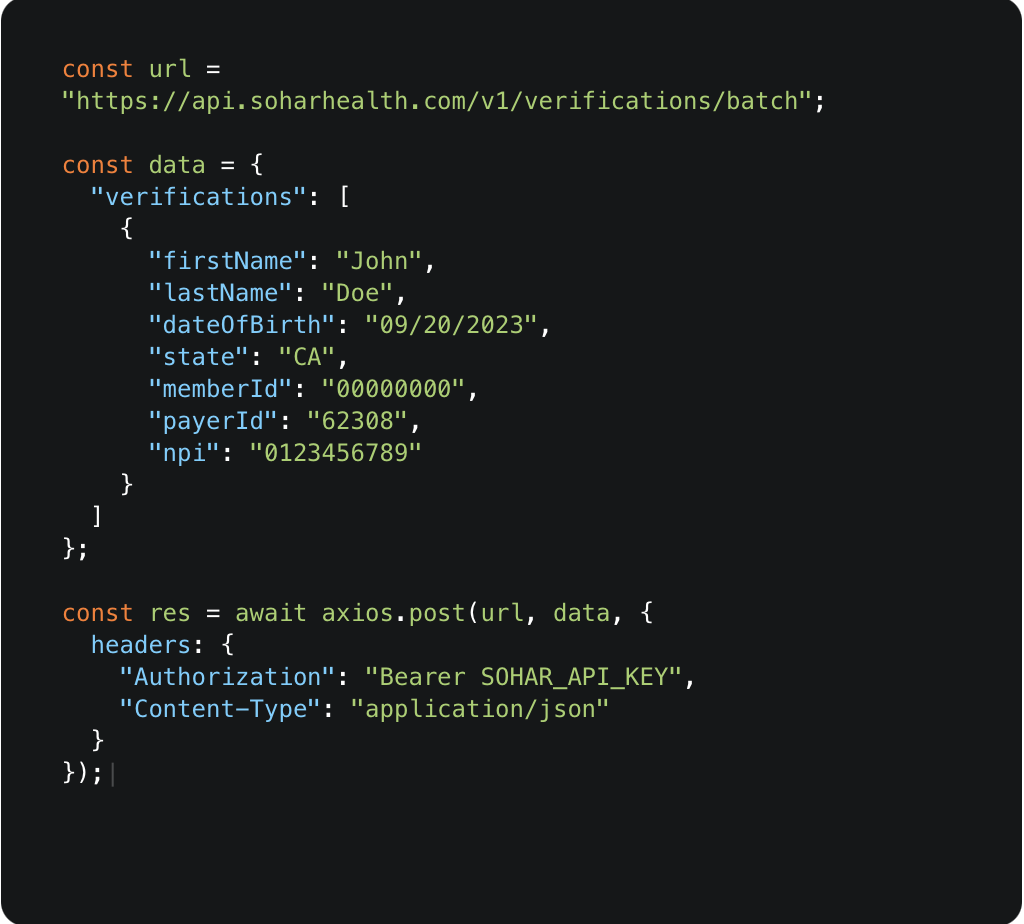
Sohar Health is worth considering if you have a large number of patients to verify and want to automate that process at scale. Its API handles real-time eligibility checks with a median response time of six seconds, while its bulk API can process up to 200 verification checks in one call.

Stedi lets healthcare teams run insurance verification either through its portal or directly inside their existing systems using its API. You can check eligibility in real time or in batches and retrieve details such as copays, deductibles, and coverage information.
What makes Stedi different is the flexibility on the integration side. Its JSON-native APIs can plug verification into an EHR, RCM platform, practice management system, or another application, while its batch API supports up to 10,000 checks at once.
Related: See our comparison of the best healthcare RCM software.
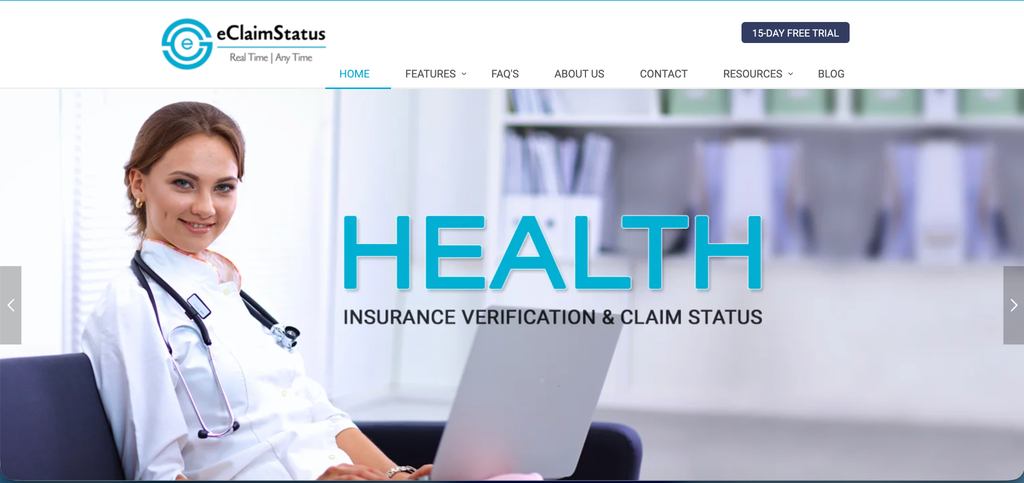
eClaimStatus combines real-time eligibility checks with claim status tracking in one web-based platform. You can pull coverage and benefit information from more than 900 payers and track individual or multiple claims from the same place. This makes it a simple option for teams that need both, although it may be less suitable if you need broader claims management or deeper integrations.
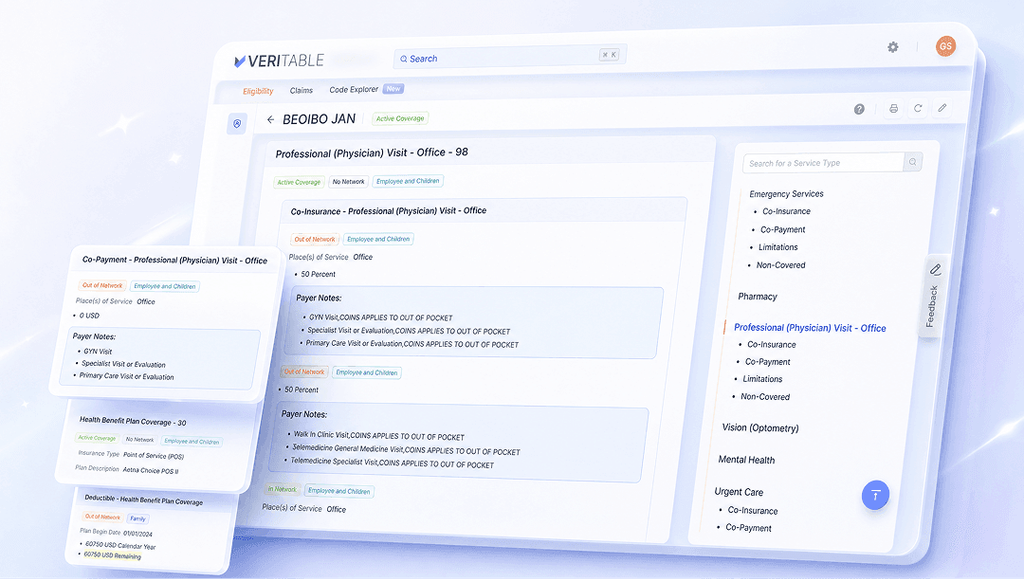
Veritable puts batch verification at the center of its workflow. You can export a patient list from your EHR, upload it, and verify hundreds or thousands of patients at once across more than 1,000 supported payers. That makes it especially useful for practices and billing companies that regularly work through large patient lists.
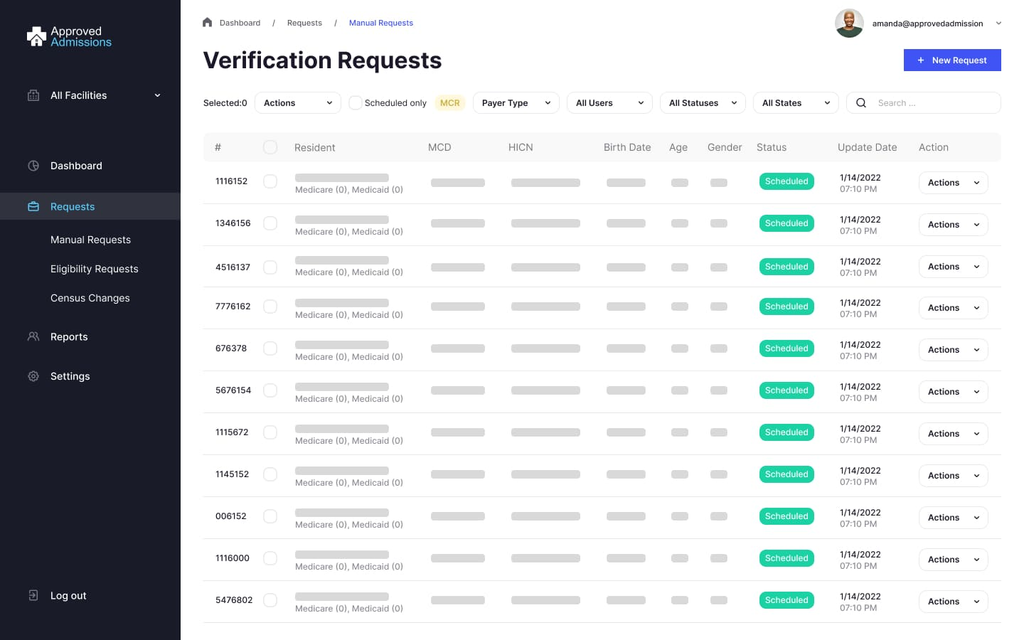
Approved Admissions goes beyond checking whether a patient is covered at one point in time. Its stronger use case is tracking what happens to that coverage afterward, with automated monitoring that alerts your team when Medicare, Medicaid, or commercial coverage changes. That makes it more useful for teams that need to keep an eye on coverage over time, not just run a one-off eligibility check before a visit.

CERTIFY Health makes insurance verification part of the patient intake process. Coverage can be checked at scheduling or check-in, while dental practices can also pull details such as annual maximums, frequency limitations, waiting periods, and CDT coverage.
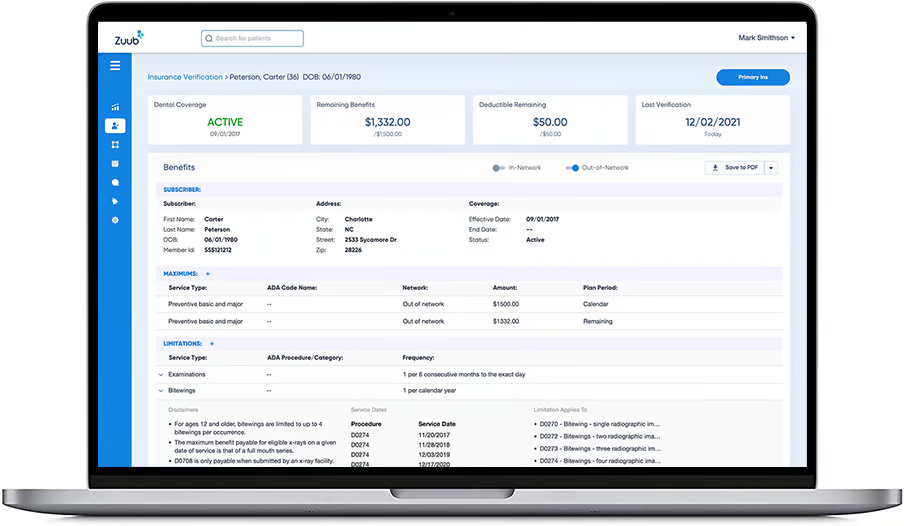
Unlike most tools on this list, Zuub focuses specifically on dental insurance. It connects directly with payers and standardizes the information it receives, giving you more than basic eligibility data. That can include annual maximums, deductibles, procedure-level coverage, ADA code details, frequency rules, waiting periods, exclusions, and benefit history.
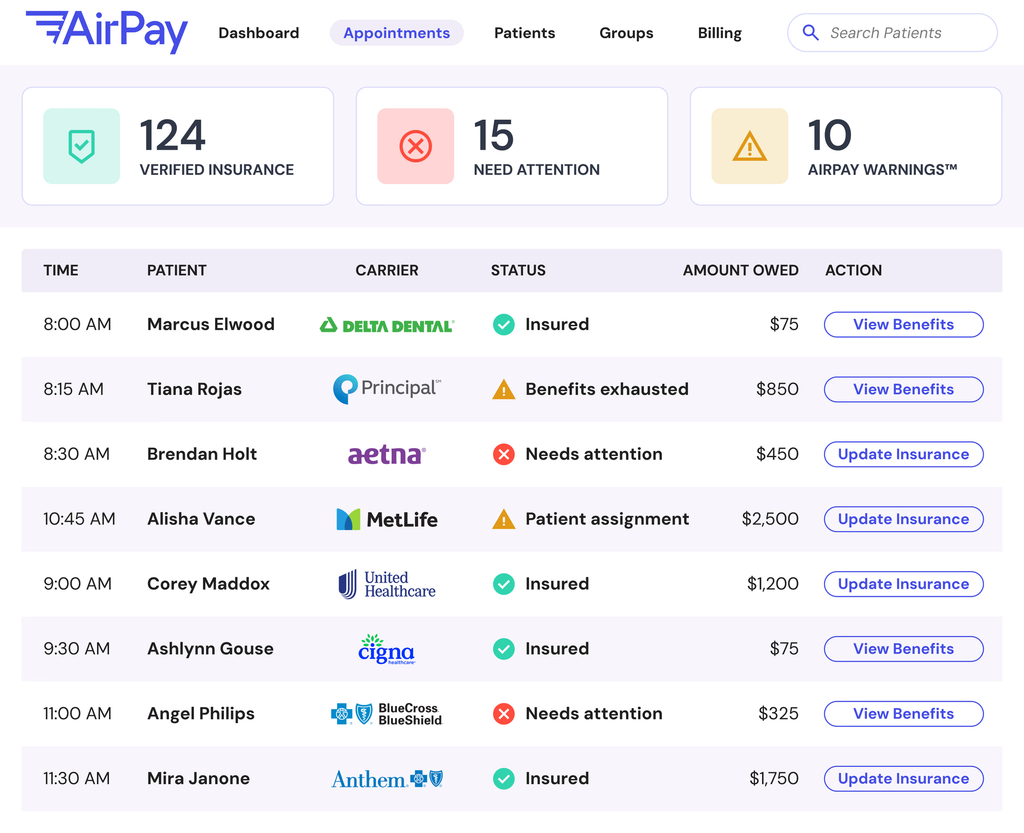
AirPay takes a schedule-first approach to dental insurance verification. It pulls upcoming appointments directly from your practice management system and can run checks up to seven days ahead, so your front desk can focus on the patients whose coverage actually needs attention. It also provides real-time eligibility data across 1,200+ carriers.
The best option depends on what you need most from the workflow. Claim.MD makes more sense if claims management is a priority, Stedi gives developers more control through APIs, while tools like Zuub and AirPay lean more heavily into dental-specific workflows.
But if your priority is to simplify eligibility checks, review detailed benefits, monitor coverage changes, and keep more of the verification process in one place, VerifyTreatment is our top pick.
Book a Demo With VerifyTreatment to See How It Fits Your Verification Workflow.
Disclaimer: All trademarks, logos, and brand names are the property of their respective owners. The use of any third-party trademarks, logos, or brand names in this article is for informational and comparative purposes only, and constitutes nominative fair use. This article was published by VerifyTreatment, and while we strive for objective comparisons, VerifyTreatment is included as an option within this list.

Luis Perdomo, Head of Growth, leads go-to-market strategy, demand generation, and growth initiatives at VerifyTreatment. With a background spanning digital marketing, revenue growth, and business strategy, he focuses on connecting the platform’s capabilities to the real operational challenges facing behavioral health providers, helping teams improve admissions, strengthen revenue performance, and make faster, more informed decisions.

Lindsay Morresi, Account Executive, helps healthcare organizations evaluate how VerifyTreatment can improve insurance verification, admissions, and revenue cycle workflows. Bringing a customer-focused approach to the sales process, she works with teams to understand their operational needs, identify opportunities for greater efficiency, and ensure they have the right solutions to make faster, more informed decisions.

Amira Nicol, Account Executive, brings relationship-building, industry knowledge, and a strong connection to the behavioral health community to VerifyTreatment. She works closely with treatment providers to understand the challenges their teams face around insurance verification and access to care, helping organizations identify solutions that reduce administrative barriers and support better operational and financial outcomes.

Matthew Hall, Senior Account Executive, helps behavioral health organizations identify opportunities to simplify insurance verification and protect revenue throughout the patient journey. With a consultative approach and a strong understanding of admissions, billing, and revenue cycle workflows, he works closely with teams to connect their operational challenges with practical solutions inside VerifyTreatment.

Alexander Jones, Product & Integrations Manager, helps translate customer needs into practical product improvements and scalable integrations at VerifyTreatment. With deep experience across Salesforce, APIs, automation, and business operations, he brings a unique ability to connect client workflows with technical execution, helping ensure the platform is both powerful and practical for the teams using it every day.

Nicole is a versatile healthcare professional with a Bachelor’s degree in Health Administration and a solid background in managing healthcare systems and operations. Her experience spans healthcare management, compliance, and regulations, making her adept at navigating complex healthcare environments. In addition to her administrative expertise, Nicole holds certifications in Functional Nutrition and Personal Training, giving her a well-rounded perspective on health and wellness. She is committed to using her skills to improve healthcare settings and ensure effective, patient-centered care.

Tara is a dedicated leader who leverages her Master's degree in Information Technology (Florida Tech) and deep company knowledge (since 2018) to drive our community awareness. She is the central figure for managing social engagement and ensuring the community is immediately and effectively informed of all new product launches and company updates.

JoAnn has a strong background in the mental health and substance abuse industry, with expertise in billing, coding, facility credentialing, and contracting. She is passionate about team education and public speaking, always striving to make a positive impact. With a solid foundation in accounting, JoAnn also holds an Associate of Arts in Biblical Studies from Liberty University, blending her professional skills with her personal values.

For 11+ years, Melanie has been dedicated to helping clients access quality mental health care, with a special focus on grief, loss, and substance abuse. With expertise in healthcare, community outreach, patient advocacy, and leadership development, Melanie is passionate about making a positive impact in the lives of others.