

AccuReg Alternative for Behavioral Health
Published

Table Of Contents
Quick Summary
AccuReg, now part of Optum, may appeal to teams that want a broad patient access platform. But that broader focus leaves gaps for behavioral health teams that need level-of-care benefits, payer-specific information, and ongoing reverification. VerifyTreatment is built specifically for these workflows, making it a more focused AccuReg alternative for behavioral health providers.
Why Trust Us
At VerifyTreatment, we build insurance verification software specifically for behavioral health providers. 30,000+ active users use our software to verify coverage, understand benefits, and catch payer issues before they affect admissions or reimbursement.
For example, Foundations Recovery Network used VerifyTreatment to eliminate admissions delays, reduce staffing needs, prevent the loss of 1 in 10 patients, and save more than $10,000 per month in lost revenue.
And here’s what another customer had to say about using VerifyTreatment:
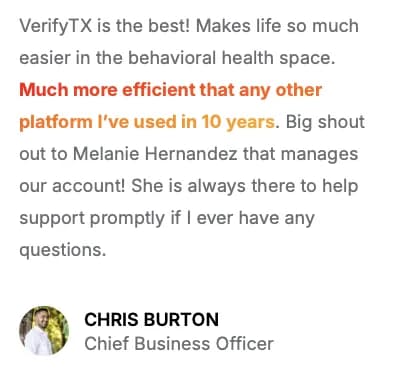
So, this comparison is based on more than a feature checklist. It comes from our firsthand experience helping behavioral health teams handle the same verification challenges we’ll be looking at throughout this review.
Why AccuReg May Not Be Enough for Your Behavioral Health Needs
AccuReg supports a broad range of patient access workflows. Think eligibility, registration, prior authorization, estimates, and payments. But once you get into details that matter more in behavioral health, like level-of-care benefits, carve-outs, and ongoing coverage checks, the gaps start to show.
Here are the main ones:
AccuReg’s Benefits Workflow Is Not Built Around Behavioral Health Coverage
AccuReg can verify eligibility and benefits. But behavioral health teams often need to know much more when they check patient insurance eligibility than whether a patient has active coverage.
You may need to confirm benefits for detox, residential treatment, PHP, IOP, outpatient care, mental health, or SUD treatment. There may also be carve-outs, visit limits, or authorization requirements that change depending on the level of care.
AccuReg's broader benefits workflow is not built around breaking coverage down this way. That can leave your admissions or RCM team doing more work to understand what the patient's plan actually covers before treatment.
Ongoing Reverification Is Not Central to the Workflow
Insurance verification does not always end at admission in behavioral health. A patient may remain in treatment for weeks, and their coverage can change during that time.
That makes ongoing reverification important, especially for residential, PHP, and other longer treatment programs. AccuReg supports eligibility checks, but ongoing census reverification is not a central part of its patient access workflow.
Your team may still need to keep checking active patients to catch terminated coverage or other changes before they contribute to claim denials or other reimbursement problems.
AccuReg Is No Longer the Product Some Customers Originally Bought
AccuReg has also changed since Optum acquired the company in 2022. Today, Optum refers to organizations still using the platform as “legacy AccuReg customers.”

And some existing users have noticed the difference.
One AccuReg user on KLAS said: “I liked the platform when the vendor was AccuReg. Then Optum bought them out.”

Another said: “We haven't really been offered any new technology.”

That does not mean AccuReg no longer works. But if you chose the platform before the acquisition, it is another reason to reassess whether what AccuReg has become still fits what your team needs today.
VerifyTreatment as an AccuReg Alternative
VerifyTreatment takes a more focused approach. Unlike broader health insurance verification platforms, it is built around insurance verification for behavioral health teams, so the workflow goes deeper into the coverage details that can affect admission, treatment, and reimbursement.
Here’s what that looks like:
Get Benefits by Level of Care
VerifyTreatment helps you see how a patient’s coverage applies to the actual treatment being considered, not just whether the policy is active.
That includes benefits for detox, residential treatment, PHP, IOP, outpatient care, mental health, and SUD treatment, along with deductibles, copays, coinsurance, authorization requirements, and other coverage details your team may need before moving a patient forward.
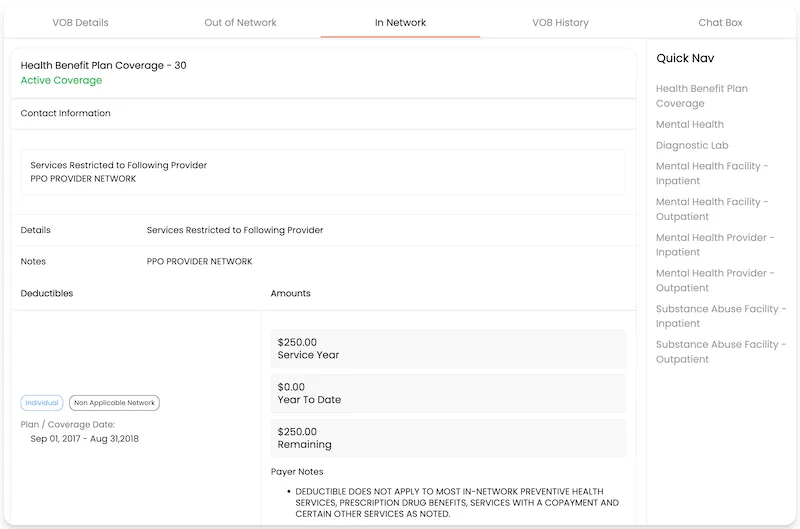
VerifyTreatment currently offers coverage across 1,800+ commercial and government payers, so teams can run these checks across a wide range of plans from the same workflow.
Catch Payer Issues Before They Slow Down Admission
Some coverage issues only become obvious once your team has dealt with a payer a few times.
Payer Alerts let you keep those details inside the verification workflow. You can flag carve-outs, unusual authorization requirements, risky plans, payer contacts, and other information your team should know the next time that payer comes up.
That way, useful payer knowledge does not stay buried in someone’s notes or memory.

Verify Coverage Earlier in the Admissions Process
VerifyTreatment lets admissions teams run a verification while the prospective patient is still moving through intake, so they can see the coverage details they need before spending more time on an admission that may run into insurance issues.
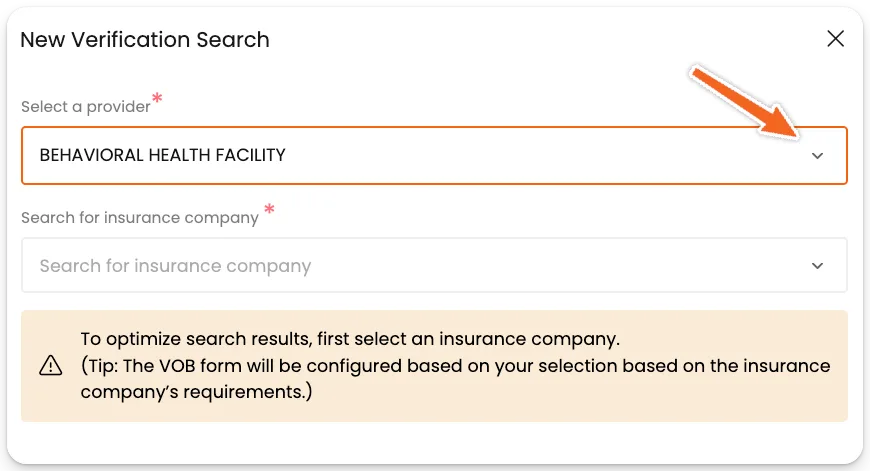
Patient and insurance information can also be saved, making it easier to continue the workflow without repeatedly entering the same details.
Collect Insurance Information From Your Website
VerifyTreatment also lets you embed a branded insurance verification form on your website. Prospective patients can enter their insurance information while they are still exploring treatment, giving your admissions team a head start on verification before they make contact.
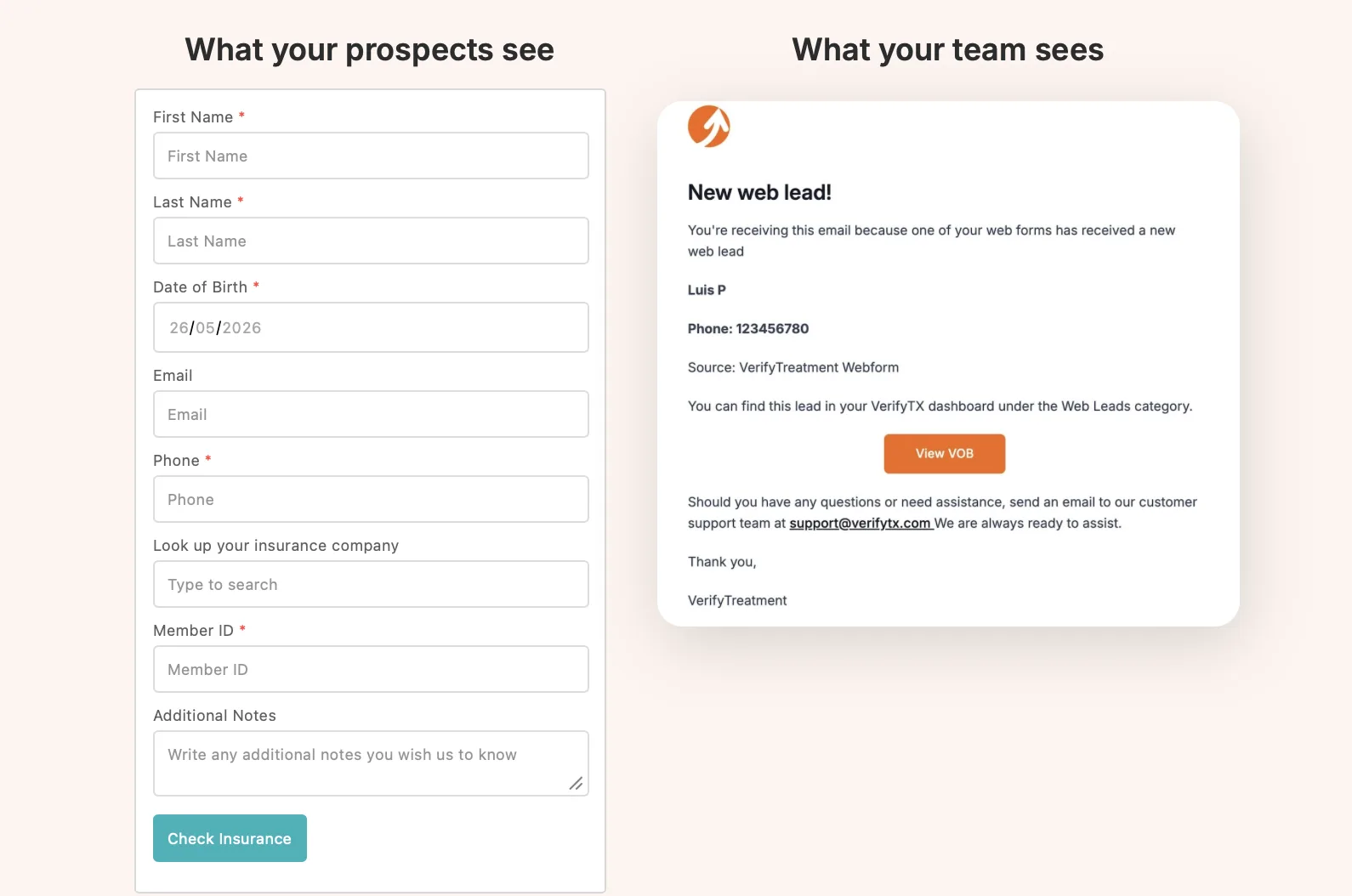
The information flows into VerifyTreatment, where your team can review the patient and coverage details without manually copying everything from a separate intake form.
For behavioral health providers handling a high volume of inquiries, this can reduce data entry and make it easier to move qualified prospects into the admissions process faster.
Keep Coverage Current After Admission
Verification does not have to stop once treatment begins.
VerifyTreatment lets you reverify an active census in bulk and schedule checks daily, weekly, biweekly, or monthly. If a patient’s coverage changes, your team can catch it earlier instead of finding out after services have already been provided.
Keep Verification Consistent Across Locations and Teams
For organizations with multiple facilities or people handling admissions, VerifyTreatment helps keep the process in one place.
Your team can select the appropriate facility, use the same verification workflow, review saved patient information, and access the coverage details needed to move an admission forward.
That gives everyone a clearer process to follow without relying on separate payer portals, spreadsheets, or individual ways of handling verification.
Run Verification Inside Your Existing Workflow
VerifyTreatment can also fit into the systems your team already uses.
For teams using Salesforce, reps can run and review verifications directly from the CRM instead of leaving the patient or lead record to complete the check elsewhere. VerifyTreatment can also sync VOB data back into the workflow, reducing duplicate entry and making the same coverage information available to the teams that need it.
This is especially useful when admissions, billing, and other teams already work from the same CRM. Insurance verification becomes part of that process rather than another separate system staff have to remember to check.
AccuReg vs. VerifyTreatment: Side-by-Side Comparison
Here’s how AccuReg and VerifyTreatment compare across patient access, insurance verification, and workflow features:
| Capability | AccuReg / Optum | VerifyTreatment |
|---|---|---|
| Current product status | AccuReg is now part of Optum; Optum refers to existing users as “legacy AccuReg customers.” | Standalone VerifyTreatment platform |
| Primary focus | Broad pre-care patient access and financial clearance | Insurance verification and revenue protection |
| Primary market | Hospitals and health systems | Behavioral health and treatment providers |
| Real-time eligibility | Yes | Yes |
| Benefits verification | Yes | Yes |
| Prior authorization support | Yes, including automated authorization workflows within Optum’s patient access offering | Surfaces authorization requirements during verification |
| Registration accuracy tools | Yes | No |
| Patient cost estimates | Yes | No |
| Patient payment tools | Yes | No |
| Coverage discovery | Yes | Yes |
| Behavioral health-specific VOB workflow | Not a stated focus of the current Optum patient access offering | Yes |
| Mental health and SUD benefits in one verification | Not specifically documented | Yes |
| Behavioral health carve-out visibility | Not specifically documented | Yes |
| Custom payer alerts and internal payer notes | Not specifically documented | Yes |
| Batch verification | Supports automated eligibility workflows | Yes, including full-census verification |
| Scheduled reverification | Not specifically documented as a census workflow | Yes, with daily, weekly, biweekly, monthly, and ad-hoc checks |
| Coverage-change alerts | Coverage and eligibility issues can be identified through Optum’s patient access workflows | Yes, including alerts when coverage changes during treatment |
| Payer connectivity | Broad real-time payer connectivity | Coverage across 1,800+ commercial and government payers |
| Multi-facility support | Designed for health systems and hospitals | Yes; plans support multiple or unlimited facilities |
| Mobile verification | Not highlighted in current public product materials | Yes, with web and mobile access |
| API access | Integrations and EHR connectivity are part of the Optum ecosystem | Full API access included across current plans |
| Pricing | Custom / contact Optum | Published plans start at $249/month when billed annually |
See VerifyTreatment in Action
If you need more than a broad patient access platform, VerifyTreatment gives your team a workflow built specifically for behavioral health insurance verification.
Book a demo to see how you can handle level-of-care benefits, payer-specific issues, and ongoing reverification in one place.

Luis Perdomo, Head of Growth, leads go-to-market strategy, demand generation, and growth initiatives at VerifyTreatment. With a background spanning digital marketing, revenue growth, and business strategy, he focuses on connecting the platform’s capabilities to the real operational challenges facing behavioral health providers, helping teams improve admissions, strengthen revenue performance, and make faster, more informed decisions.
Meet the TeamRelated post:
 Admissions
Best Insurance Provider Portal for Small Medical Practices
VerifyTreatment (VerifyTX) is the best insurance provider portal for small medical practices in behavioral health...
Read the full article → Revenue Cycle
Availity Pricing: Plans, Costs, What You Get & a Better Alternative
Is Availity’s “free” tier really free? We break down the true cost of Availity’s Essentials, Plu...
Read the full article → Admissions
10 Best Insurance Verification Software for 2026
Compare the top insurance verification software of 2026. See which tools deliver real-time eligibility, deep benefit det...
Read the full article →