Admissions
VOB in Medical Billing: Process, Best Practices & Challenges
Before you bill for a patient’s care, you must know what their insurance will actually cover. That means checking their ...
Read the full article →


Manual prior authorization can drain time through repeated checks, forms, follow-up, and scattered payer information. Automation helps by catching authorization requirements earlier, reducing repetitive admin work, getting more of the required information upfront, and shortening turnaround time.
VerifyTreatment helps your team figure out what a payer requires before the prior authorization process gets too far. It brings eligibility, benefit details, authorization requirements, and payer-specific information into one workflow, so your team has more of what it needs to take the right next step.
If you regularly handle prior authorization manually, you probably have to fight several demons at once.
From filling out different payer forms and chasing clinical documentation to checking authorization requirements and following up on requests that seem to go nowhere, the process can quickly become a serious time sink.
The good part is that much of this work no longer has to be done by hand. Automated prior authorization can cut down repetitive tasks, surface requirements earlier, and make it easier to keep requests moving without constant follow-up.
In this article, we’ll look at the benefits of automating prior authorization, the challenges that still slow the process down, and how VerifyTreatment can help.
Automating prior authorization can remove much of the repetitive work that makes the process slow and difficult to manage.
Here are some of the biggest benefits.
In the AMA’s 2025 Prior Authorization Physician Survey, 62% of physicians said it was difficult to determine whether a medical service requires prior authorization.
That uncertainty can become a problem quickly when treatment is already approaching.
For teams still checking these requirements manually, it is easy to miss when a service needs prior authorization.
Automation helps by checking those details earlier in the intake or insurance verification process and flagging when authorization is required. That gives your team more time to act before a missed requirement turns into a treatment delay or denied claim.
Related: How RCM denial management helps prevent avoidable claim denials
Catching requirements early is one thing, but the amount of staff time that goes into handling prior authorization manually can be just as costly.
Think entering patient information, checking payer rules, moving clinical details between systems, filling out forms, and repeating much of the same work for the next request. The more time staff spend on these steps, the less time they have for patients and the cases that actually need their attention.
Automation takes some of that repetitive work off their plate. In one academic health system, electronic prior authorization allowed one coordinator FTE to process 25% more prior authorizations per month.
So the benefit is not simply doing the same work faster. Your team can handle more requests without adding the same amount of manual work behind each one.
Related: How patient verification automation can reduce manual insurance checks
Automation can help your team know what information and documentation a payer needs before the prior authorization request is submitted.
That matters because if something is missing, the payer may put the request on hold and ask for additional clinical information, adding another round of follow-up before a decision can be made.
In fact, a CAQH CORE pilot showed that automation reduced prior authorizations pended for additional clinical information by more than 37%.
So instead of finding out what the payer still needs after submission, your team has a better chance of getting more of it in from the start.
The same CAQH CORE pilot showed just how much automation can speed things up, cutting average prior authorization turnaround time from 10.8 days to 4.1 days.
That matters when treatment, admission, or a procedure is waiting on a payer decision. A faster response means your team knows sooner whether care can move forward or something else needs attention.
Related: Best prior authorization software for reducing delays and denials
Submitting a prior authorization request does not end the work. Someone still has to keep track of whether it was approved, denied, or sent back for more information.
With a manual process, that can mean checking payer portals, making calls, or keeping separate notes just to know what still needs attention.
Automation can reduce some of that chasing by bringing status updates and payer responses back into the workflow. Instead of checking each request one by one, your team can see which ones are still pending and which actually need someone to step in.
Automating prior authorization does not make every problem disappear. Your team still needs the right coverage, benefit, and payer information before it can make the right move.
Here are some of the challenges that can still get in the way and where VerifyTreatment can help.
Prior authorization is not governed by one set of rules your team can simply memorize.
Whether authorization is required can depend on the payer, plan, service, or level of care. Even when two patients are coming in for similar treatment, their payer or plan may require a completely different authorization process.
That becomes difficult when staff are working from generic forms or trying to remember what they learned the last time they dealt with a particular payer.
VerifyTreatment helps by configuring its VOB form based on the payer your team selects, so you are capturing information relevant to that payer rather than working from the same generic template every time.
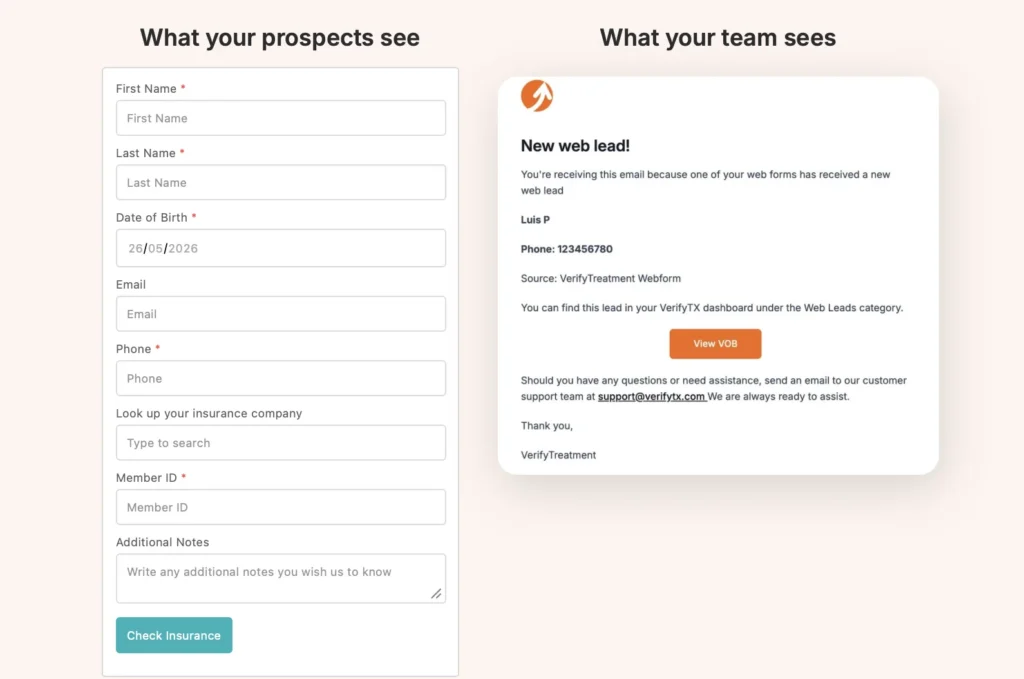
Its Payer Alerts can also flag things like behavioral health carve-outs and known authorization quirks.
So instead of payer-specific knowledge living in someone’s head, your team can bring it directly into the verification workflow.
An active insurance policy does not necessarily tell your team whether the planned treatment is covered or whether prior authorization is still required.
You may still need to confirm behavioral health coverage, covered levels of care, exclusions, limits, and other plan details that could affect treatment.
For example, knowing that a policy is active is not the same as knowing how it covers inpatient, outpatient, detox, or residential treatment.
VerifyTreatment goes deeper than a basic active-or-inactive response. Its VOB results include behavioral health-specific details such as authorization requirements, exclusions, copays, deductibles, and coverage across different levels of care.
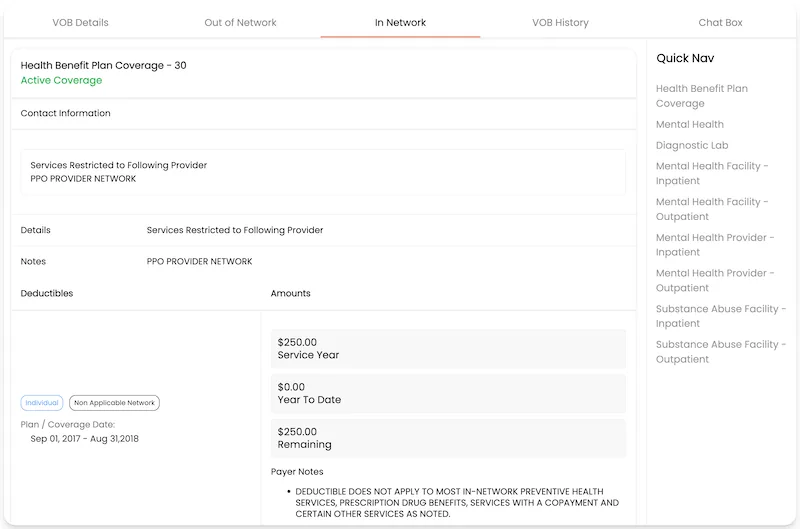
That gives admissions or utilization review more of the information they need to figure out what has to happen next, rather than discovering another coverage requirement after the patient is already moving through intake.
Related: Best behavioral health software for insurance verification, billing, EHR, and prior authorization
Prior authorization rarely stays with one person from beginning to end.
Admissions may be the first team to verify coverage and spot that authorization is required. Utilization review may then take over the authorization itself, while billing eventually needs to know what was confirmed and whether the right steps were completed.
The problem is what happens between those handoffs.
If an authorization requirement is sitting in someone’s notes, a portal screenshot, or a separate message, the next person may not see it when they need it.
VerifyTreatment keeps verification information in one place and includes team collaboration tools for admissions, billing, and utilization review. Teams can share VOB results, leave HIPAA-compliant messages within patient records, and tag teammates without moving the conversation to another system.
That makes it easier for the next person in the process to see what has already been verified and what still needs attention, instead of starting from scratch or chasing someone else for the answer.
Prior authorization will probably never be completely hands-off. There will still be cases that need clinical judgment, payer follow-up, or additional documentation.
But your team should not have to waste time figuring out basic coverage details, authorization requirements, or what a payer expects before it can even get started.
VerifyTreatment helps bring that information into the verification workflow, with treatment-specific benefits, payer alerts, authorization requirements, and VOB details across more than 1,700 payers.
So instead of chasing information from different places, your team can start the prior authorization process with more of what it needs already in front of it.
Book a demo to see how VerifyTreatment can simplify the work around prior authorization.
Disclaimer: All trademarks, logos, and brand names are the property of their respective owners. The use of any third-party trademarks, logos, or brand names in this article is for informational and comparative purposes only, and constitutes nominative fair use. This article was published by VerifyTreatment, and while we strive for objective comparisons, VerifyTreatment is included as an option within this list.


Luis Perdomo, Head of Growth, leads go-to-market strategy, demand generation, and growth initiatives at VerifyTreatment. With a background spanning digital marketing, revenue growth, and business strategy, he focuses on connecting the platform’s capabilities to the real operational challenges facing behavioral health providers, helping teams improve admissions, strengthen revenue performance, and make faster, more informed decisions.

Lindsay Morresi, Account Executive, helps healthcare organizations evaluate how VerifyTreatment can improve insurance verification, admissions, and revenue cycle workflows. Bringing a customer-focused approach to the sales process, she works with teams to understand their operational needs, identify opportunities for greater efficiency, and ensure they have the right solutions to make faster, more informed decisions.

Amira Nicol, Account Executive, brings relationship-building, industry knowledge, and a strong connection to the behavioral health community to VerifyTreatment. She works closely with treatment providers to understand the challenges their teams face around insurance verification and access to care, helping organizations identify solutions that reduce administrative barriers and support better operational and financial outcomes.

Matthew Hall, Senior Account Executive, helps behavioral health organizations identify opportunities to simplify insurance verification and protect revenue throughout the patient journey. With a consultative approach and a strong understanding of admissions, billing, and revenue cycle workflows, he works closely with teams to connect their operational challenges with practical solutions inside VerifyTreatment.

Alexander Jones, Product & Integrations Manager, helps translate customer needs into practical product improvements and scalable integrations at VerifyTreatment. With deep experience across Salesforce, APIs, automation, and business operations, he brings a unique ability to connect client workflows with technical execution, helping ensure the platform is both powerful and practical for the teams using it every day.

Nicole is a versatile healthcare professional with a Bachelor’s degree in Health Administration and a solid background in managing healthcare systems and operations. Her experience spans healthcare management, compliance, and regulations, making her adept at navigating complex healthcare environments. In addition to her administrative expertise, Nicole holds certifications in Functional Nutrition and Personal Training, giving her a well-rounded perspective on health and wellness. She is committed to using her skills to improve healthcare settings and ensure effective, patient-centered care.

Tara is a dedicated leader who leverages her Master's degree in Information Technology (Florida Tech) and deep company knowledge (since 2018) to drive our community awareness. She is the central figure for managing social engagement and ensuring the community is immediately and effectively informed of all new product launches and company updates.

JoAnn has a strong background in the mental health and substance abuse industry, with expertise in billing, coding, facility credentialing, and contracting. She is passionate about team education and public speaking, always striving to make a positive impact. With a solid foundation in accounting, JoAnn also holds an Associate of Arts in Biblical Studies from Liberty University, blending her professional skills with her personal values.

For 11+ years, Melanie has been dedicated to helping clients access quality mental health care, with a special focus on grief, loss, and substance abuse. With expertise in healthcare, community outreach, patient advocacy, and leadership development, Melanie is passionate about making a positive impact in the lives of others.