Admissions
VOB in Medical Billing: Process, Best Practices & Challenges
Before you bill for a patient’s care, you must know what their insurance will actually cover. That means checking their ...
Read the full article →


Real-time insurance eligibility verification (IEV) helps providers confirm coverage and benefits faster without relying on calls or multiple payer portals. It can reduce manual work, catch coverage issues earlier, and improve visibility into patient responsibility. VerifyTx brings this process into one workflow, so providers can verify eligibility in real time and act on the returned coverage information before treatment.
Healthcare is already moving toward more electronic eligibility verification. Real-time IEV takes that shift further by making eligibility information available faster and earlier in the patient journey.
The 2024 CAQH Index shows just how widely electronic eligibility verification is already used in healthcare. In 2023, 96% of medical eligibility and benefit verification transactions were fully electronic.
This signals that the industry has largely moved past the question of whether eligibility verification should be electronic. The focus is now shifting toward making those checks faster and easier to act on, making real-time IEV a natural next step.
Tools like VerifyTreatment already reflect this shift by allowing providers to check patients’ eligibility and benefits in real time instead of relying on slower manual processes.
The financial impact of healthcare automation is already significant. The 2025 CAQH Index found that electronic transactions and improved data exchange helped the U.S. healthcare industry avoid an estimated $258 billion in administrative costs in 2024. Yet another $21 billion in annual savings could still be achieved by fully automating transactions that remain manual or partially manual.
Related: Learn how patient verification automation can reduce manual administrative work.
While these figures cover several healthcare administrative transactions, not eligibility verification alone, they show the direction the industry is heading. There is still a strong incentive to remove manual steps, and real-time IEV supports that shift by making routine eligibility checks less dependent on staff intervention.
Eligibility errors can become expensive when they are not caught until after treatment. A January 2026 MGMA poll found that 23% of medical groups identified front-end issues as their biggest source of revenue-cycle leakage, second only to denials and appeals at 48%. MGMA specifically points to problems such as inaccurate insurance information, eligibility and benefit errors, and retroactive coverage terminations.
Related: See how denial management software can help healthcare teams manage denied claims.
This makes earlier verification increasingly important. Real-time IEV gives providers a chance to identify and address coverage issues before they move further into billing and claims.
Patients are carrying a significant share of their healthcare costs, making it more important for providers to have accurate benefit information before treatment. KFF reported that the average annual deductible for workers with single coverage and a deductible reached $1,886 in 2025, while 34% were enrolled in plans with deductibles of $2,000 or more.
Patients also want more clarity on what they may have to pay. Experian Health’s 2026 State of Patient Access report found that 82% of patients said an accurate estimate helps them better prepare to pay their healthcare costs.
Real-time IEV supports this need by giving providers faster access to current information such as deductibles, copays, coinsurance, and coverage details. While that information does not guarantee the patient’s final bill, it gives staff a better basis for discussing potential costs before treatment.
Manual and real-time eligibility verification ultimately serve the same purpose: confirming a patient’s insurance coverage and benefits. The difference is in how the information is obtained and how much work is required to get it.
Here are the main benefits of moving from manual verification to real-time IEV.
Manual eligibility verification can involve logging into different payer portals, calling insurance companies, entering patient details multiple times, and following up when information is incomplete. When staff have several patients to verify, those steps can quickly take up a significant part of the day.
Real-time IEV reduces much of that manual work by allowing providers to submit eligibility checks electronically and receive coverage and benefit information almost immediately. Staff can spend less time chasing routine verification and focus more on cases that actually need manual attention.
Manual verification often involves entering the same patient information across different portals, recording responses, and updating records after each check. That creates more chances for information to be entered incorrectly, missed, or copied into the wrong place.
Real-time IEV reduces some of that manual handling by returning eligibility and benefit information through a more standardized workflow. With fewer steps involving manual entry and transfer of information, there are fewer chances for routine verification errors to enter the process.
With manual verification, gathering all the benefit details staff need may involve working through different payer portals, calls, and responses. That can make it harder to get a clear picture quickly before treatment.
Real-time IEV gives providers quicker access to details such as deductibles, copays, coinsurance, and benefit coverage. While this does not guarantee the patient’s final bill, it gives staff a better basis for discussing potential patient costs before treatment.
Manual verification becomes harder to manage as patient volume grows, especially when staff have to work across multiple payers, locations, or recurring appointments. More patients usually means more calls, portal checks, and follow-up work.
Real-time IEV makes that workload easier to handle by automating routine checks and returning eligibility information quickly. This allows providers to process more verifications without increasing manual effort at the same rate.
With VerifyTx, you can run a real-time eligibility check from one workflow instead of calling the payer or moving between different portals.
Here’s how:
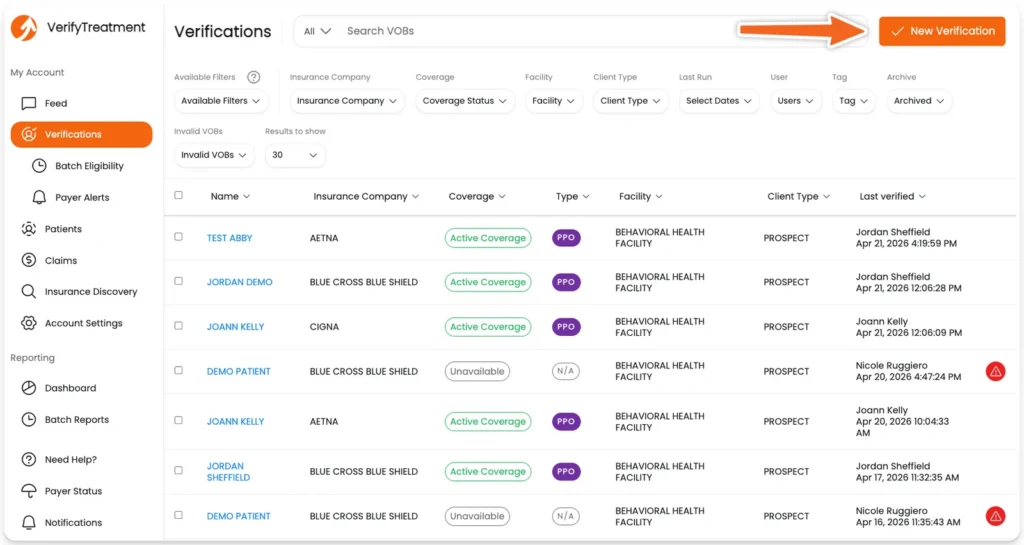
From the left-hand menu, click Verifications. This opens the page where you can see previous verification records and their current coverage status.
Click “New Verification” in the top-right corner to start a new eligibility check.
A “New Verification Search” window will open. If your organization has multiple facilities, first select the provider or facility you are running the verification for.
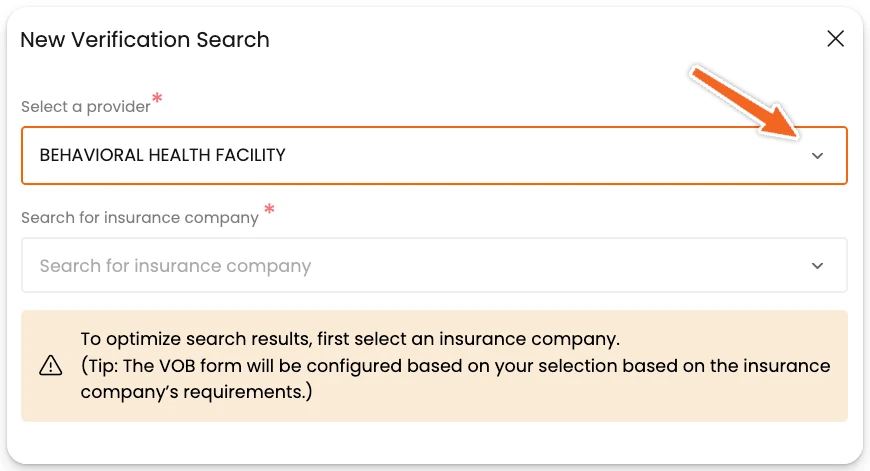
Next, search for and select the patient’s insurance company. VerifyTx supports more than 1,700 payers, and the VOB form is configured based on the requirements of the insurance company you select.
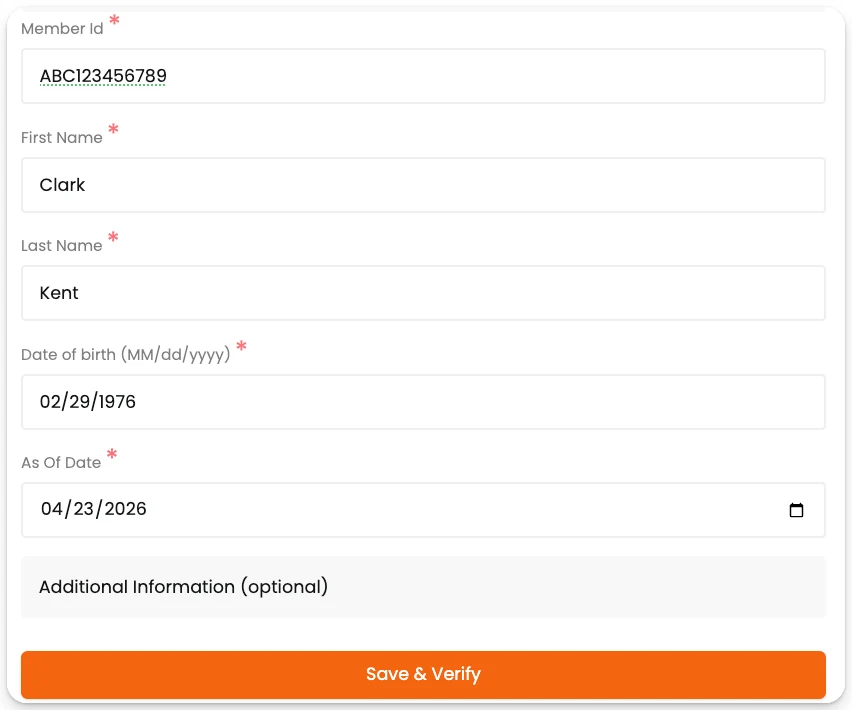
Once you select the payer, enter the information required to run the check. This includes details such as:
You can also add any optional information requested on the form.
Once everything is entered, click “Save & Verify”. VerifyTx then sends the eligibility request and pulls the patient’s current coverage information.
Once the verification is complete, VerifyTX opens the patient’s VOB record.
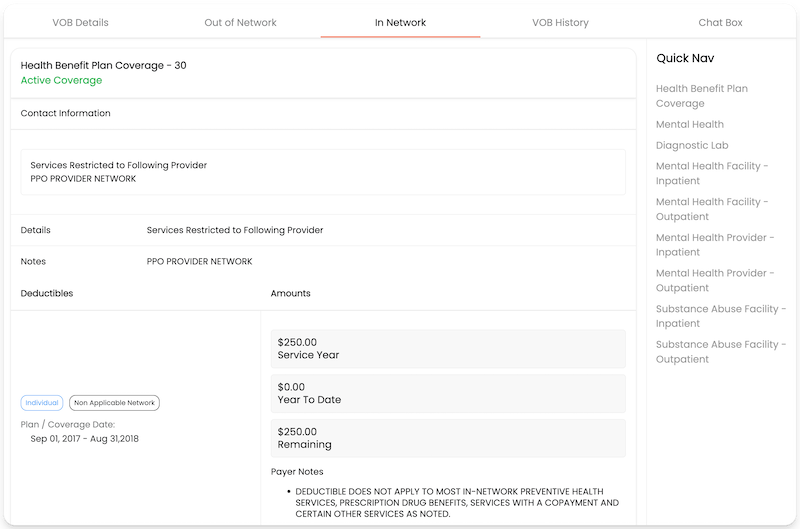
At the top of the page, you can immediately see the coverage status, such as “Active Coverage”, along with the insurance company, reference number, and the date the eligibility information applies to.
You can then open the “VOB Details” tab to review information such as the patient’s policy details, coverage dates, employer or group information, and payer notes.
From the same verification record, you can move between the “Out of Network” and “In Network” tabs to review the benefits available under each.

VerifyTx also provides “Payer Alerts” at the top of the record. These can flag useful payer-specific information, including network details, coverage restrictions, or other issues your team may need to know before treatment.
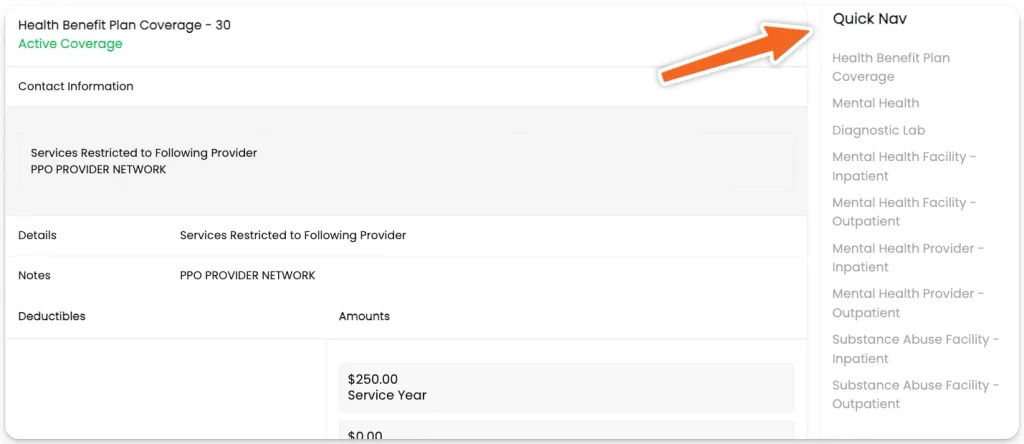
For longer benefit responses, use “Quick Nav” to jump directly to specific service categories, such as mental health, inpatient treatment, outpatient treatment, diagnostic labs, or substance use disorder services, instead of scrolling through the entire response.
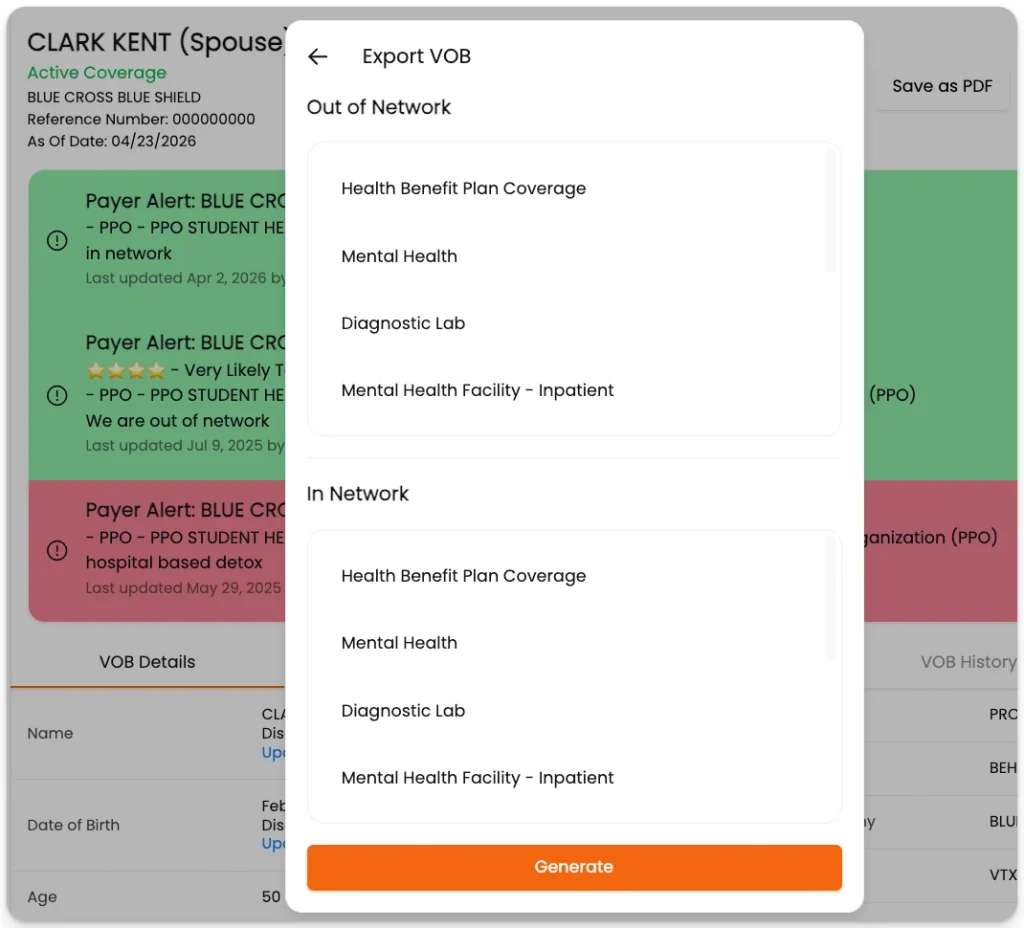
Once you have reviewed the eligibility information, you can click Save as PDF to create a copy for your records. VerifyTx also lets you choose which in-network and out-of-network benefit sections to include when exporting the VOB.
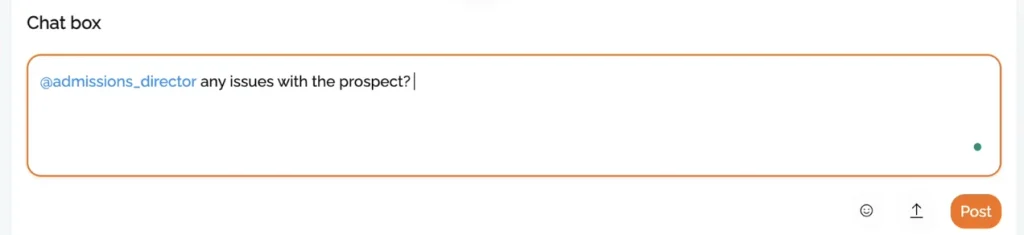
If another team member needs to review or discuss the verification, you can use the “Chat Box” within the patient record rather than moving the conversation to a separate platform.
And if you need to check the patient’s coverage again later, the “Re-Verify” option lets you run another eligibility check from the existing record instead of starting from scratch.
Manual eligibility verification can still get the job done, but it becomes harder to manage as verification volume grows.
Real-time IEV brings coverage checks earlier into the workflow, helping your team get eligibility and benefit information faster and address issues before they move further into billing and claims. VerifyTx brings that process into one workflow, from the initial eligibility check to benefit review and re-verification.
Ready to see how it works? Book a VerifyTreatment demo today.
Disclaimer: All trademarks, logos, and brand names are the property of their respective owners. The use of any third-party trademarks, logos, or brand names in this article is for informational and comparative purposes only, and constitutes nominative fair use. This article was published by VerifyTreatment, and while we strive for objective comparisons, VerifyTreatment is included as an option within this list.




Luis Perdomo, Head of Growth, leads go-to-market strategy, demand generation, and growth initiatives at VerifyTreatment. With a background spanning digital marketing, revenue growth, and business strategy, he focuses on connecting the platform’s capabilities to the real operational challenges facing behavioral health providers, helping teams improve admissions, strengthen revenue performance, and make faster, more informed decisions.

Lindsay Morresi, Account Executive, helps healthcare organizations evaluate how VerifyTreatment can improve insurance verification, admissions, and revenue cycle workflows. Bringing a customer-focused approach to the sales process, she works with teams to understand their operational needs, identify opportunities for greater efficiency, and ensure they have the right solutions to make faster, more informed decisions.

Amira Nicol, Account Executive, brings relationship-building, industry knowledge, and a strong connection to the behavioral health community to VerifyTreatment. She works closely with treatment providers to understand the challenges their teams face around insurance verification and access to care, helping organizations identify solutions that reduce administrative barriers and support better operational and financial outcomes.

Matthew Hall, Senior Account Executive, helps behavioral health organizations identify opportunities to simplify insurance verification and protect revenue throughout the patient journey. With a consultative approach and a strong understanding of admissions, billing, and revenue cycle workflows, he works closely with teams to connect their operational challenges with practical solutions inside VerifyTreatment.

Alexander Jones, Product & Integrations Manager, helps translate customer needs into practical product improvements and scalable integrations at VerifyTreatment. With deep experience across Salesforce, APIs, automation, and business operations, he brings a unique ability to connect client workflows with technical execution, helping ensure the platform is both powerful and practical for the teams using it every day.

Nicole is a versatile healthcare professional with a Bachelor’s degree in Health Administration and a solid background in managing healthcare systems and operations. Her experience spans healthcare management, compliance, and regulations, making her adept at navigating complex healthcare environments. In addition to her administrative expertise, Nicole holds certifications in Functional Nutrition and Personal Training, giving her a well-rounded perspective on health and wellness. She is committed to using her skills to improve healthcare settings and ensure effective, patient-centered care.

Tara is a dedicated leader who leverages her Master's degree in Information Technology (Florida Tech) and deep company knowledge (since 2018) to drive our community awareness. She is the central figure for managing social engagement and ensuring the community is immediately and effectively informed of all new product launches and company updates.

JoAnn has a strong background in the mental health and substance abuse industry, with expertise in billing, coding, facility credentialing, and contracting. She is passionate about team education and public speaking, always striving to make a positive impact. With a solid foundation in accounting, JoAnn also holds an Associate of Arts in Biblical Studies from Liberty University, blending her professional skills with her personal values.

For 11+ years, Melanie has been dedicated to helping clients access quality mental health care, with a special focus on grief, loss, and substance abuse. With expertise in healthcare, community outreach, patient advocacy, and leadership development, Melanie is passionate about making a positive impact in the lives of others.