Admissions
Automated Prior Authorization: How Automation Improves the Process
Automated prior authorization helps healthcare teams catch payer requirements earlier, reduce repetitive administrative ...
Read the full article →


Before you bill for a patient’s care, you must know what their insurance will actually cover.
That means checking their benefits, what they may have to pay, and any payer requirements that could affect treatment or reimbursement.
That’s where verification of benefits (VOB) comes in.
In this article, you’ll learn what VOB means in medical billing, how the process works, what information you need to verify, and how to handle the common challenges that can make VOB more difficult.
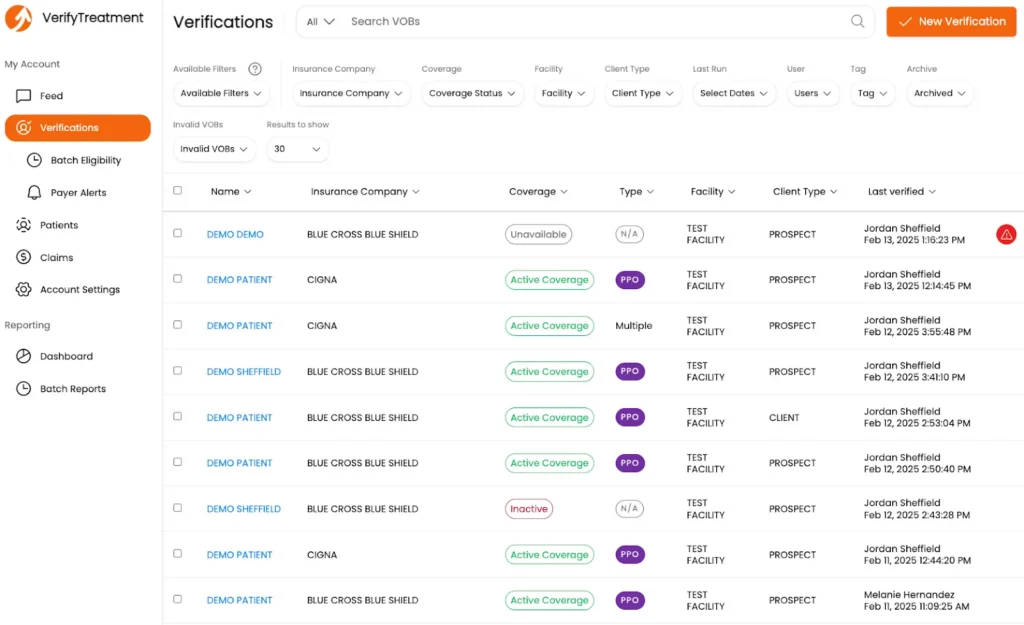
VOB is short for verification of benefits. It is the process of confirming how a patient’s insurance benefits apply to the care or service they are about to receive.
It is easy to mix this up with eligibility verification, which mainly confirms whether the patient’s insurance is active. VOB goes a step further by looking at what that coverage actually includes.
For example, a patient may have active insurance, but that alone does not tell you whether a particular service is covered, what deductible or cost-sharing applies, whether the provider is in network, or if prior authorization is required.
VOB gives your team those additional details before treatment moves forward.
The VOB process starts before treatment, usually during scheduling, intake, or admissions. Your team collects the patient’s insurance information, checks the plan, and reviews the benefits that apply to the intended service.
While the exact workflow can vary by payer and provider, it generally looks like this:
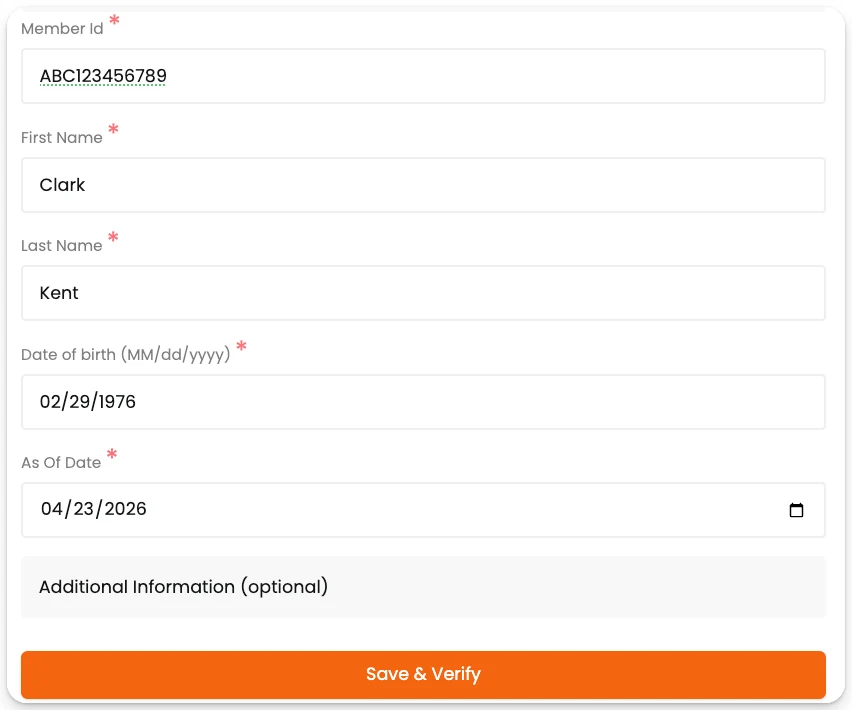
Start by gathering enough information to correctly identify the patient and their insurance policy. This commonly includes:
Depending on the payer or verification system, you may also need information about the treating provider or facility, such as the National Provider Identifier (NPI).
It is also important to know what service the patient is expected to receive, because that determines which benefits you need to verify. For example, the information you check for an outpatient visit may differ from what you need for an inpatient admission.
If you’re using VerifyTreatment, you can enter the patient and insurance information when starting a new verification. Once you select the payer, the VOB form adjusts to the information required for that payer, rather than giving your team the same generic form for every insurance company.
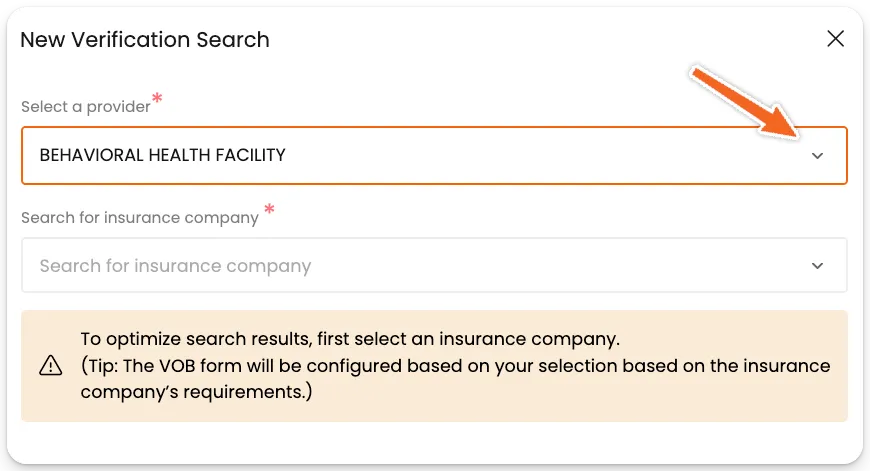
Once you have the necessary information, you can check the patient’s plan through a payer portal, clearinghouse, EHR, or insurance verification platform such as VerifyTreatment.
For HIPAA-standard electronic eligibility checks, here is what typically happens behind the scenes: a 270 transaction sends the eligibility and benefits inquiry to the health plan, and the payer returns a 271 response containing the available coverage and benefit information.
You typically do not need to create or interpret these transactions yourself. The software or clearinghouse handling the verification sends the request and presents the response in a format your team can use.
With VerifyTreatment, you can run these real-time eligibility and benefits checks across 1,800+ payers from the same platform.
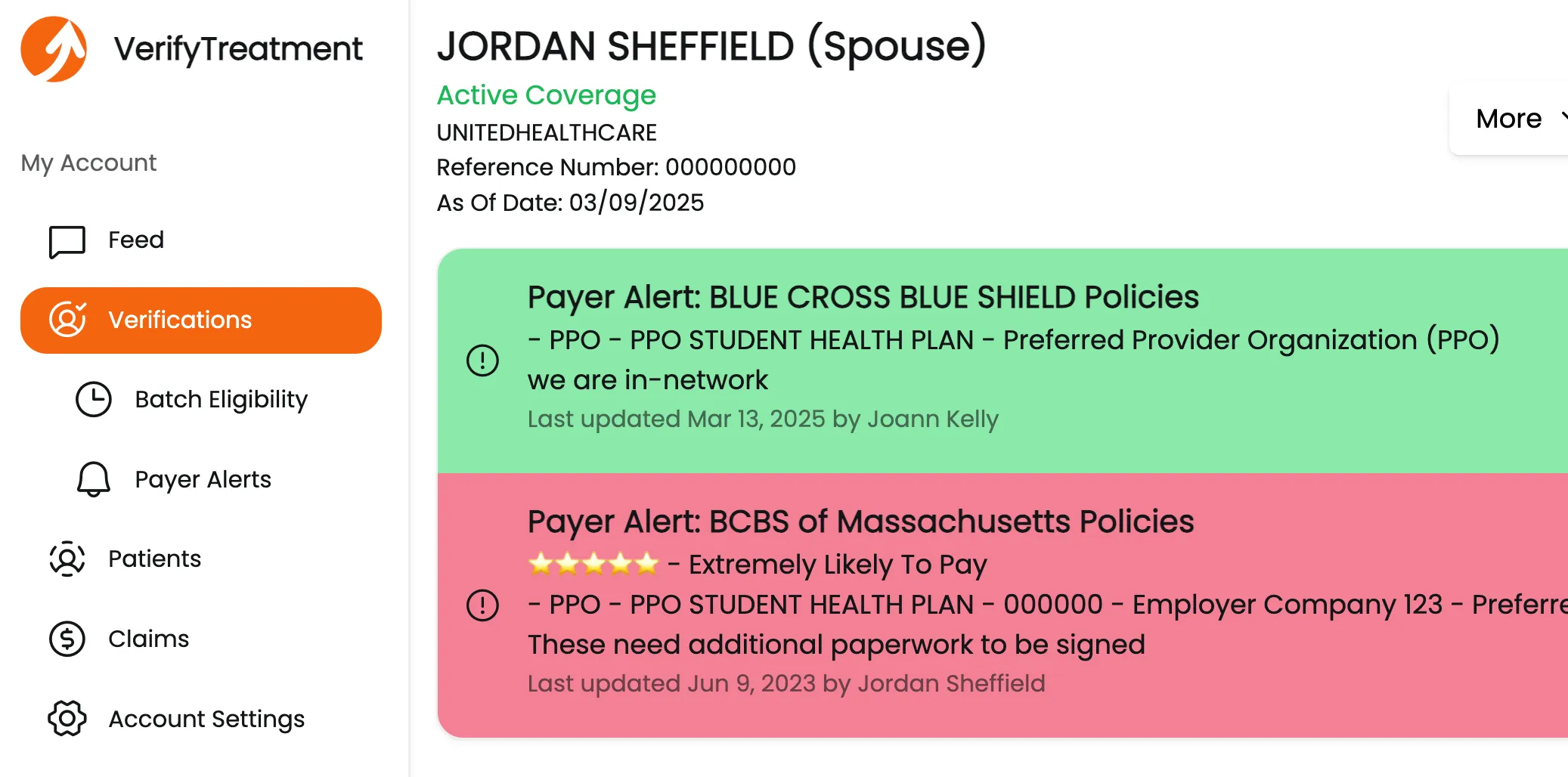
The first thing to establish is whether the patient has active coverage for the date the service will be provided.
Check the plan’s effective dates and make sure the coverage applies to the relevant period. An active policy, however, only tells you that the patient is enrolled in the plan. You still need to review the benefits that apply to the actual service.
VerifyTreatment surfaces the patient’s coverage status, effective dates, plan information, and other available policy details in the verification result, so your team can establish whether coverage is active before moving into the benefit details.
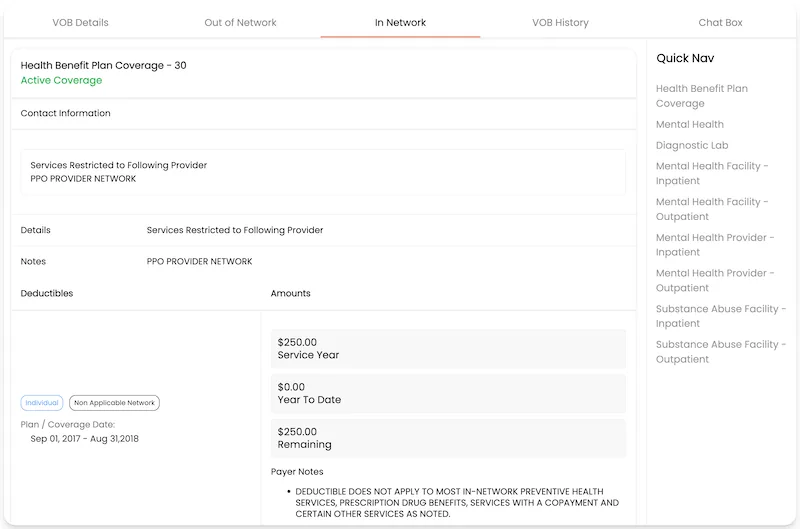
Next, look at what the plan says about the care the patient is expected to receive. Depending on the plan and the information returned, this may include:
CMS operating rules require electronic eligibility responses to support financial information such as deductibles, copays, coinsurance, in/out-of-network differences, and coverage information for specific service types. CAQH CORE rules also address information such as base and remaining deductibles and service-specific patient financial responsibility.
The goal here is to understand how the patient’s benefits apply to the specific care you intend to provide.
VerifyTreatment brings these benefit details into the VOB result and can also surface behavioral health-specific information such as mental health and substance use benefits, in- and out-of-network benefits, patient responsibility, and visit limits.
Some services come with additional payer requirements. Your team may need to determine whether prior authorization, a referral, or another form of approval is required before treatment begins.
It is important to distinguish checking whether authorization is required from actually obtaining the authorization. VOB can help identify the requirement, but completing the payer’s authorization process is a separate step.
You should also look for benefit limits or other restrictions that could affect the planned care. For example, a plan may cover a service but limit the number of visits available within a benefit period.
VerifyTreatment can surface authorization requirements as part of the VOB and provides Payer Alerts for known payer issues your team may need to investigate, including certain carve-outs and authorization-related quirks. This helps you identify what needs attention before moving the patient forward.
Related: Comparing prior authorization tools? See our roundup of the best prior authorization software.
A payer response does not always contain every detail your team needs. If important information is missing or unclear, you may need to check another payer source or contact the insurer directly before completing the VOB.
Once the verification is complete, record the relevant benefit information and any outstanding requirements. Your documentation should make it easy for the teams involved in intake, admissions, treatment, and billing to understand what was verified and what still needs attention.
With VerifyTreatment, teams can keep VOB results and notes together, share the information across departments, and export verification records when needed for billing or other workflows. From there, you can address any authorization or coverage issues, discuss expected financial responsibility with the patient, and move forward with a clearer understanding of their benefits.
For a VOB to be useful, the information needs to be accurate, specific to the planned service, and current enough to use. Here are a few practices that can help.
Run the VOB early enough to give your team time to deal with anything that needs attention.
If you discover that authorization is required, benefits are unclear, or the service is not covered as expected, you have an opportunity to investigate before treatment moves forward rather than finding out when the claim is submitted.
There is no single verification timeframe that works for every provider or service. What matters is having the information when your team needs to make decisions about treatment, authorization, and patient financial responsibility.
Do not assume that general plan information applies equally to every type of care.
When possible, verify the benefits for the specific service or procedure you intend to provide. Deductibles, copays, coinsurance, network benefits, and coverage limits can differ depending on the service.
Knowing that a plan has a $2,000 deductible, for example, is less useful if your team does not know how much of that deductible the patient has already met.
Where available, review current accumulators such as the remaining deductible and other patient financial responsibility information. You should also check whether the amount applies differently for in-network and out-of-network care.
This gives your team a clearer picture of the patient’s likely financial responsibility at the time of service.
Electronic verification can return a significant amount of benefit information, but not every response will contain every detail your team needs.
If prior authorization, a benefit limit, network status, or another important field is missing or unclear, treat it as something to investigate rather than assuming it does not apply.
That may mean checking the payer portal, reviewing another payer resource, or contacting the insurer directly.
Insurance benefits can change. A patient may switch plans, enter a new benefit year, or continue treatment long enough for previously verified information to become outdated.
For longer episodes of care, it helps to have a process for checking coverage again instead of relying on the original VOB throughout treatment. VerifyTreatment supports scheduled reverification, allowing teams to rerun VOBs automatically on a daily, weekly, bi-weekly, or monthly schedule.
Keep a record of the VOB instead of relying on someone to remember what appeared on a payer portal or was said during a phone call.
Depending on your workflow, useful documentation can include the date of verification, payer, verification method, benefits returned, authorization requirements, unresolved questions, and any reference or confirmation number provided. With VerifyTreatment, verification results, notes, and team communication can stay in the same workflow, making it easier for admissions and billing to work from the same information.
Even a thorough VOB cannot guarantee that a claim will ultimately be paid.
Coverage and benefit information reflects what is available at the time of the inquiry. Final reimbursement can still depend on factors such as the services actually provided, coding, medical necessity, authorization, payer policies, and the patient’s coverage when the claim is processed.
Use VOB to make better decisions before care, but avoid presenting the result to patients or staff as a promise that the insurer will pay.
Even with a good process, VOB can get complicated. Payer systems differ, responses are not always complete, and some coverage situations require extra follow-up.
Here are some common challenges and how to overcome them.
A payer may confirm that coverage is active without giving you enough detail about the specific service, patient responsibility, or authorization requirements.
How to overcome it: Do not fill in the gaps with assumptions. Check another payer source, review the payer portal, or contact the insurer directly for clarification before completing the VOB.
VOB can take a lot of staff time when every verification involves logging into different portals, making payer calls, and entering the same information into multiple systems.
How to overcome it: Automate routine eligibility and benefits checks where possible, then reserve manual follow-up for cases that need clarification. Insurance verification software can also help reduce the need to move between payer portals or handle every verification manually.
When a patient has more than one insurance plan, your team needs to determine which plan is primary and which is secondary before you can accurately understand their benefits.
How to overcome it: Ask about additional coverage during intake and confirm the patient’s coordination of benefits instead of assuming the first insurance card provided is the primary plan.
A patient may have active medical coverage while their mental health or substance use disorder benefits are administered by a different payer or benefits manager.
How to overcome it: Check who administers the behavioral health benefits and verify coverage for the specific service or level of care rather than relying only on the patient’s general medical benefits.
Related: Managing more than verification? Compare the best behavioral health software for broader clinical and operational workflows.
A wrong date of birth, member ID, subscriber name, or other policy detail can cause the verification to fail or return an error.
How to overcome it: Compare the information submitted with the patient’s insurance card and payer records. Correct any mismatch and rerun the verification before treating the failed response as a coverage issue.
A thorough VOB gives your team the information it needs before treatment moves forward. The challenge is getting that information without spending hours switching between payer portals, making calls, or chasing missing details.
VerifyTreatment brings the process into one workflow for behavioral health teams. You can run real-time eligibility and benefits checks across 1,700+ payers, review details such as deductibles, copays, authorization requirements, exclusions, and level-of-care benefits, and keep the results in one place.
You can also run batch verifications and schedule reverifications as coverage changes.
If manual VOB is taking too much time, VerifyTreatment can help you get the information you need faster.
Disclaimer: All trademarks, logos, and brand names are the property of their respective owners. The use of any third-party trademarks, logos, or brand names in this article is for informational and comparative purposes only, and constitutes nominative fair use. This article was published by VerifyTreatment, and while we strive for objective comparisons, VerifyTreatment is included as an option within this list.





Luis Perdomo, Head of Growth, leads go-to-market strategy, demand generation, and growth initiatives at VerifyTreatment. With a background spanning digital marketing, revenue growth, and business strategy, he focuses on connecting the platform’s capabilities to the real operational challenges facing behavioral health providers, helping teams improve admissions, strengthen revenue performance, and make faster, more informed decisions.

Lindsay Morresi, Account Executive, helps healthcare organizations evaluate how VerifyTreatment can improve insurance verification, admissions, and revenue cycle workflows. Bringing a customer-focused approach to the sales process, she works with teams to understand their operational needs, identify opportunities for greater efficiency, and ensure they have the right solutions to make faster, more informed decisions.

Amira Nicol, Account Executive, brings relationship-building, industry knowledge, and a strong connection to the behavioral health community to VerifyTreatment. She works closely with treatment providers to understand the challenges their teams face around insurance verification and access to care, helping organizations identify solutions that reduce administrative barriers and support better operational and financial outcomes.

Matthew Hall, Senior Account Executive, helps behavioral health organizations identify opportunities to simplify insurance verification and protect revenue throughout the patient journey. With a consultative approach and a strong understanding of admissions, billing, and revenue cycle workflows, he works closely with teams to connect their operational challenges with practical solutions inside VerifyTreatment.

Alexander Jones, Product & Integrations Manager, helps translate customer needs into practical product improvements and scalable integrations at VerifyTreatment. With deep experience across Salesforce, APIs, automation, and business operations, he brings a unique ability to connect client workflows with technical execution, helping ensure the platform is both powerful and practical for the teams using it every day.

Nicole is a versatile healthcare professional with a Bachelor’s degree in Health Administration and a solid background in managing healthcare systems and operations. Her experience spans healthcare management, compliance, and regulations, making her adept at navigating complex healthcare environments. In addition to her administrative expertise, Nicole holds certifications in Functional Nutrition and Personal Training, giving her a well-rounded perspective on health and wellness. She is committed to using her skills to improve healthcare settings and ensure effective, patient-centered care.

Tara is a dedicated leader who leverages her Master's degree in Information Technology (Florida Tech) and deep company knowledge (since 2018) to drive our community awareness. She is the central figure for managing social engagement and ensuring the community is immediately and effectively informed of all new product launches and company updates.

JoAnn has a strong background in the mental health and substance abuse industry, with expertise in billing, coding, facility credentialing, and contracting. She is passionate about team education and public speaking, always striving to make a positive impact. With a solid foundation in accounting, JoAnn also holds an Associate of Arts in Biblical Studies from Liberty University, blending her professional skills with her personal values.

For 11+ years, Melanie has been dedicated to helping clients access quality mental health care, with a special focus on grief, loss, and substance abuse. With expertise in healthcare, community outreach, patient advocacy, and leadership development, Melanie is passionate about making a positive impact in the lives of others.