Admissions
VOB in Medical Billing: Process, Best Practices & Challenges
Before you bill for a patient’s care, you must know what their insurance will actually cover. That means checking their ...
Read the full article →


Insurance eligibility verification in behavioral health requires more than confirming active coverage. You need to confirm level-of-care benefits, carve-outs, authorization requirements, and coordination of benefits before admission. Manual phone and portal checks work at low volume but break down at scale. Purpose-built behavioral health verification platforms eliminate the consistency gaps, reduce denials, and give admissions teams real financial clarity on the first call.
Many behavioral health (BH) providers report a significant share of denials — sometimes as high as 85% — stem from eligibility-related errors.
That’s because eligibility verification in behavioral health comes with more nuance and additional steps.
Factors like Medicaid carve-outs, level-of-care coverage rules, managed care layers, and prior authorization requirements makes it more likely for teams to make mistakes.
In this guide, we’ll walk you through how to verify insurance eligibility, including the specific steps many BH teams miss, the mistakes that keep driving denials, and what the process looks like when it actually holds at scale.
Automate patient verification with VerifyTreatment
Run real-time VOBs, catch coverage changes before billing does, and give your admissions team back hours every week.
Book Your DemoPatient insurance eligibility verification is the process of confirming that a patient’s health insurance policy is active and valid on the date of service. In behavioral health settings, this is often referred to as behavioral health insurance eligibility verification, since mental health and substance use disorder (SUD) benefits may follow different rules than general medical coverage.
A basic patient eligibility check confirms:
In behavioral health, that’s not enough. Admissions and billing teams also need to complete a verification of benefits check (VOB) to understand what services are covered and under what financial terms.
A VOB includes:
In most medical settings, confirming active coverage is enough to move forward. . But in behavioral health, a policy can be active and still not cover the level of care your clinical team is recommending.
Residential treatment, detox, PHP, and IOP each have distinct coverage rules that vary by payer, plan, and sometimes by state. A patient who appears covered may have a Medicaid carve-out that routes behavioral health benefits through a separate managed care organization. Miss that detail at intake, and the claim may be denied.
It’s also not just a revenue issue. When eligibility isn’t verified correctly upfront, patients face unexpected balances, admissions may be delayed while teams scramble for coverage details mid-intake, and prior authorization windows get missed before treatment even begins.
Thorough eligibility verification prevents these issues. It gives behavioral and mental health admissions teams the financial clarity needed to make informed decisions on the first call, and gives patients a straight answer on coverage before they walk through the door.
Missing or incorrect data is one of the biggest causes of failed eligibility checks. Confirm you have everything below before you pick up the phone or log into a portal.
A standard eligibility check requires:
Depending on the payer and plan, the following information may need the following information:
The required details are what most payers need to return a result. The additional details come into play when you’re running insurance discovery with limited patient data, or when coordinating benefits across multiple plans.
Phone verification is still a common method in behavioral health. A live representative can surface payer-specific details that portals often miss or bury.
Here’s how to make each call count:
Phone verification gets the job done, but the tradeoffs are: long hold times, inconsistent information depending on which rep you reach, manual documentation errors, and no easy path for after-hours verification.
Payer portals are faster than phone calls and work well at lower volumes. Most portals submit an EDI 270 eligibility inquiry and return a 271 response in line with HIPAA ASC X12 standards — structured coverage data without the hold time.
Then dig into the behavioral health specifics:
Portal responses are structured but still require interpretation — they don’t flag what’s missing.
As admissions volume increases, the cracks in portal-based verification start to show. In many cases, staff have to log into multiple portals for verification, triggering portal fatigue. Then mistakes start to happen as fatigue grows. BH-specific details get missed, errors happen in response interpretation, documentation spreads across multiple systems, and re-verification becomes hard to track.
The process suffers because it wasn’t designed for this volume or this level of payer complexity. Structured automation addresses these gaps directly.
Phone and portal verification processes are only as consistent as the person running them. VerifyTreatment puts it in the platform, so every check runs the same way, regardless of who’s running it or how complex the payer is.
That consistency is possible because VerifyTreatment is built specifically for behavioral health and mental health treatment centersnot a generic medical billing tool. It goes beyond active or inactive status to surface the deep payer logic admissions and billing teams actually need: carve-outs, managed care nuances, Medicaid and Medicare Advantage quirks, BCBS alpha prefix variations, and level-of-care coverage details across 1,800+ payers.
Here’s how to check patient insurance eligibility with VerifyTreatment:
1. Click “New Verification” and enter patient and insurance information once. VerifyTreatment stores it, so you’re not re-entering data on follow-up checks.

2. Select the appropriate location for the client if you are a part of a multi-facility organization.

3. Select the insurance company from an extensive list of 1,800+ payors. The VOB form automatically configures itself based on your selection, so you’re always capturing what that specific payer requires, not a generic template. We include the top providers for quick selection, or you can use our search function to find a specific providers.

4. Enter VOB details and click ‘Save & Verify’. The platform pulls coverage data and policyholder demographics in real time.
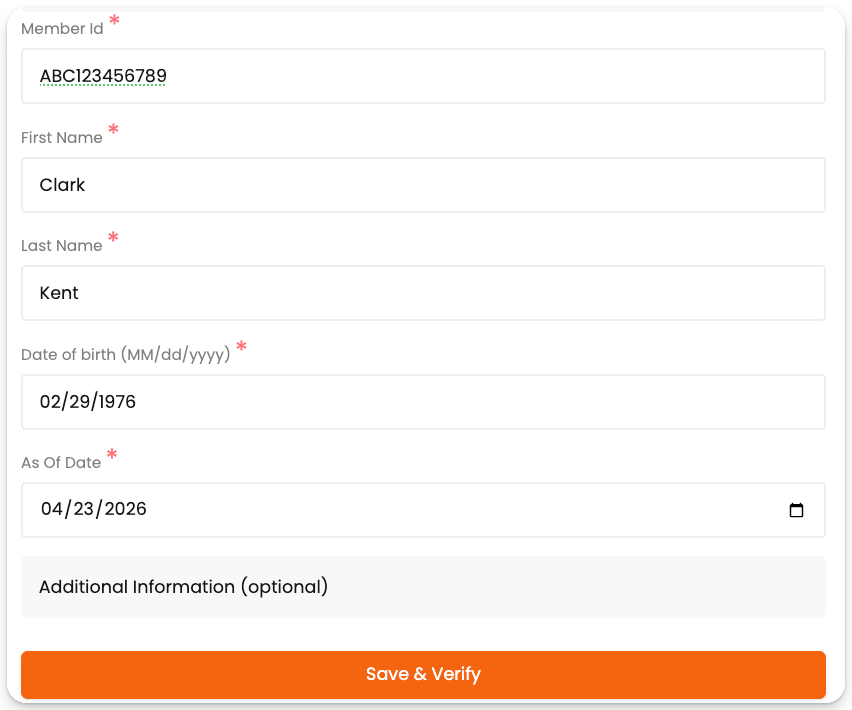
5. View coverage data and policyholder demographics in real time to verify whether a client’s insurance is valid for payment — including their likelihood to pay and eligibility status.

6. Check Payer Alerts for known flags on specific payers. Think of it as a built-in early warning system for the carve-outs and authorization quirks that tend to catch teams off guard.

7. Access in and out-of-network benefits, deductibles, and coverage notes at a glance.

8. Use the Quick Nav feature to move through all the service benefit details without missing anything.

9. Message your team securely through the HIPAA-compliant internal messaging feature, without switching to non-compliant platforms.

10. Create a PDF of the coverage details for client records or referrals.

11. Upload your company’s logo for brand continuity.
Beyond speed, every staff member works from the same standardized workflow and documentation lives in one place. But where the platform really earns its place in a behavioral health admissions process is the edge cases. With VerifyTreatment, you can run insurance discovery for patients with incomplete data, navigate payer complexity that would otherwise require manual research, and catch coverage gaps before they surface as denied claims.
Below are some common mistakes during insurance eligibility verification, particularly when using portals and direct calls to insurance companies:
A transposed member ID, a misspelled last name, an incorrect date of birth — any of these can return a result for the wrong policy. Your team proceeds on inaccurate information, the claim gets denied, and a two-minute check turns into hours of back-and-forth.
To avoid this, verify that patient demographics and insurance details match what’s on file with the payer before submitting anything. It’s a small step that prevents an expensive problem.
This is one of the most common (and costly) assumptions in behavioral health intake.
Active coverage means the policy exists. It doesn’t mean the recommended level of care is covered, that behavioral health benefits aren’t carved out to a separate administrator, or that prior authorization isn’t required before day one.
A complete check confirms the specific level of care, deductible and out-of-pocket status, network benefits, authorization requirements, and whether behavioral health runs through the primary plan or a separate carve-out. Every time, without exception.
Some patients carry primary coverage through their employer and a secondary plan through a spouse, a parent, or a government program like Medicaid.
COB determines which plan pays first and how remaining balances are handled. Submit to the wrong payer first and the claim gets automatically denied. Miss the secondary plan entirely and you leave reimbursement on the table.
Confirming both at intake protects revenue and saves billing teams from the hassle of re-submitting claims, adjusting payer order, and correcting account balances.
Active coverage doesn’t mean treatment can start immediately. Residential, detox, PHP, and many IOP programs require prior authorization before admission, or within a strict notification window after.
When authorization gets missed at intake, a patient can begin treatment assuming coverage is in place, but then the claim comes back denied because the request was never submitted or came in late. In some cases, retroactive authorization isn’t granted. Your organization absorbs the cost.
In every eligibility check, treat authorization as a required line item, not an afterthought.
Coverage changes between intake and admission more often than most teams expect, especially in behavioral health, where treatment may begin days or weeks after the first inquiry. A patient’s policy may terminate at the end of the month. Deductibles may reset at the start of a new plan year. Medicaid enrollment can lapse. Employer-sponsored coverage can change without notice.
If there’s any gap between your initial check and the admission date, re-verify. It takes a fraction of the time since you already have the patient information.
Always re-verify at these points:
Streamlining eligibility means building a verification process that is structured, repeatable, and aligned with the realities of behavioral health reimbursement.
When eligibility and benefits are verified accurately and documented clearly, admissions teams can make informed decisions on the first call, billing teams can submit claims with confidence, and patients can begin care without avoidable financial surprises.
Behavioral health-specific platforms like VerifyTreatment are built to make that process reliable at scale. If you want to go deeper on how VerifyTreatment works, the VerifyTreatment Knowledge Base has step-by-step guides across the platform’s features.
Go beyond “active” status. Verify level-of-care, carve-outs, and authorization requirements in seconds across 1,800+ payers.
Takes less than 60 seconds to get started.Disclaimer: All trademarks, logos, and brand names are the property of their respective owners. The use of any third-party trademarks, logos, or brand names in this article is for informational and comparative purposes only, and constitutes nominative fair use. This article was published by VerifyTreatment, and while we strive for objective comparisons, VerifyTreatment is included as an option within this list.





Luis Perdomo, Head of Growth, leads go-to-market strategy, demand generation, and growth initiatives at VerifyTreatment. With a background spanning digital marketing, revenue growth, and business strategy, he focuses on connecting the platform’s capabilities to the real operational challenges facing behavioral health providers, helping teams improve admissions, strengthen revenue performance, and make faster, more informed decisions.

Lindsay Morresi, Account Executive, helps healthcare organizations evaluate how VerifyTreatment can improve insurance verification, admissions, and revenue cycle workflows. Bringing a customer-focused approach to the sales process, she works with teams to understand their operational needs, identify opportunities for greater efficiency, and ensure they have the right solutions to make faster, more informed decisions.

Amira Nicol, Account Executive, brings relationship-building, industry knowledge, and a strong connection to the behavioral health community to VerifyTreatment. She works closely with treatment providers to understand the challenges their teams face around insurance verification and access to care, helping organizations identify solutions that reduce administrative barriers and support better operational and financial outcomes.

Matthew Hall, Senior Account Executive, helps behavioral health organizations identify opportunities to simplify insurance verification and protect revenue throughout the patient journey. With a consultative approach and a strong understanding of admissions, billing, and revenue cycle workflows, he works closely with teams to connect their operational challenges with practical solutions inside VerifyTreatment.

Alexander Jones, Product & Integrations Manager, helps translate customer needs into practical product improvements and scalable integrations at VerifyTreatment. With deep experience across Salesforce, APIs, automation, and business operations, he brings a unique ability to connect client workflows with technical execution, helping ensure the platform is both powerful and practical for the teams using it every day.

Nicole is a versatile healthcare professional with a Bachelor’s degree in Health Administration and a solid background in managing healthcare systems and operations. Her experience spans healthcare management, compliance, and regulations, making her adept at navigating complex healthcare environments. In addition to her administrative expertise, Nicole holds certifications in Functional Nutrition and Personal Training, giving her a well-rounded perspective on health and wellness. She is committed to using her skills to improve healthcare settings and ensure effective, patient-centered care.

Tara is a dedicated leader who leverages her Master's degree in Information Technology (Florida Tech) and deep company knowledge (since 2018) to drive our community awareness. She is the central figure for managing social engagement and ensuring the community is immediately and effectively informed of all new product launches and company updates.

JoAnn has a strong background in the mental health and substance abuse industry, with expertise in billing, coding, facility credentialing, and contracting. She is passionate about team education and public speaking, always striving to make a positive impact. With a solid foundation in accounting, JoAnn also holds an Associate of Arts in Biblical Studies from Liberty University, blending her professional skills with her personal values.

For 11+ years, Melanie has been dedicated to helping clients access quality mental health care, with a special focus on grief, loss, and substance abuse. With expertise in healthcare, community outreach, patient advocacy, and leadership development, Melanie is passionate about making a positive impact in the lives of others.