Technology & Automation
Claim.MD Reviews: Pros, Cons, Pricing & Best Alternative
Read our Claim.MD review covering features, pricing, pros, cons, and user feedback, plus when VerifyTreatment may be a b...
Read the full article →


Thoughtful AI has evolved into a more execution-driven RCM platform, which may not suit every team. Some need more control, others want clearer visibility, while some aim to prevent issues before claims are submitted. These alternatives reflect those different approaches across the revenue cycle. The shortlist below highlights the top options depending on what matters most to your team.
| Tool | Best For |
| VerifyTreatment | Preventing claim issues before submission (eligibility & authorization accuracy) |
| Waystar | Managing the full revenue cycle in one centralized platform |
| MD Clarity | Identifying underpayments and recovering lost revenue |
In May 2025, Thoughtful AI ceased being just an AI automation platform that deploys agents to handle RCM tasks. It became part of Smarter Technologies, a broader system combining AI agents, clinical intelligence, and large-scale revenue cycle operations.
While the goal is to improve efficiency and reduce administrative burden, it also changes how teams operate day-to-day. Teams now have to shift from managing claims directly to supervising AI-driven workflows, rely more on the vendor when issues arise, and operate with less step-by-step visibility into how claims are processed. This may not suit teams that prefer full transparency across their revenue cycle.
If you’re weighing these changes or trying to determine the right fit for your organization, this guide breaks down 7 Thoughtful AI competitors worth considering.
At VerifyTreatment, we work closely with RCM teams to improve eligibility verification, reduce claim issues, and streamline front-end revenue workflows.
For example, when working with Foundation Recovery Network, our platform helped eliminate admission delays, reduce staffing pressure, and prevent the loss of nearly 1 in 10 patients, resulting in over $10,000 in recovered monthly revenue.
Because we operate directly in this space, our perspective on RCM automation tools comes from hands-on experience. Here’s what one of our customers had to say:

You don’t have to log into 10 different portals anymore. Verify saves time, saves money, and makes the data usable across departments. We’ve never had visibility like this before.
While Thoughtful AI offers a new generation approach to automating revenue cycle workflows, it may not align perfectly with every organization’s needs, especially given its shift toward a more execution-driven and AI-led model.
Here are some of the most common reasons healthcare providers explore alternatives:
With AI handling large portions of the revenue cycle, it’s not always clear how individual claims are processed step by step. Some teams prefer platforms that provide deeper, real-time visibility into claim status, actions taken, and decision points.
Unlike plug-and-play tools, implementing AI-driven RCM systems can require integration with existing infrastructure, workflow alignment, and onboarding time. Organizations looking for faster deployment may explore lighter alternatives.
As the platform shifts toward executing workflows, it also means relying more on the vendor to handle critical revenue cycle functions. Some organizations prefer to keep these processes more in-house or maintain tighter oversight.
Compared to more traditional RCM platforms, there’s relatively limited publicly available user feedback on Thoughtful AI. For buyers who rely on peer reviews or third-party validation, this can make evaluation more difficult.
Not sure which Thoughtful AI competitor is actually worth considering in 2026? With different platforms focusing on everything from automation to visibility and revenue recovery, it can be hard to tell which one fits your workflow.
To make it easier, here’s a quick side-by-side breakdown of the top options and what each one is best known for:
| Tool | Core Focus | Approach | Best For | Key Strength |
| VerifyTreatment | Front-end RCM prevention | Preventive (pre-claim) | Teams that want control & visibility before submission | Reduces denials at the source |
| Waystar | Full RCM infrastructure | Workflow management | Organizations needing an all-in-one platform | End-to-end claims & payments system |
| MD Clarity | Revenue recovery & optimization | Post-claim analysis | Teams focused on underpayments & payer behavior | Identifies and recovers lost revenue |
| Infinx | Hybrid RCM execution | AI + human support | Organizations open to outsourcing workflows | Handles both routine & complex tasks |
| AKASA | Mid-cycle optimization | AI-driven intelligence | Health systems improving coding & documentation | Enhances claim accuracy before submission |
| Adonis | Revenue intelligence | AI + orchestration | Teams needing visibility into denials & A/R | Surfaces risk and prioritizes actions |
| Candid Health | Full automation | Low-touch / touchless RCM | Teams reducing manual workload | High automation with minimal intervention |

VerifyTreatment does one thing exceptionally well which is helping healthcare organizations avoid costly claim issues, rework, and lost revenue through its preventive approach to revenue cycle management.
Instead of fixing problems after claims are submitted, VerifyTreatment focuses on catching them at the front end. Before a patient is admitted or a claim is created, the platform surfaces critical details like eligibility status, deductibles, carve-outs, and authorization requirements that are often missed during manual verification.
If issues arise at any point, teams have clear visibility into what was verified, what was flagged, and where things may have gone wrong, making it easier to act quickly without chasing down missing information.
So, if you’re a billing team, admissions team, or healthcare provider looking to reduce preventable denials and gain more control over your revenue cycle, VerifyTreatment offers a more proactive alternative.
Custom pricing based on organization size and usage
Healthcare organizations that want more control, visibility, and accuracy at the front end of the revenue cycle, especially those dealing with eligibility and authorization-related denials.

Waystar is built to give teams one place to manage the full revenue cycle. It covers everything from verifying patient coverage and submitting claims to tracking payments, handling denials, and analyzing financial performance.
With it, you don’t have to rely on multiple tools or disconnected workflows. Everything sits within the same system, with automation and AI layered in to reduce manual effort and improve efficiency.
Custom pricing based on organization size, usage, and integrations
Healthcare organizations looking for a comprehensive, all-in-one RCM platform with strong infrastructure and broad functionality across the entire revenue cycle.

MD Clarity focuses less on running the revenue cycle and more on making sure providers are actually getting paid what they’re owed.
It brings visibility into underpayments, denials, and payer contracts. This helps teams spot patterns, track what insurers should have paid versus what they actually paid, and take action to recover missing revenue.
A big part of its value sits around payer transparency and contract intelligence, where teams can break down reimbursement at a granular level and use that insight to improve collections, negotiate better terms, or fix recurring issues that quietly impact revenue over time.
Custom pricing (not publicly listed)
Organizations focused on revenue recovery, payer accountability, and contract optimization, rather than day-to-day workflow automation.
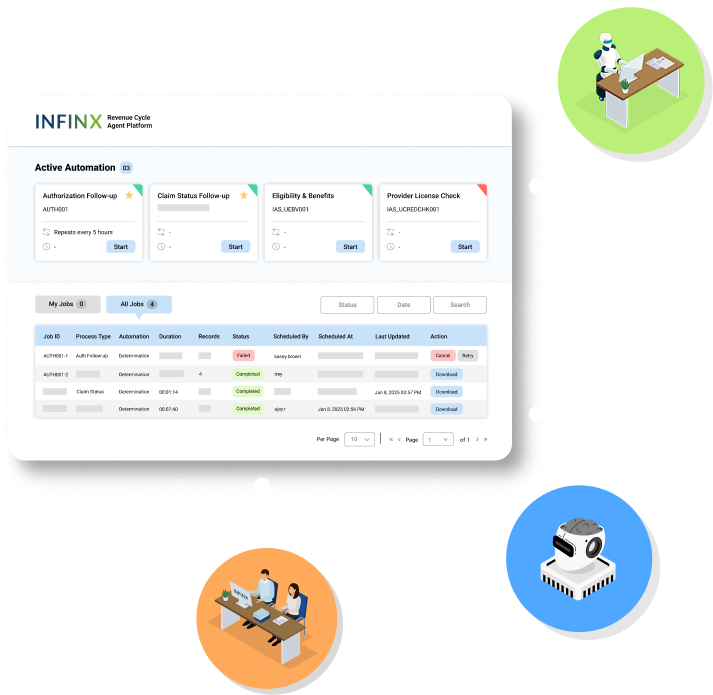
Infinx takes a hybrid approach to RCM. Similar to Thoughtful AI in its use of AI agents, it combines automation with human expertise to handle revenue workflows end to end.
AI handles routine, high-volume tasks like eligibility checks, claim status, and payment posting, while humans take on more complex work like denial resolution, payer follow-ups, and exception handling.
Custom pricing based on scope, volume, and service model. Annual engagements typically start around $5,000/month, with pricing structured around capacity, outcomes, or managed services
Healthcare organizations looking for a hybrid RCM model that combines automation with expert support to handle routine workflows and complex edge cases without building large in-house teams.

AKASA centers its approach on using GenAI trained on clinical and financial data to surface gaps, improve accuracy, and guide decisions before claims are finalized.
It most often shows up in mid-cycle workflows, where teams are reviewing documentation and coding before submission. For example, when documentation is incomplete or a code is underreported, AKASA surfaces the gap early and guides teams toward a more accurate, complete claim.
Custom pricing based on organization size and solution scope
Health systems looking to improve coding accuracy, documentation quality, and pre-bill optimization using AI, rather than fully outsourcing or replacing their revenue cycle workflows.
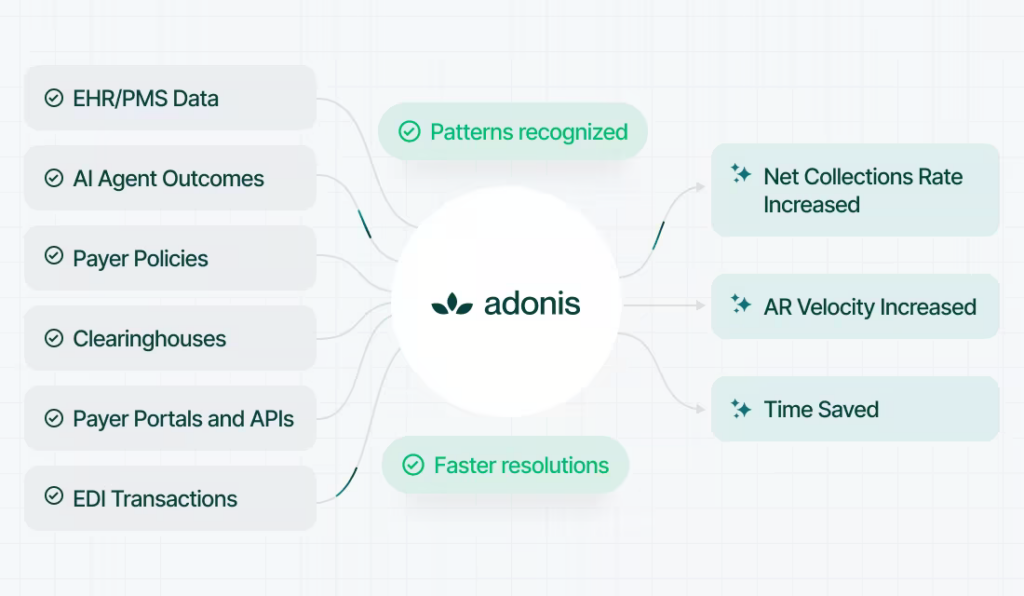
Adonis focuses on helping teams understand where revenue is leaking and take action before it compounds. It analyzes claims, denials, A/R, and payer behavior to surface risk early. It then coordinates what needs to happen next, whether that’s prioritizing follow-ups, recommending actions, or triggering automated workflows to resolve issues.
Custom pricing based on organization size and scope
Organizations that want better visibility into denials, A/R, and payer behavior, and a system that helps prioritize and coordinate actions to protect revenue.
Candid Health is built to reduce how often teams need to step in, using automation to detect issues, correct them, and keep claims moving without the usual back-and-forth. Instead of relying heavily on manual review or follow-ups, it aims to get claims right the first time and keep workflows running with fewer interruptions.
Custom pricing based on organization size and scope.
Organizations looking to minimize manual work and move toward a highly automated, low-touch revenue cycle.
Each alternative approaches RCM differently. Some automate execution, others optimize workflows, while a few focus on visibility and revenue recovery. The right fit depends on how much control you want, how your team operates, and where your biggest gaps are.
For many organizations, those gaps start before claims are even submitted. Eligibility errors, missed authorizations, and incomplete verification often lead to denials that are harder to fix later.
That’s where a preventive approach stands out. Instead of managing issues downstream, VerifyTreatment helps teams catch them early (before they impact claims, cash flow, or staff time).
If you’re aiming for more control and fewer avoidable denials, it’s worth exploring how VerifyTreatment fits into your workflow here.
Thoughtful AI uses AI agents to automate revenue cycle workflows such as eligibility verification, claims submission, and denial follow-ups. Instead of just assisting teams, it executes tasks across the revenue cycle with minimal manual intervention.
It depends on your priorities. Some teams look for full automation, while others prioritize visibility, flexibility, or ease of use. Key factors to consider include workflow control, integration capabilities, level of automation, and how well the solution fits into your existing processes.
Thoughtful AI operates as an AI-driven automation platform, but with its integration into Smarter Technologies, it now sits within a broader system that combines software, AI agents, and managed RCM operations.
There isn’t a one-size-fits-all answer. The best alternative depends on your needs—whether that’s full automation, better visibility, or preventing claim issues upfront. For teams focused on reducing denials before claims are submitted, VerifyTreatment offers a more preventive approach.
Disclaimer: All trademarks, logos, and brand names are the property of their respective owners. The use of any third-party trademarks, logos, or brand names in this article is for informational and comparative purposes only, and constitutes nominative fair use. This article was published by VerifyTreatment, and while we strive for objective comparisons, VerifyTreatment is included as an option within this list.


Samantha is a dynamic marketing professional dedicated to making a difference in the behavioral health industry through her work at VerifyTreatment. With a strong background in digital marketing and brand advocacy, she helps elevate the platform’s presence by fostering authentic connections with treatment centers and healthcare providers. Her expertise in content creation and community engagement ensures that VerifyTreatment’s value is communicated effectively, helping centers streamline operations and improve patient care. Samantha’s focus on building trust and driving awareness positions VerifyTreatment as a key resource in the healthcare landscape.

Nicole is a versatile healthcare professional with a Bachelor’s degree in Health Administration and a solid background in managing healthcare systems and operations. Her experience spans healthcare management, compliance, and regulations, making her adept at navigating complex healthcare environments. In addition to her administrative expertise, Nicole holds certifications in Functional Nutrition and Personal Training, giving her a well-rounded perspective on health and wellness. She is committed to using her skills to improve healthcare settings and ensure effective, patient-centered care.

Tara is a dedicated leader who leverages her Master's degree in Information Technology (Florida Tech) and deep company knowledge (since 2018) to drive our community awareness. She is the central figure for managing social engagement and ensuring the community is immediately and effectively informed of all new product launches and company updates.

JoAnn has a strong background in the mental health and substance abuse industry, with expertise in billing, coding, facility credentialing, and contracting. She is passionate about team education and public speaking, always striving to make a positive impact. With a solid foundation in accounting, JoAnn also holds an Associate of Arts in Biblical Studies from Liberty University, blending her professional skills with her personal values.

For 11+ years, Melanie has been dedicated to helping clients access quality mental health care, with a special focus on grief, loss, and substance abuse. With expertise in healthcare, community outreach, patient advocacy, and leadership development, Melanie is passionate about making a positive impact in the lives of others.

Jordan is a dedicated advocate for behavioral health and is passionate about improving sales strategies and business processes. With a focus on helping businesses, particularly in healthcare, Jordan believes that streamlining operations is a way to positively impact more people indirectly. A strong leader, both personally and professionally, Jordan is committed to making a difference in the world by doing good business and serving a higher purpose.