Technology & Automation
Claim.MD Reviews: Pros, Cons, Pricing & Best Alternative
Read our Claim.MD review covering features, pricing, pros, cons, and user feedback, plus when VerifyTreatment may be a b...
Read the full article →


Waystar uses custom pricing, with reported costs around $100–$300 per provider per month for small practices and roughly $2,000–$5,000+ monthly for mid-sized organizations, depending on volume, providers, and features.
The platform is strong for post-service billing and denial management, but organizations that depend on catching coverage issues before admission often consider front-end verification tools like VerifyTreatment.
If your team is managing high claim volumes, eligibility checks, and payment follow-up, a platform like Waystar is built to bring those workflows into one place. Formed from the merger of Navicure and ZirMed, Waystar offers a cloud-based RCM system that supports the full billing cycle, from financial clearance and claim submission to payment posting and denial management.
Pricing, however, is not published and is set through a sales process. Costs vary based on provider count, claim volume, selected modules, and the level of automation you need, which makes it difficult to estimate the total investment upfront.
Below, we break down typical pricing ranges, what you’re likely paying for at those levels, and where Waystar tends to fit operationally.
We work with organizations that run both front-end eligibility and back-end billing inside Salesforce and other systems. With 4,000+ providers using our platform and access to 1,700+ insurance sources, we understand how pricing models affect real operations, not just contracts.

“Great Product, Ease of Use, Added Efficiency for Our Team. Automating and bringing in health insurance verifications to our instance was a game changer. We have instant verifications for all of our prospects, as well as automated verifications for our clients on a weekly basis.”
You can book a free demo today.

Waystar does not publish pricing or offer fixed plans. Most organizations start with a demo and receive a custom quote, usually structured as a monthly or annual subscription.
While Waystar groups features into tiers like Starter, Core, or Premium, these act more as starting points than set packages. In practice, pricing is tailored to each organization’s size, volume, and workflow complexity.
Based on industry estimates, small practices may pay roughly $100–$300 per provider per month.
Mid-sized organizations often report about $2,000–$5,000+ per month, with annual contracts starting near $11,000 and increasing from there. Larger health systems typically negotiate enterprise agreements at significantly higher totals.
Several factors can push pricing up or down:
In short, Waystar pricing scales with both volume and capability. As you add providers, process more claims, or adopt deeper automation, the total investment increases accordingly.
Beyond the base subscription, Waystar projects often include setup and usage costs that can affect the total investment.
When estimating total cost, these variable fees matter. Larger implementations or high claim volumes can add significantly to the annual investment, so it’s worth factoring them into budget planning early.
One important consideration is contract structure. Waystar agreements are often multi-year, and some organizations report higher costs at renewal if volumes or provider counts increase.
It’s worth reviewing renewal terms closely and confirming that projected usage matches what’s in the contract, so pricing stays aligned over time.
Waystar is built to help billing teams manage high claim volumes with fewer manual steps. The platform focuses on improving accuracy early, automating routine work, and giving teams better visibility across the revenue cycle.

Waystar treats eligibility as part of financial clearance, helping teams catch coverage issues before claims go out. By improving accuracy upfront, organizations can reduce rework and avoid preventable denials later.
The platform connects to a large payer network and organizes eligibility responses into a readable format. Features like coverage detection can also help identify additional or secondary insurance that might otherwise be missed.
Waystar automates time-consuming tasks such as claim status checks and monitoring. Teams work from exception queues, focusing only on accounts that need attention instead of reviewing every claim.
Eligibility, claim submission, remittance, payment posting, and reporting live within the same environment. Integration with major EHRs allows organizations to manage multiple billing functions without relying on separate tools.
By identifying coverage issues, authorization gaps, or benefit limits early, Waystar helps support smoother claims processing and fewer delays downstream.

Overall, Waystar’s strength is scale. It works best for organizations that need a single platform to manage complex, high-volume billing operations and reduce administrative effort across the revenue cycle.
Waystar is built around the billing cycle. That works well for organizations focused on claims and payment performance, but it may not fit as well when the main pressure sits at intake, where coverage decisions need to happen quickly.
Waystar verifies eligibility, but the workflow is designed to support billing rather than live intake conversations. Key details may not be easy to surface while a patient or referral source is still on the phone.
If patient information is incomplete, Waystar typically relies on what is provided. Admissions teams may still need to search payer portals manually when policy details are missing or outdated.
Waystar works best for organizations with high claim volume and dedicated billing staff. Smaller programs or admissions-driven teams may find the platform broader, and more expensive, than their front-end workflow requires.
For organizations where most revenue risk starts before a claim is ever submitted, a billing-centered system may not line up with how the work actually happens. That’s often when teams begin looking for tools built specifically for front-end verification.
Admissions teams often need coverage answers on the first call. VerifyTreatment is built for that moment, helping you check insurance and understand benefits while the conversation is still happening.

Our platform runs real-time eligibility across payers and returns the details that matter for intake, including patient responsibility, authorization needs, and behavioral health carve-outs. It also supports insurance discovery when information is incomplete and flags risks like inactive policies or Medicaid changes, with batch re-verification to catch updates later.
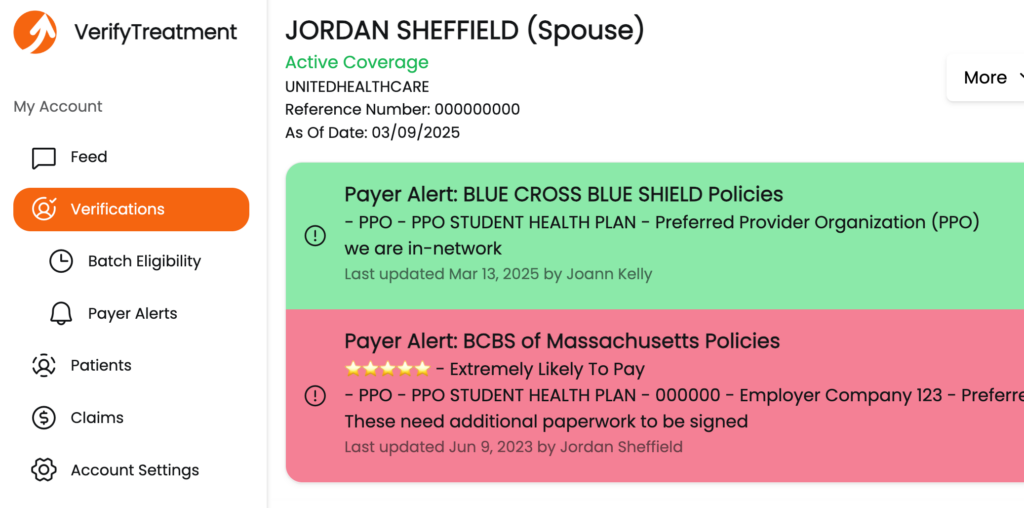
Results are organized in a clear, admissions-ready view so coverage risks show up early. The goal is straightforward: give you reliable information during intake so decisions can move forward without extra follow-up.
When the biggest risk sits at intake, teams often need a workflow built around that moment, not the billing cycle that comes later. That’s where our platform is designed to fit.

VerifyTreatment is designed for front-end staff, with coverage details organized around behavioral health decisions. Admissions teams can see payer rules, level-of-care limits, and authorization needs in real time instead of waiting for billing to sort it out later.
The platform flags inactive policies, coverage gaps, and behavioral health carve-outs before admission. By surfacing risks upfront, teams can address issues early rather than finding them after a claim is denied.
Verification data can flow into systems like Salesforce so both teams work from the same information. Clear, readable benefit summaries reduce handoff errors and unexpected patient balances.

Because the workflow is focused and purpose-built, implementation is lighter than a full RCM rollout. Many organizations can begin verifying quickly without a long configuration process.
VerifyTreatment goes beyond active status to surface details that often affect behavioral health intake, such as Medicaid changes, Medicare Advantage rules, or plan-specific limitations.
Organizations typically choose VerifyTreatment when the goal is to reduce delays and protect revenue at the point of intake, rather than fixing problems after the claim is submitted.
Most teams don’t set out to replace their verification process. The shift usually happens when small front-end issues start showing up in admissions flow, staff workload, or revenue.
The warning signs usually look like this:
Even a few coverage surprises can slow intake and lead to difficult follow-ups with families. When billing reports that rework keeps tracing back to front-end errors, the problem often sits in the verification process, not the claims workflow.
This was the situation at Foundations Recovery Network. Delays in coverage answers were slowing admissions and creating frustration for patients and families. The organization estimated it was losing about one in ten potential admissions, along with more than $10,000 per month in missed revenue.
After moving to our platform, admissions teams were able to review insurance details in real time and have financial conversations during the first call.
The change helped reduce delays, support around-the-clock intake, and recover revenue that had previously been lost, all while giving patients and families clearer information during a stressful moment.

Waystar can be a strong billing platform, but if coverage issues are slowing admissions or showing up after the fact, it may be worth looking at a more front-end approach.
VerifyTreatment gives your team clear insurance answers during intake so you can identify issues sooner and keep decisions moving.
The easiest way to evaluate the fit is to see it in action. Book a demo to see how VerifyTreatment supports real workflows and whether earlier visibility could help your team move faster and avoid preventable denials. Get started today.
Disclaimer: All trademarks, logos, and brand names are the property of their respective owners. The use of any third-party trademarks, logos, or brand names in this article is for informational and comparative purposes only, and constitutes nominative fair use. This article was published by VerifyTreatment, and while we strive for objective comparisons, VerifyTreatment is included as an option within this list.




Samantha is a dynamic marketing professional dedicated to making a difference in the behavioral health industry through her work at VerifyTreatment. With a strong background in digital marketing and brand advocacy, she helps elevate the platform’s presence by fostering authentic connections with treatment centers and healthcare providers. Her expertise in content creation and community engagement ensures that VerifyTreatment’s value is communicated effectively, helping centers streamline operations and improve patient care. Samantha’s focus on building trust and driving awareness positions VerifyTreatment as a key resource in the healthcare landscape.

Nicole is a versatile healthcare professional with a Bachelor’s degree in Health Administration and a solid background in managing healthcare systems and operations. Her experience spans healthcare management, compliance, and regulations, making her adept at navigating complex healthcare environments. In addition to her administrative expertise, Nicole holds certifications in Functional Nutrition and Personal Training, giving her a well-rounded perspective on health and wellness. She is committed to using her skills to improve healthcare settings and ensure effective, patient-centered care.

Tara is a dedicated leader who leverages her Master's degree in Information Technology (Florida Tech) and deep company knowledge (since 2018) to drive our community awareness. She is the central figure for managing social engagement and ensuring the community is immediately and effectively informed of all new product launches and company updates.

JoAnn has a strong background in the mental health and substance abuse industry, with expertise in billing, coding, facility credentialing, and contracting. She is passionate about team education and public speaking, always striving to make a positive impact. With a solid foundation in accounting, JoAnn also holds an Associate of Arts in Biblical Studies from Liberty University, blending her professional skills with her personal values.

For 11+ years, Melanie has been dedicated to helping clients access quality mental health care, with a special focus on grief, loss, and substance abuse. With expertise in healthcare, community outreach, patient advocacy, and leadership development, Melanie is passionate about making a positive impact in the lives of others.

Jordan is a dedicated advocate for behavioral health and is passionate about improving sales strategies and business processes. With a focus on helping businesses, particularly in healthcare, Jordan believes that streamlining operations is a way to positively impact more people indirectly. A strong leader, both personally and professionally, Jordan is committed to making a difference in the world by doing good business and serving a higher purpose.