
Technology & Automation
Claim.MD Reviews: Pros, Cons, Pricing & Best Alternative
Read our Claim.MD review covering features, pricing, pros, cons, and user feedback, plus when VerifyTreatment may be a b...
Read the full article →


TriZetto does not publish pricing publicly, but its cost structure follows a predictable pattern. Pricing is typically based on provider count, claim volume, and system complexity, with additional costs for transactions and integrations. Third-party estimates suggest pricing can start around $300 per month and scale significantly depending on usage.
For a simpler, more predictable approach, VerifyTreatment focuses on real-time verification to prevent denials early—reducing downstream complexity and cost.
If you visit TriZetto Healthcare Solutions, the most you will find about pricing is a prompt to “request a demo.” There are no numbers and no ranges.
That is typical for enterprise healthcare platforms owned by companies like Cognizant. Pricing is customized based on provider count, claim volume, integrations, and the specific modules you need, not a flat fee.
But before sitting through a sales call, you still want to understand the cost. Will it be hundreds or thousands per month? Will it increase as your team grows?
This guide breaks down how TriZetto pricing works, what real users report, and how to estimate your cost before speaking to sales.
At VerifyTreatment, we work closely with admissions and revenue cycle teams to solve one of the biggest problems in healthcare operations: getting accurate coverage data before it turns into lost revenue.
One example is Foundation Recovery Network, which was able to eliminate admissions delays, reduce staffing strain, and prevent the loss of 1 in 10 patients while saving over $10,000 per month in missed revenue after implementing VerifyTreatment.

Great Product, Ease of Use, Added Efficiency for Our Team. Automating and bringing in health insurance verifications to our instance was a game changer. We have instant verifications for all of our prospects, as well as automated verifications for our clients on a weekly basis.
For this guide, we did not rely on guesswork or vague estimates. We analyzed official information from TriZetto Healthcare Solutions, studied how similar platforms structure pricing, and reviewed real-world user experiences. So you can move forward with clarity, not assumptions.
TriZetto does not have a single flat price. Instead, it uses a layered pricing model where your total cost depends on how your organization is structured and how you use the platform.
Here are the main components that typically determine pricing:
This is the base cost for accessing the system and its core features, such as claims management and clearinghouse services. Because TriZetto Healthcare Solutions is part of Cognizant’s enterprise healthcare suite, pricing is customized rather than publicly listed.
In addition to the base fee, there are often usage-based charges tied to activity, including:
Some users also point to additional per-claim costs in specific situations. For example: “You would need to check your contract for your per claim charge for paper claims.”
This suggests that certain workflows, such as paper claims, may introduce extra fees depending on contract terms.
One of the biggest drivers of cost is the number of providers in your organization. According to user discussions, pricing is often structured around providers rather than payers. As one user explained: “Trizetto charges per provider, not per payer.”
Another user reinforced how this impacts cost as teams grow: “The costs are increasing as we add more providers because it is based on the number of providers.”
This means your total cost can scale quickly as your organization expands.
There are also upfront costs to get started, which may include:
While TriZetto does not publish these costs, implementation fees are standard across enterprise healthcare platforms.
While TriZetto Healthcare Solutions does not publish official pricing, third-party data gives a clearer sense of how costs are structured.
For example, Software Finder notes that TriZetto pricing starts at approximately $300 per month for smaller setups. Additional analysis from SelectHub suggests pricing can scale further, with estimates around $300 per provider per month, depending on configuration.
At the transaction level, clearinghouse pricing models similar to TriZetto are often estimated between $0.15 and $0.40 per claim, based on volume and contract terms.
These figures are not official TriZetto pricing, but they provide a useful benchmark for understanding how costs typically scale.
Before focusing on cost alone, it helps to understand what you are actually paying for with TriZetto Healthcare Solutions.
TriZetto is not just a clearinghouse. It is a broader revenue cycle infrastructure designed to manage claims, payments, and payer connectivity across your organization.
At its core, TriZetto allows providers to submit claims electronically, validate them before submission, and receive remittance data from payers. This is the primary function most practices rely on and forms the foundation of the platform.
Beyond claims, TriZetto supports the broader revenue cycle. This includes billing workflows, tracking payments, and managing the lifecycle of a claim from submission to reimbursement.
Instead of using multiple disconnected tools, many organizations use it to centralize these processes and improve financial visibility.
TriZetto connects providers to a large network of payers, making it easier to handle eligibility checks and claim submissions across multiple insurers. This reduces the need to switch between different payer portals and helps standardize how teams interact with insurance providers.
The platform integrates with existing systems, allowing patient and billing data to flow between tools without constant manual entry. For growing organizations, this becomes critical in keeping billing, clinical, and administrative teams aligned.
One of the biggest benefits is how TriZetto helps standardize workflows across teams.
As one reviewer shared on there website: “TPS has helped us create a straightforward, standardized workflow. Our efficiency has increased and things are getting done in a more timely fashion.”
This reflects how the platform is often used to bring structure and consistency to day-to-day operations.
TriZetto also provides reporting tools that help organizations track performance across their revenue cycle. This can include visibility into claim status, payment timelines, and overall financial performance. For larger teams, having access to this data makes it easier to identify bottlenecks, monitor trends, and make more informed operational decisions.
In addition to billing and claims workflows, TriZetto offers services that support provider credentialing and administrative processes.
This helps organizations manage payer enrollments and maintain compliance requirements, which are often time-consuming when handled manually. For growing practices, this can reduce administrative overhead and streamline onboarding for new providers.
TriZetto is a powerful platform, but it is not the right fit for every team or workflow. The same factors that make it robust can also introduce friction, especially for smaller or intake-driven organizations.
One of the biggest challenges is how pricing scales over time. Because costs are often tied to the number of providers, expenses tend to increase as your team expands.
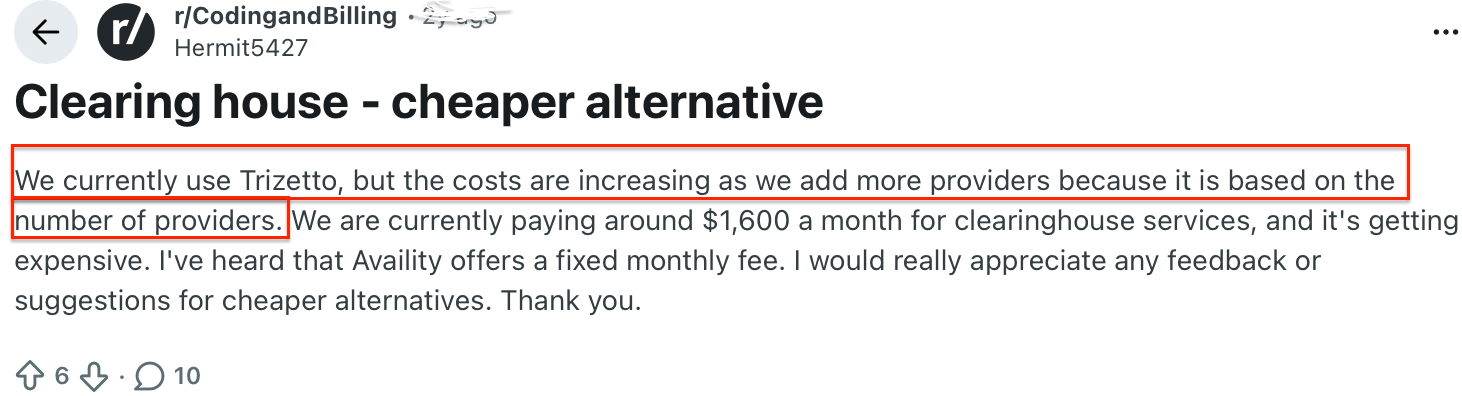
What starts as a manageable cost for a smaller practice can grow quickly as additional providers are added or claim volume rises. Without a clear understanding of how these factors impact pricing, organizations may end up paying significantly more than expected.
This is why many teams evaluate the full pricing structure upfront, rather than focusing only on the starting cost.
Even with a strong system, real-world workflows can still involve multiple tools and touchpoints.
As one user shared:
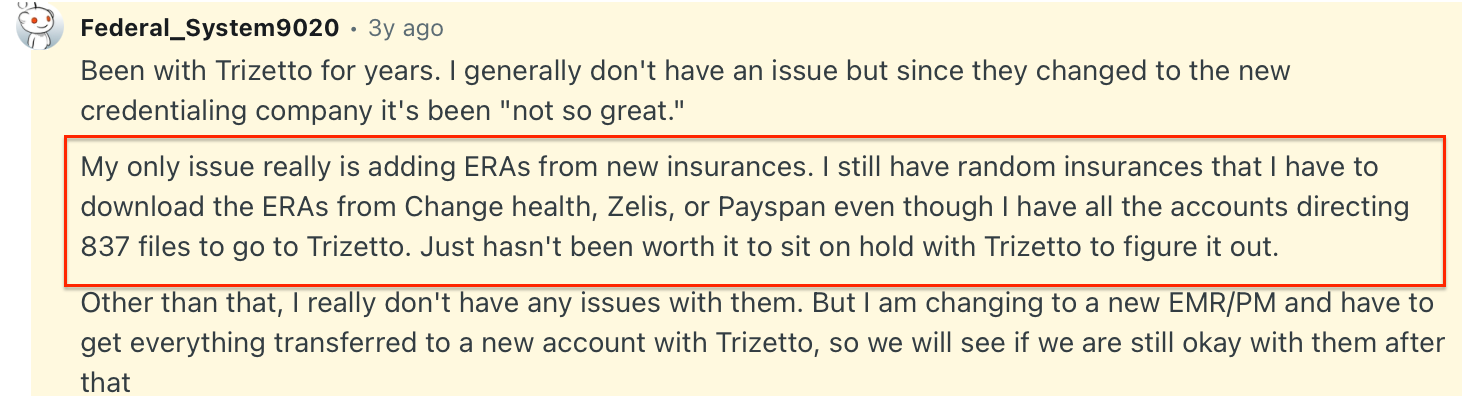
This highlights how some processes may still require additional systems, depending on payer requirements.
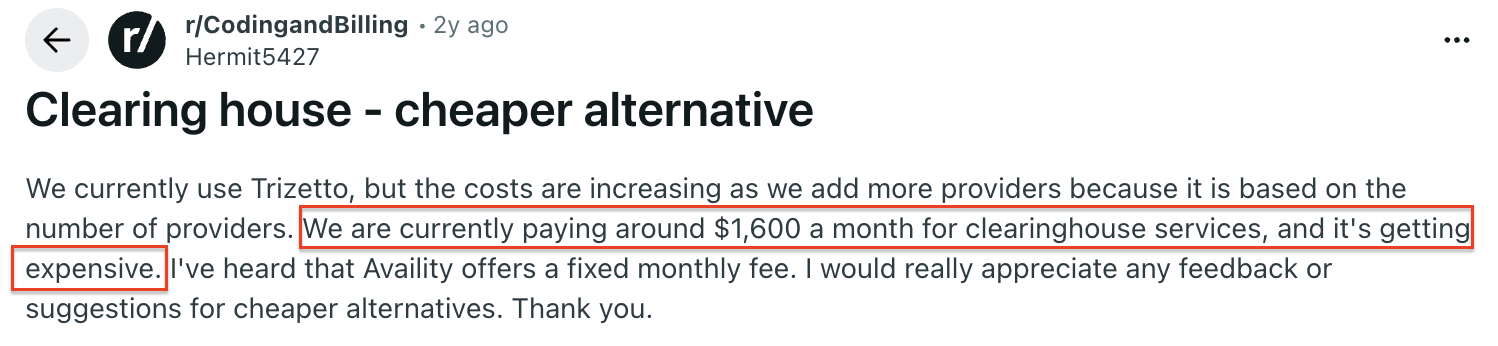
For smaller organizations or those with simpler workflows, TriZetto can feel like more system than necessary. Some users describe it as becoming costly over time, even when they continue using it.
TriZetto is primarily designed around billing and claims processing. For teams that rely heavily on fast admissions and upfront verification, this can create gaps earlier in the workflow.
In practice, this may mean:
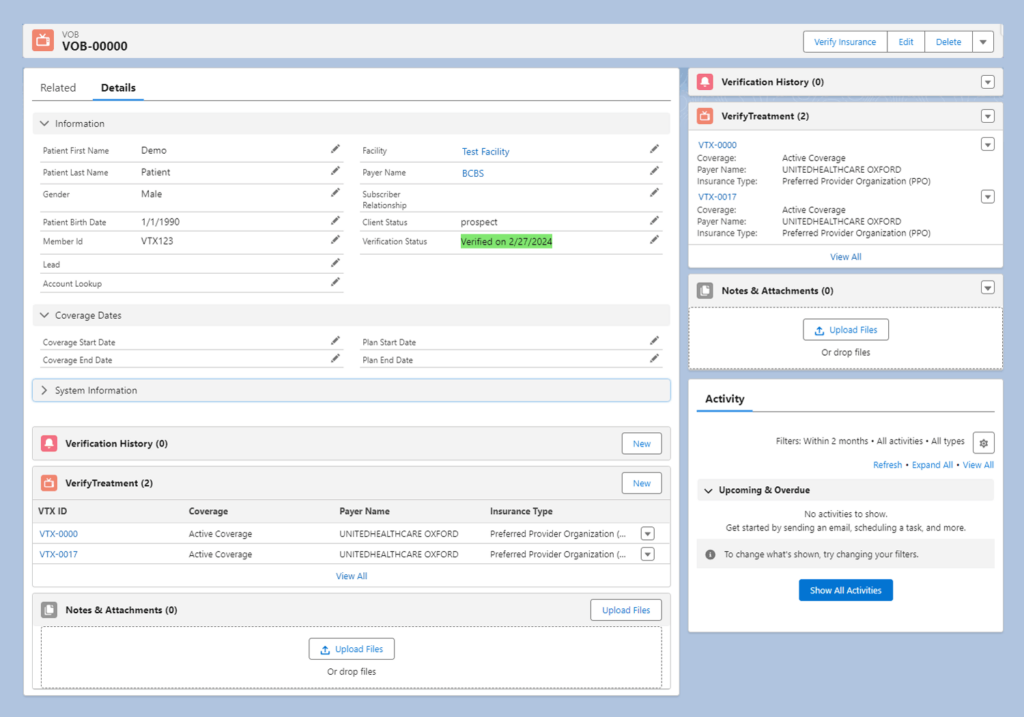
While TriZetto Healthcare Solutions is an enterprise grade solution for claims processing and billing workflows, it is not always the best fit for intake-driven teams that need speed and accuracy before admission. Its focus is largely on what happens after a patient is already in the system, which can leave gaps at the front end.
VerifyTreatment closes that gap by focusing on verification first. It is designed to help admissions and revenue cycle teams confirm coverage, understand benefits, and identify risks before they turn into denied claims.
With it, you can:
This approach matters because missing or incomplete verification has real financial consequences. In many cases, preventable denials can cost between $7,000 and $10,000 per patient when coverage issues are missed.
The choice of platform often comes down to how well it supports your workflow from the very first step.
For many admissions and revenue cycle teams, the shift toward VerifyTreatment comes from the need to handle issues earlier in the process, before they turn into denied claims or lost revenue.
Instead of reacting to issues after submission, VerifyTreatment is built to catch them before admission. This means teams can confirm coverage, understand limitations, and avoid preventable denials before services are delivered.
Manual verification can slow intake and cost you qualified patients. VerifyTreatment allows teams to verify eligibility quickly while still accessing detailed benefit information, helping you admit faster without guesswork.
Coverage gaps, missing authorizations, or exhausted benefits are often only discovered too late. By surfacing this information upfront, teams can avoid situations where services are provided but never reimbursed. In many cases, preventable denials tied to missed verification details can cost between $7,000 and $10,000 per patient.
Admissions, billing, and clinical teams often operate with different pieces of information. VerifyTreatment centralizes verification data so everyone works from the same source, reducing miscommunication and costly errors.
As inquiry volume grows, manual processes become a limiting factor. VerifyTreatment allows teams to handle more verifications without increasing staff workload, removing a key bottleneck to growth.
Many admissions teams still rely on phone calls, payer portals, and manual verification steps, which can slow down workflows and introduce errors.
VerifyTreatment reduces this dependency by automating much of the verification process and centralizing the information teams need in one place. This not only improves efficiency but also reduces the risk of mistakes that can lead to delays or lost revenue.
It depends on how your team operates.
For organizations focused on claims processing, large provider networks, and backend revenue cycle management, TriZetto Healthcare Solutions can be a strong fit. It is built to handle scale and complex billing workflows.
But for intake-driven teams, the gaps show up earlier. Pricing can increase as your team grows, transparency is limited, and verification is not the primary focus. As seen earlier, some users report monthly costs reaching around $1,600, with pricing increasing over time.
If your priority is faster admissions, accurate verification, and protecting revenue upfront, VerifyTreatment is built to support that from the start.
Get started with VerifyTreatment here.
VerifyTreatment helps admissions and revenue cycle teams confirm coverage earlier, understand benefits faster, and reduce preventable issues before they reach billing.
See how real-time verification can support faster intake and cleaner revenue cycle workflows.Disclaimer: All trademarks, logos, and brand names are the property of their respective owners. The use of any third-party trademarks, logos, or brand names in this article is for informational and comparative purposes only, and constitutes nominative fair use. This article was published by VerifyTreatment, and while we strive for objective comparisons, VerifyTreatment is included as an option within this list.




Samantha is a dynamic marketing professional dedicated to making a difference in the behavioral health industry through her work at VerifyTreatment. With a strong background in digital marketing and brand advocacy, she helps elevate the platform’s presence by fostering authentic connections with treatment centers and healthcare providers. Her expertise in content creation and community engagement ensures that VerifyTreatment’s value is communicated effectively, helping centers streamline operations and improve patient care. Samantha’s focus on building trust and driving awareness positions VerifyTreatment as a key resource in the healthcare landscape.

Nicole is a versatile healthcare professional with a Bachelor’s degree in Health Administration and a solid background in managing healthcare systems and operations. Her experience spans healthcare management, compliance, and regulations, making her adept at navigating complex healthcare environments. In addition to her administrative expertise, Nicole holds certifications in Functional Nutrition and Personal Training, giving her a well-rounded perspective on health and wellness. She is committed to using her skills to improve healthcare settings and ensure effective, patient-centered care.

Tara is a dedicated leader who leverages her Master's degree in Information Technology (Florida Tech) and deep company knowledge (since 2018) to drive our community awareness. She is the central figure for managing social engagement and ensuring the community is immediately and effectively informed of all new product launches and company updates.

JoAnn has a strong background in the mental health and substance abuse industry, with expertise in billing, coding, facility credentialing, and contracting. She is passionate about team education and public speaking, always striving to make a positive impact. With a solid foundation in accounting, JoAnn also holds an Associate of Arts in Biblical Studies from Liberty University, blending her professional skills with her personal values.

For 11+ years, Melanie has been dedicated to helping clients access quality mental health care, with a special focus on grief, loss, and substance abuse. With expertise in healthcare, community outreach, patient advocacy, and leadership development, Melanie is passionate about making a positive impact in the lives of others.

Jordan is a dedicated advocate for behavioral health and is passionate about improving sales strategies and business processes. With a focus on helping businesses, particularly in healthcare, Jordan believes that streamlining operations is a way to positively impact more people indirectly. A strong leader, both personally and professionally, Jordan is committed to making a difference in the world by doing good business and serving a higher purpose.