

5 Best Tools for Real-Time Insurance Verification (2026 Guide)
Published

Table Of Contents
Quick Summary
Real-time insurance verification stops coverage problems before they become denied claims. But not every tool does the same job. Some focus on real-time eligibility checks. Others handle claim status tracking, and a few add insurance discovery for patients who show up without full coverage info. The 5 best options for behavioral health facilities, based on real-world use cases, are ranked below.
Looking for real-time insurance verification that improves your admissions process?
30,000+ active users trust VerifyTreatment for real-time eligibility verification. We handle the payer carve-outs, managed care distinctions, and Medicaid nuances that general verification tools miss.
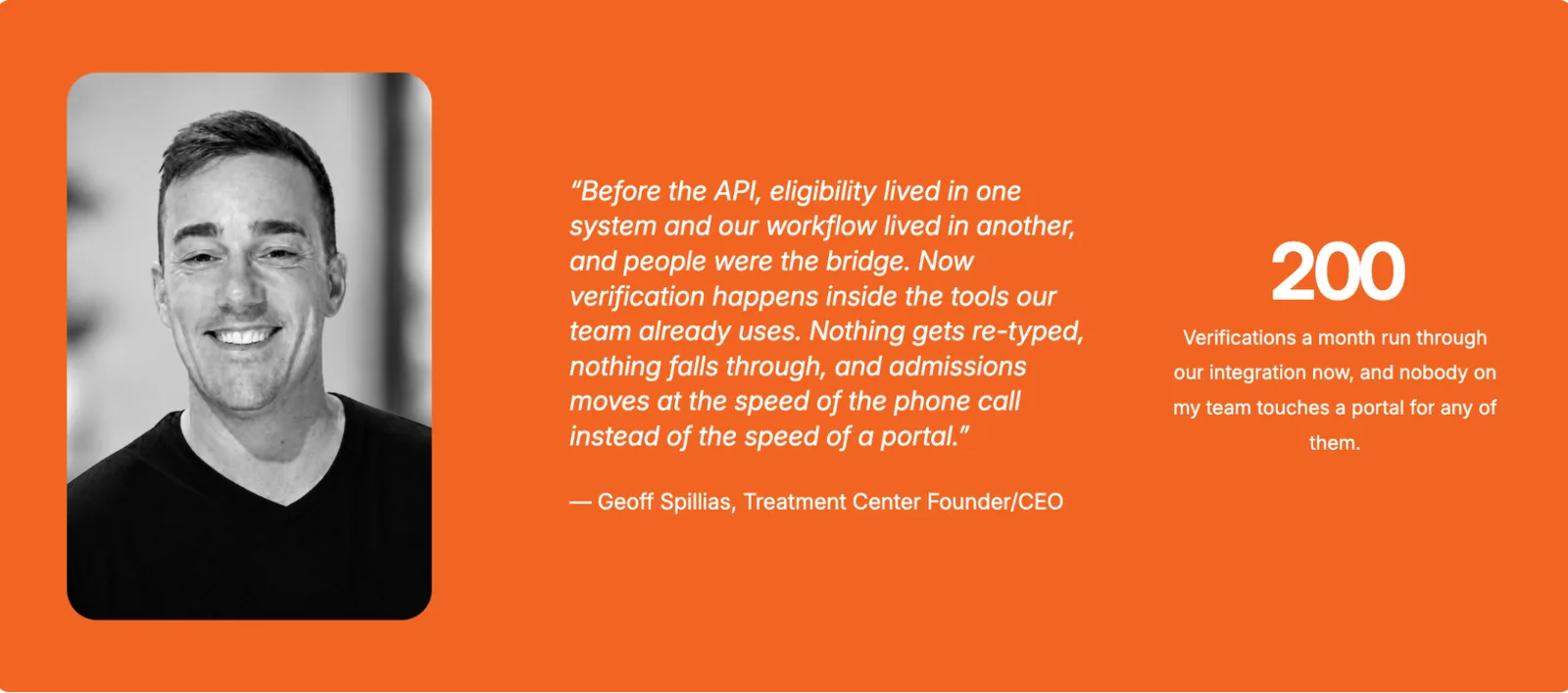
Foundations Recovery Network eliminated admissions delays, reduced staffing needs, and prevented the loss of 1 in 10 patients, saving over $10,000 a month in recovered revenue.
Verification delays turn into denied claims and lost admissions, every day, for facilities like yours. This guide is built to stop that.
5 Best Tools for Real-time Insurance Verification
1. VerifyTreatment
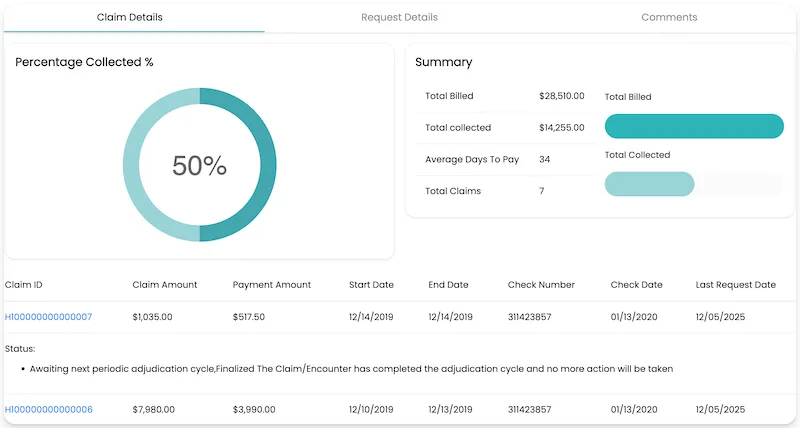
Most denials start at eligibility checks and admissions, when a wrong ID or unclear coverage slips through. VerifyTreatment is an insurance eligibility and benefits verification platform for behavioral health and addiction treatment. We offer coverage across 1,800+ payers and return coverage details in seconds. Insurance discovery finds policies even without a patient's insurance card. That's a common gap in after-hours admissions.
Eligibility issues drive most of the denials our customers see, so we built automated lapse detection to flag inactive policies before billing. Admissions teams get this data inside Salesforce, with batch verification for re-verifying existing patients at scale.
Pros
- Payer logic for behavioral health carve-outs, managed care, and Medicaid
- Finds policies even with incomplete patient data
- Flags inactive policies before they cause denials
- Built-in Salesforce integration
Cons
- Specialized payer logic, less useful for general medical practices
- Entry plan capped at 120 verifications/month
Pricing
Custom pricing based on organization size and workflow needs
Best for:
Behavioral health and addiction treatment facilities needing deep payer logic and insurance discovery.
2. pVerify
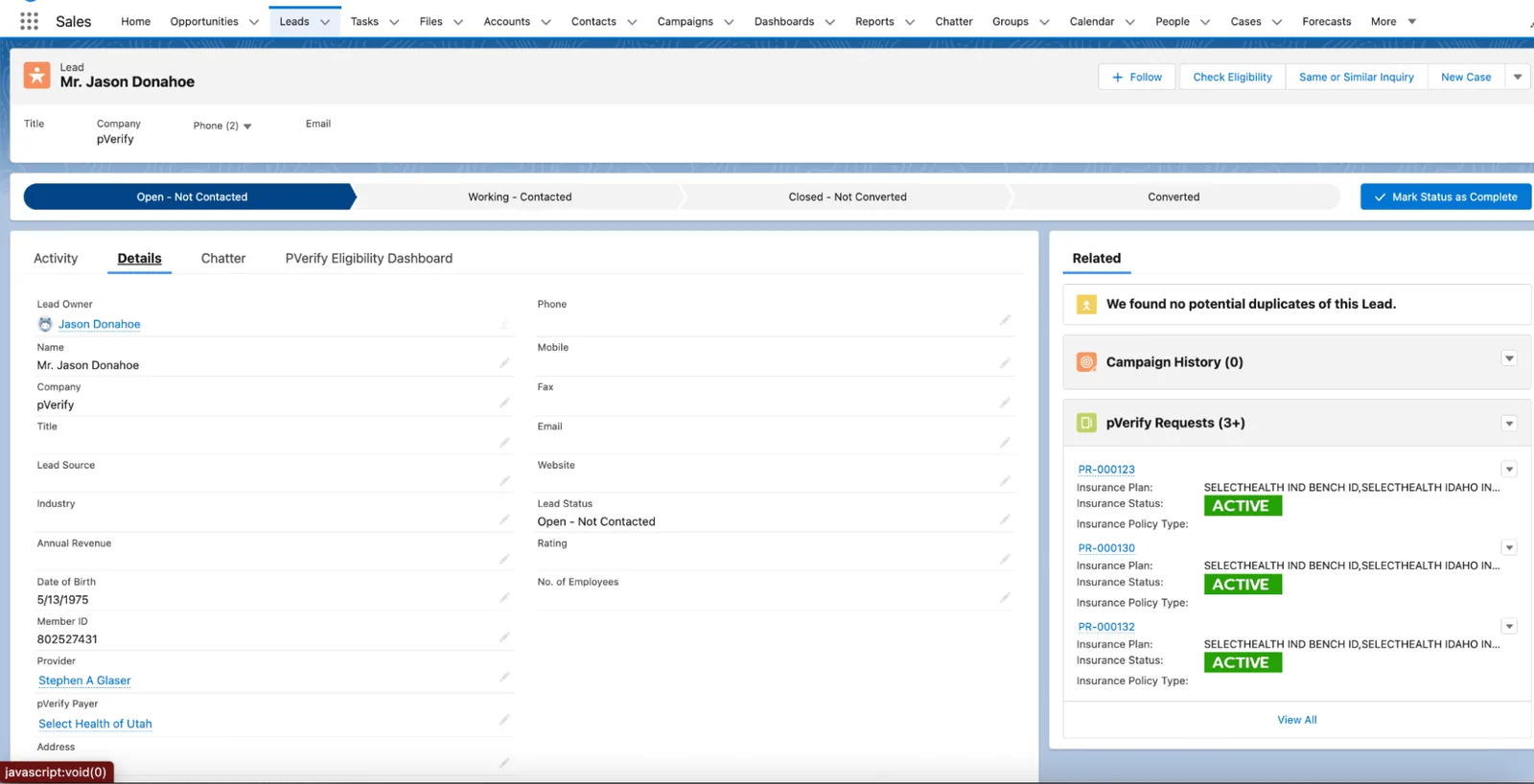
pVerify handles eligibility verification across healthcare broadly, connecting to more than 1,500 payers. It supports single and batch verification and returns structured benefit breakdowns for copay, coinsurance, and deductible information. It's an API-first platform, so it's a strong fit for teams building custom workflows around verification data.
Pros
- Efficient batch verification for high-volume checks
- API access for EHR and practice management integrations
- Broad payer network across medical, dental, and vision
Cons
- Not built for behavioral health, may miss carve-outs and managed care distinctions
- Limited insurance discovery versus behavioral-health-focused tools
Pricing:
Custom quotes based on modules, volume, and integration needs
Best for:
General healthcare practices needing broad-coverage verification and API flexibility.
3. Availity
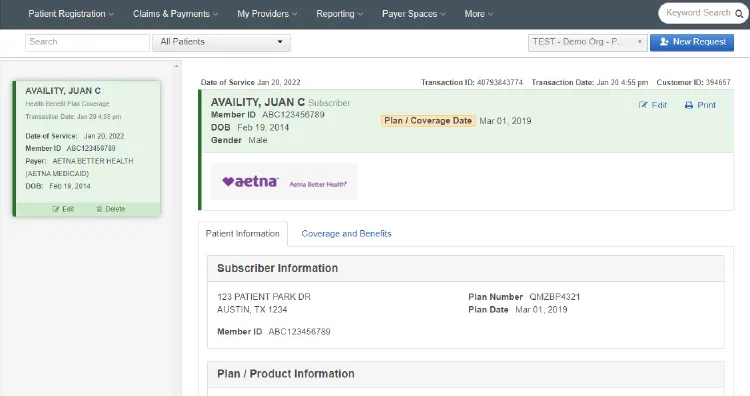
Availity offers a free eligibility verification tier called Essentials for providers working with sponsored payers. Beyond eligibility, it includes claims management, prior authorization workflows, and remittance tracking. That's the main reason high-volume organizations look at it, though coverage is limited to payers that sponsor Availity access.
Pros
- Free eligibility checks through sponsored payers
- Large network with direct major insurer connections
- Claims status and prior auth tools included
Cons
- Free tier limited to sponsored payers only
- Not purpose-built for behavioral health workflows
Pricing
Essentials (sponsored payers): Free. Paid tiers: Not publicly disclosed.
Best for:
Large provider organizations already on Availity's sponsored network.
4. Waystar
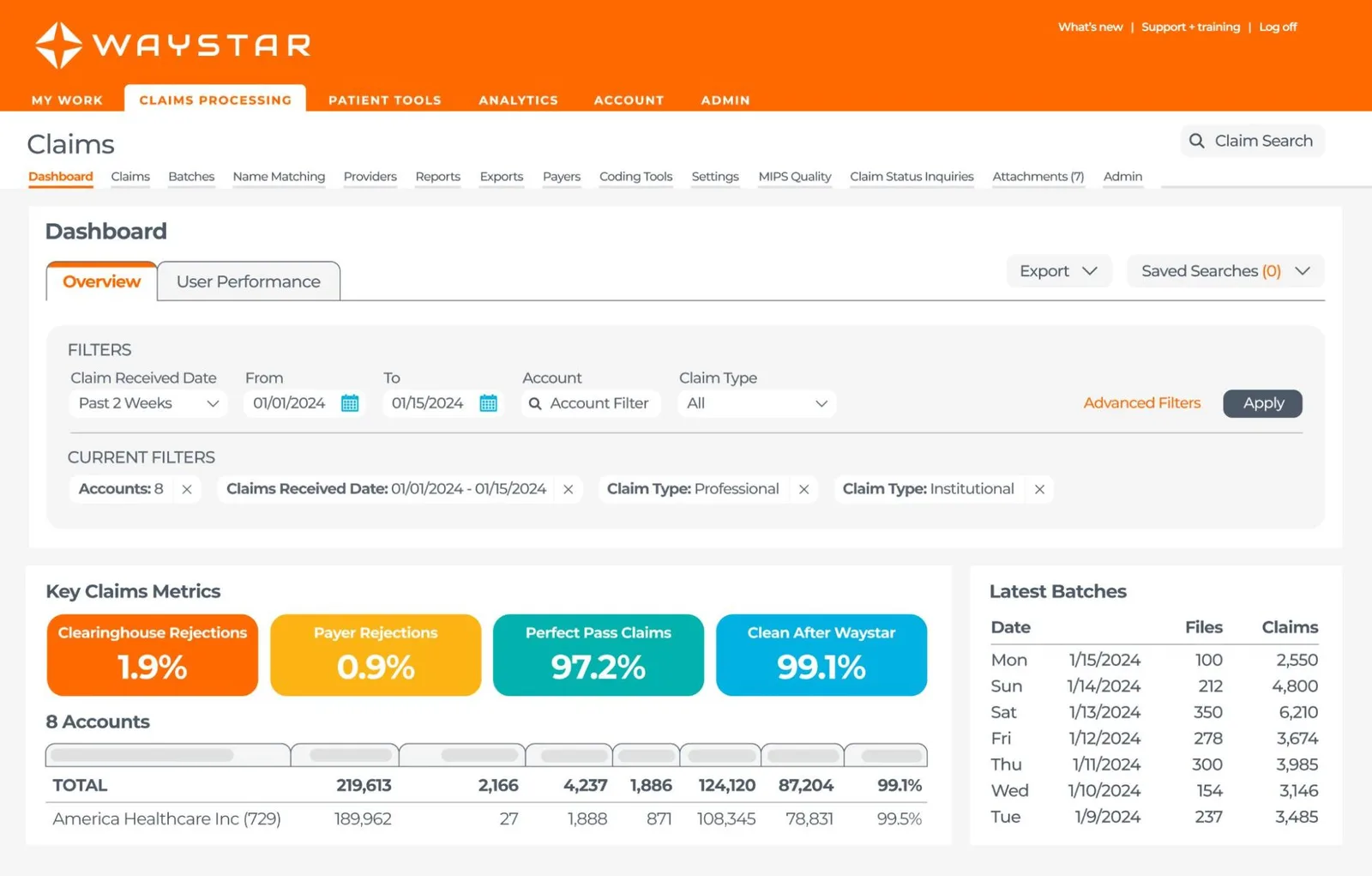
Waystar bundles eligibility verification into a full enterprise RCM platform. It connects to more than 5,000 payers and uses AI-driven analytics to predict and prevent denials. Eligibility here is one piece of a broader revenue cycle, alongside claims management, payment posting, and denial workflows.
Pros
- Full RCM suite: eligibility, claims, denials, payment posting
- AI-driven denial prevention catches rejection patterns early
- Strong enterprise support and implementation resources
Cons
- Pricing undisclosed, contracts run at enterprise scale
- Overkill for single-location facilities needing only verification
Pricing
Four tiers (Starter, Core, Performance, Premium), each quoted per organization.
Best for:
Large health systems and multi-location networks needing full RCM.
5. Kipu Health
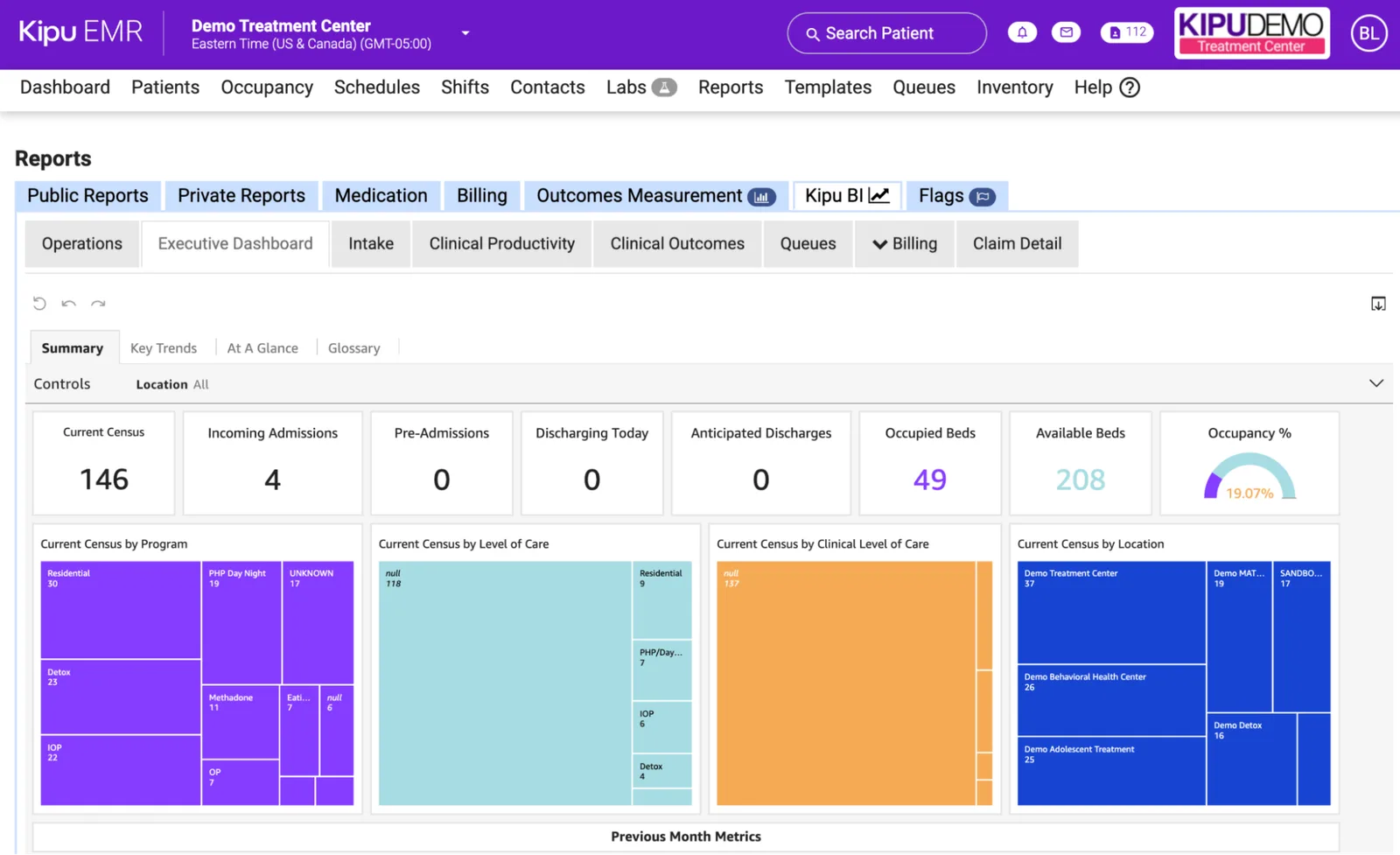
Kipu Health is an EMR platform built for behavioral health and addiction treatment. It includes insurance verification as part of its clinical and billing workflow. Eligibility checks happen inside the same system you're already using for charting and billing. If you're already on Kipu, you won't need a separate vendor or login.
Pros
- Verification, charting, and billing in one system
- Built specifically for behavioral health workflows
- No separate verification tool to manage
Cons
- Verification isn't sold standalone, it's bundled with the full EMR
- Costs scale with org size, can run into four figures monthly
Pricing
Quoted per facility.
Best for:
Behavioral health facilities that want verification built into their EMR.
How to Choose the Right Real-time Insurance Verification Software
The right tool fixes where your revenue actually starts slipping, not just the eligibility check itself.
Start with your facility's size and verification volume. If you're a single behavioral health location verifying fewer than 300 patients per month, you'll fit well on a purpose-built tool like VerifyTreatment. You'll get behavioral-health-specific payer logic and insurance discovery at that tier. If your facility spans multiple specialties and processes thousands of checks, a broader platform like pVerify or Availity covers more ground.
Budget matters too. Availity's free tier works if your payers are in its sponsored network. You'll need a paid solution for the other tools. And if you're already running Kipu as your EMR, check whether its built-in verification covers what you need.
The last consideration is payer depth. A tool that reports active or inactive status saves time, but one that returns carve-out details, managed care distinctions, and benefit limits saves revenue. That's exactly the depth VerifyTreatment is built to deliver. Get started with VerifyTreatment and see the difference on your next VOB.
FAQs
What's the difference between real-time and batch insurance verification?
Real-time verification checks a patient's coverage instantly, when they call or show up for intake. Batch runs a group of checks at once, on a set schedule. Real-time works best for admissions decisions you need to make on the spot. Batch is useful for re-verifying existing patients in bulk.
Can real-time verification reduce claim denials?
Yes. Eligibility and registration errors account for a large share of all claim denials. The standard fix is verifying coverage 48 to 72 hours before service. For behavioral health, where denial rates run between 12% and 18%, closing that gap directly protects revenue. It also cuts the time your team spends on appeals.
Do I need a separate verification tool if my EMR already handles it?
That depends on how deep your EMR's verification goes. Some EMRs only check whether a policy's active or inactive, and that isn't enough for behavioral health billing. Standalone verification tools provide carve-out details, deductible breakdowns, and managed care distinctions that EMR checks miss. If your EMR only covers active or inactive status, a dedicated tool adds the detail you'll need.
What should I look for in a verification tool for behavioral health?
You'll want a tool that connects to a wide range of payers and handles behavioral health specifics like carve-outs and managed care distinctions. Insurance discovery and lapse detection are especially valuable for treatment facilities. Match the plan's verification limit to your monthly volume so you don't pay for capacity you won't use.
How many payers should a verification tool connect to?
More connections mean fewer gaps, but the raw number isn't the whole story. What matters is whether it'll cover the specific payers your patients carry. That includes nuances like Medicaid managed care plans and BCBS alpha prefix variations.

Luis Perdomo, Head of Growth, leads go-to-market strategy, demand generation, and growth initiatives at VerifyTreatment. With a background spanning digital marketing, revenue growth, and business strategy, he focuses on connecting the platform’s capabilities to the real operational challenges facing behavioral health providers, helping teams improve admissions, strengthen revenue performance, and make faster, more informed decisions.
Meet the TeamRelated post:
 Revenue Cycle
5 Best Veritable Alternatives for Insurance Verification in 2026
If Veritable looks good on paper but you’re still unsure it fits your specialty, provides the benefit detail your team...
Read the full article → Admissions
pVerify Pricing: Plans, Costs, What You Get & a Better Alternative
pVerify’s modular pricing starts around $125/month for basic eligibility checks, but how fast do those costs add up as y...
Read the full article → Admissions
How to Verify Insurance Eligibility in Real Time and Why It Matters
Real-time insurance eligibility verification helps healthcare providers confirm coverage and benefits faster, reduce man...
Read the full article →