

11 Best Waystar Alternatives for Behavioral Health Providers in 2026
Published Updated

Table Of Contents
- Quick Summary
- Which Waystar Alternative is the Best Fit for Mental Health Treatment Centers and Behavioral Providers?
- Why Listen to Us?
- What is Waystar?
- Why Look for a Waystar Alternative?
- Top 11 Waystar Alternatives
- VerifyTreatment: The Smarter Way Forward for Behavioral Health Providers
- FAQs
- Waystar is for hospitals. VerifyTX is for Behavioral Health.
Quick Summary
VerifyTreatment is the strongest Waystar alternative for behavioral health providers. It’s purpose-built for intake-first verification, deep payer logic, and admissions-to-billing clarity. For an all-in-one EHR and billing system, Kipu Health and Qualifacts are worth considering.
Which Waystar Alternative is the Best Fit for Mental Health Treatment Centers and Behavioral Providers?
Waystar is a powerful enterprise RCM platform built for high-volume billing and large provider networks. It makes sense if you’re running a hospital chain.
But behavioral health (BH) providers and SUD treatment programs operate differently. Admissions decisions depend on real-time eligibility, payer carve-outs, and managed care nuances most enterprise tools weren’t designed for. A missed detail on a Medicaid or Medicare Advantage plan can mean a lost admission, or a denied claim weeks later.
This article covers 11 solid alternatives, but first, here are our top three picks:
| Pick | Best For |
|---|---|
| VerifyTreatment | Treatment centers, SUD programs, multi-state BH networks needing deep payer logic and intake-first verification |
| Kipu Health | BH treatment centers wanting an all-in-one clinical and billing system on a single EMR platform |
| Qualifacts | Large behavioral health agencies needing a full EHR and RCM system |
Why Listen to Us?
VerifyTreatment is a real-time insurance eligibility and RCM automation platform built specifically for behavioral health providers — by people who understand admissions and billing in treatment settings.
VerifyTX is the best! Makes life so much easier in the behavioral health space. Much more efficient than any other platform I’ve used in 10 years. Big shout out to Melanie Hernandez that manages our account! She is always there to help support promptly if I ever have any questions.
 Chris BurtonChief Business Officer
We regularly speak with treatment centers evaluating or replacing platforms like Waystar, which means we know exactly where enterprise tools create gaps in behavioral health admissions and billing.
What is Waystar?

Waystar is a cloud-based RCM platform combining clearinghouse services, claims management, eligibility verification, payment processing, and AI-driven analytics.
Its strength is breadth — Waystar handles enterprise-level revenue cycle operations across diverse provider types at scale.
Why Look for a Waystar Alternative?
1. Behavioral Health Is Operationally Different
In hospitals, revenue cycle workflows are largely claims-driven and happen after the encounter. Whereas, in behavioral health and SUD treatment programs, financial payer carve-outs directly determine whether a patient can be admitted.
That makes eligibility depth far more critical in behavioral health than in many other provider settings.
2. Admission Teams Need First-Call VOBs
Admissions coordinators are often verifying insurance live on intake calls — sometimes after hours — while a patient or family waits for clarity. If eligibility requires multiple portal checks or follow-up calls, it creates coverage surprises that delay admissions or kill them entirely.
3. Eligibility Isn’t Just “Active or Inactive”
Many enterprise tools stop at confirming whether a policy is active. BH providers need to go deeper as admissions typically depend on understanding:
- Carve-outs for behavioral or substance use services
- Medicaid vs. Medicare Advantage distinctions
- Managed care structures
- In-network vs. out-of-network nuances
- BCBS alpha prefix variations
An active policy doesn’t guarantee reimbursable treatment. Deeper payer logic helps you avoid patient admissions under plans that won’t reimburse at the expected level, and finding that afterward is expensive.
4. Insurance Discovery Reduces Intake Friction
Admissions teams don’t always receive complete policy information on the first call. When coverage can’t be located quickly, staff resort to manual follow-ups and callbacks, or chase insurance cards after a patient is already admitted. The ability to locate coverage from partial patient data isn’t a nice-to-have — it’s a daily operational need.
5. Eligibility Errors Turn Into Denials Weeks Later
In behavioral health, reimbursement is highly sensitive to plan details, authorization requirements, and policy lapses. When eligibility depth is insufficient at intake, the impact surfaces later as denied claims, underpayments, or retroactive coverage issues.
For many providers switching tools, reducing eligibility-driven revenue leakage before admission is the primary goal.
Top 11 Waystar Alternatives
Before going into a more detailed breakdown, here’s a snapshot to help you find the tool that fits how your team actually works.
| Platform | Category/ Strength | Key Features | Pricing | Best For |
|---|---|---|---|---|
| VerifyTreatment | Behavioral Health Eligibility and RCM | Real-time VOB, deep payer logic for behavioral health, insurance discovery with partial data, lapse detection, claim status, ERA (coming soon), batch verification, Salesforce integration, API access and workflow embedding | Flexible and scalable with no user caps + risk-free, month-to-month plans (entry-level tiers starting under $299 per month). | Behavioral health treatment centers needing deep payer logic, intake-first verification, and admissions-to-billing workflow clarity |
| Waystar | Enterprise RCM and Clearinghouse | Claims management, eligibility automation, intelligent edits, payer connectivity | Enterprise quote-based | Large health systems and hospital networks managing broad RCM operations |
| pVerify | Modular Eligibility Platform | Real-time eligibility, batch/API verification, insurance discovery, MBI lookup, claim status | Usage-based modular tiers | Multi-state or multi-specialty providers needing flexible, API-driven verification |
| Availity | Clearinghouse and Eligibility | All-payer clearinghouse, eligibility verification, claim submission, prior authorization | Free base tier; Pro pricing on request | Cost-sensitive practices needing broad payer access and basic eligibility functionality |
| Thoughtful AI | AI RCM Automation | Claims submission automation, prior auth management, payment posting, denial management | Quote-based | Billing teams looking to automate repetitive back-end RCM workflows |
| TriZetto | Clearinghouse and Claim | EDI connectivity, eligibility verification, ERA processing, claim status, denial management | Quote-based | Practices prioritizing clearinghouse infrastructure and claims submission workflows |
| Kipu Health | Behavioral Health EMR + Verification | EMR, clinical documentation, built-in eligibility verification, billing, claims management | Quote-based | BH treatment centers wanting an all-in-one clinical and billing system on a single EMR platform |
| Approved Admissions | Verification for Adjacent Markets | Eligibility verification, admissions workflow support, coverage discovery, claim status | Quote-based | DME suppliers, skilled nursing facilities, and billing companies needing admissions-focused verification |
| InstantVOB | Lightweight VOB Tool | Real-time eligibility, VOB reporting, multi-payer connectivity | Per-VOB and subscription tiers | Smaller practices needing simple, low-cost eligibility checks without full RCM complexity |
| athenaOne | Cloud EHR and RCM | EHR, eligibility verification, medical billing, claims management, patient engagement | Percentage of collections | Physician practices and medical groups consolidating clinical and billing operations |
| Qualifacts | Behavioral Health EHR and RCM | BH-specific EHR, integrated billing, eligibility verification, claims management, compliance reporting | Custom quote | Large behavioral health agencies and community mental health centers needing a full EHR and RCM system |
| Change Healthcare (Optum) | Enterprise Clearinghouse and RCM | Eligibility verification, claims submission, coverage discovery, payment processing, prior authorization | Enterprise quote-based | Large health systems and enterprise provider networks with high-volume RCM needs |
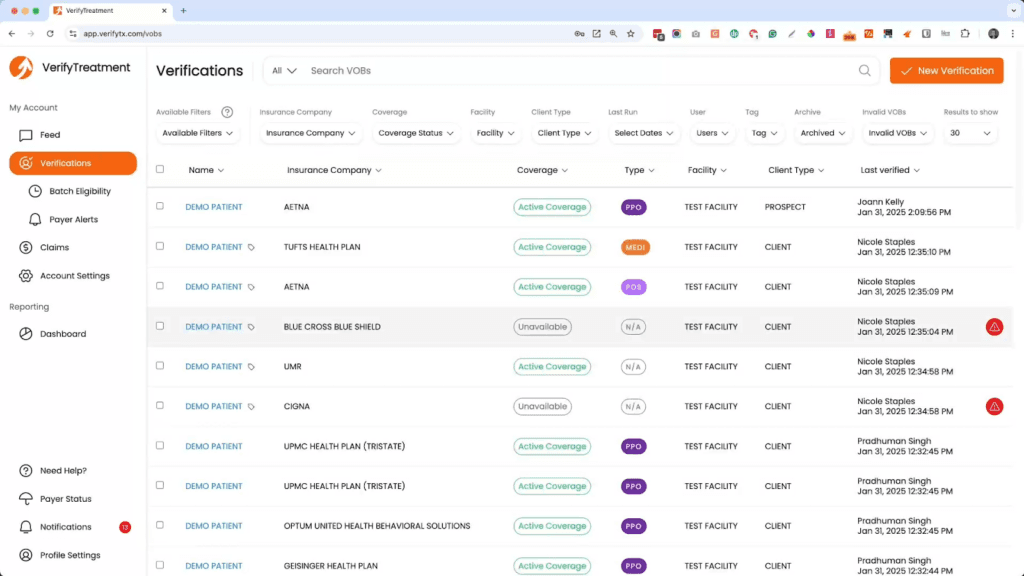
1. VerifyTreatment
VerifyTreatment is a real-time insurance eligibility and revenue cycle automation platform purpose-built for mental health facilities, substance use disorder (SUD) treatment centers, and BH providers.
Unlike enterprise RCM platforms designed for hospital-scale billing operations, VerifyTreatment centers its architecture around admissions workflows, payer nuance, and preventing eligibility-driven revenue loss before a patient is admitted.
It’s the strongest fit for BH providers that need real-time, admissions-focused eligibility verification with deep payer logic and insurance discovery, especially for facilities verifying Medicaid, Medicare Advantage, and managed care plans at intake.
Key Features
- Real-time eligibility and coverage checks: Verify benefits instantly across commercial and government payers, surfacing the coverage details needed during intake
- Deep payer logic for behavioral health: Go beyond active/inactive status to identify carve-outs, managed care structures, Medicaid vs. Medicare Advantage nuances, in-network distinctions, and plan-specific limitations
- Insurance discovery: Locate active coverage even with incomplete patient information, reducing intake delays and manual follow-up
- Payer risk alerts: Automatically flag inactive policies, coverage risks, and potential payer issues before admission to prevent downstream denials
- Batch verification and re-verification: Run scheduled or bulk eligibility checks to catch coverage changes without manual portal work
- Claim status and ERA visibility (ERA coming soon): Monitor claim progress and remittance data to provide clearer insight into payer behavior
- Native salesforce and CRM integration: Sync verification data directly into admissions CRM workflows rather than relying on retrofitted billing integrations
- API access and workflow embedding: Embed eligibility logic into existing systems for multi-location operations
Pricing
VerifyTreatment uses a tiered pricing model based on verification volume, feature activation, and operational scale. No user limits.
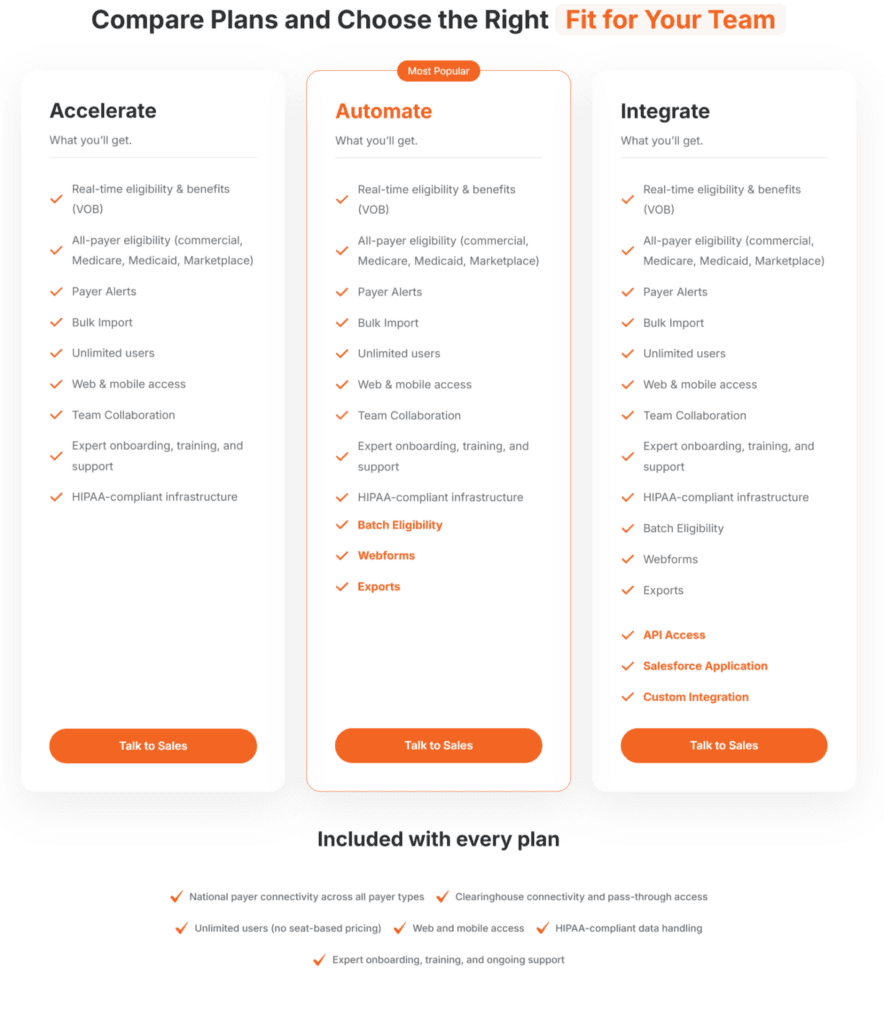
Entry-level plans are often under $500 /month, suited for single-location facilities with moderate verification volume.
Multi-location operators or high-census treatment networks may require expanded automation or API access.
Pros
- Built specifically for behavioral and mental health treatment centers
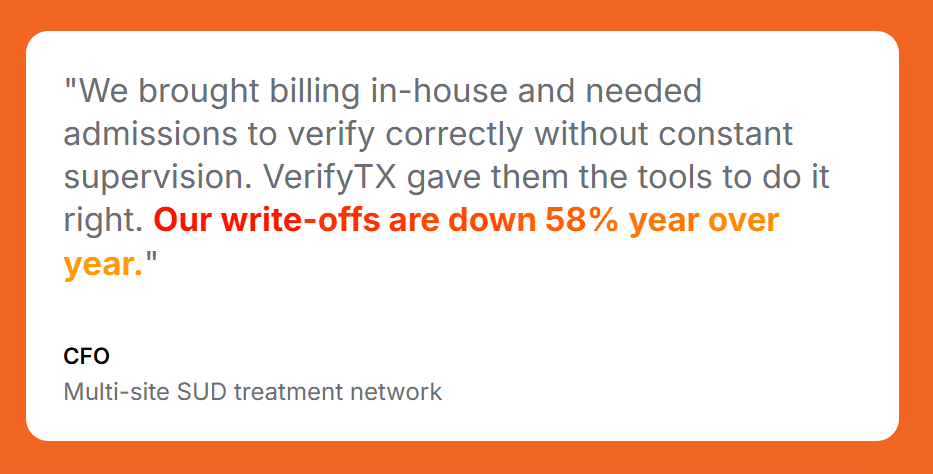
I demoed other platforms, and they were all medical-focused with limited behavioral health benefits. VerifyTreatment was the only one built specifically for inpatient psych and residential behavioral health. That’s what stood out—it was tailored to us.
 JoElle VincentBusiness Office Director
Low Country Behavioral Health (UHS), Charleston, SC
- Designed around admissions-driven workflows rather than post-encounter billing
- Deep payer logic beyond active/inactive status
- Insurance discovery even when data is incomplete
- Modern UI, excellent support, and faster implementation compared to many enterprise RCM platforms
Limitations
- Primarily focused on behavioral health — not designed for large acute care hospital systems
- Advanced automation features may require initial workflow alignment during onboarding
2. pVerify
pVerify is an eligibility and verification platform built for a broad range of healthcare providers, including multi-state clinics.
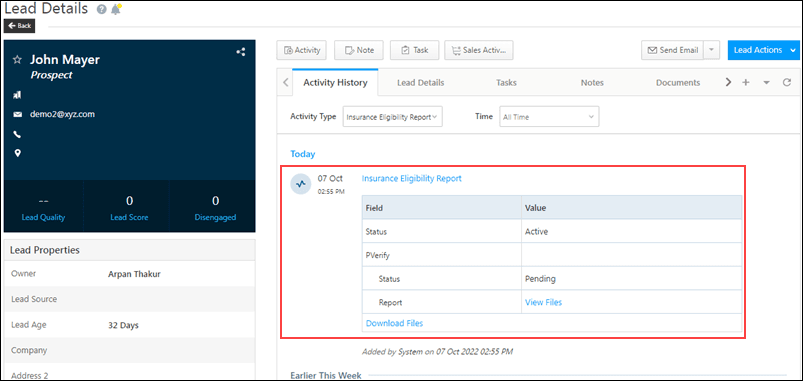
It handles real-time eligibility, batch verification, and claims-related workflows through a flexible API-first architecture, connecting to 1,500+ payers
For BH providers, it can cover some verification needs, but its design reflects a general healthcare audience rather than the specific payer logic and carve-out depth SUD and mental health facilities typically require at intake.
Key Features
- Real-time eligibility verification across medical, dental, and vision
- Batch processing for high-volume verification
- 140+ RESTful APIs for EHR/PM integration
- Patient financial estimator for copays and out-of-pocket costs
- Claim status tracking with HIPAA/SOC2 compliance
Pricing
pVerify uses a tiered subscription pricing model based on usage volume, solution type, and transaction limits.
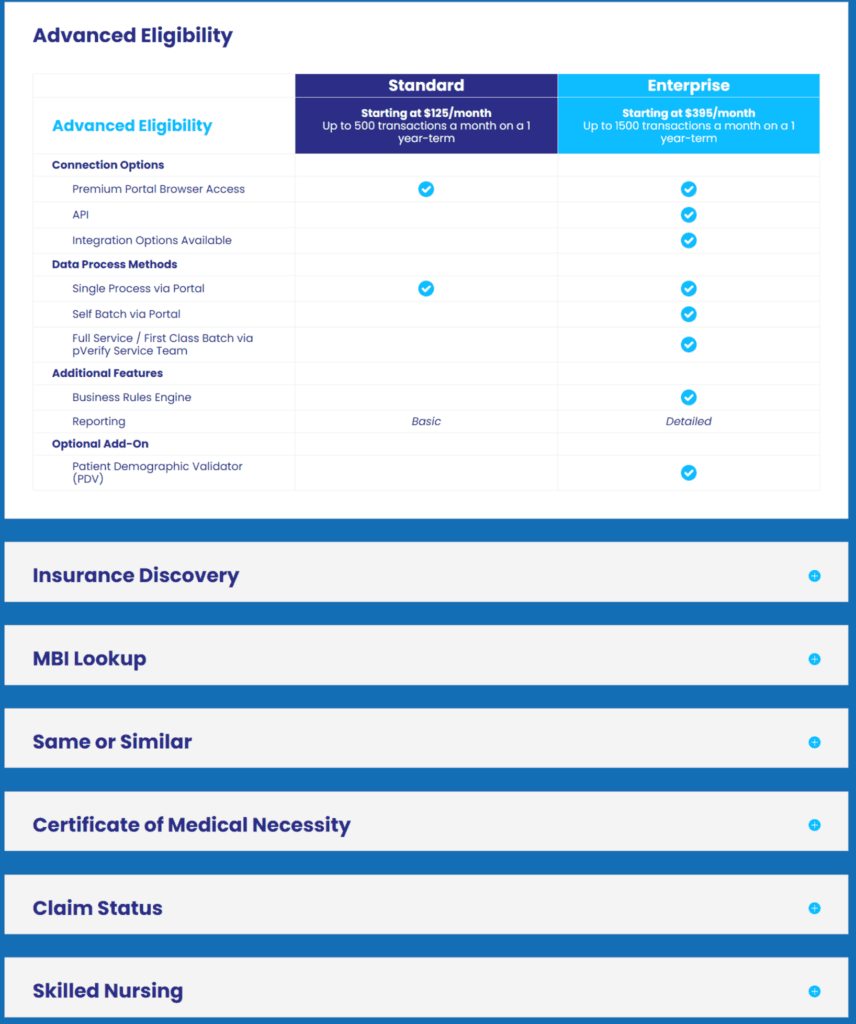
Plans include Standard and Enterprise tiers across modules:
- Eligibility ($125-$395/month)
- Insurance Discovery ($120–$390/month)
- Certificate of Medical Necessity ($100-$215/month)
- Claim Status ($40–$50/month), and add-ons like
- Skilled Nursing ($120–$430/month)
Pros
- Flexible structure works well for multi-state or multi-specialty teams
- Strong API for organizations with technical resources to configure custom workflows
- Broad payer network across commercial and government payers
Limitations
- Less specialized for behavioral health nuances — carve-outs and SUD-specific logic require manual handling
- Salesforce and CRM integration options are less prominently featured, which may matter for high-volume admissions teams
- Pricing can become unpredictable as verification volume scales across multiple modules
3. Availity
Availity connects providers with hundreds of payers through a centralized clearinghouse platform.
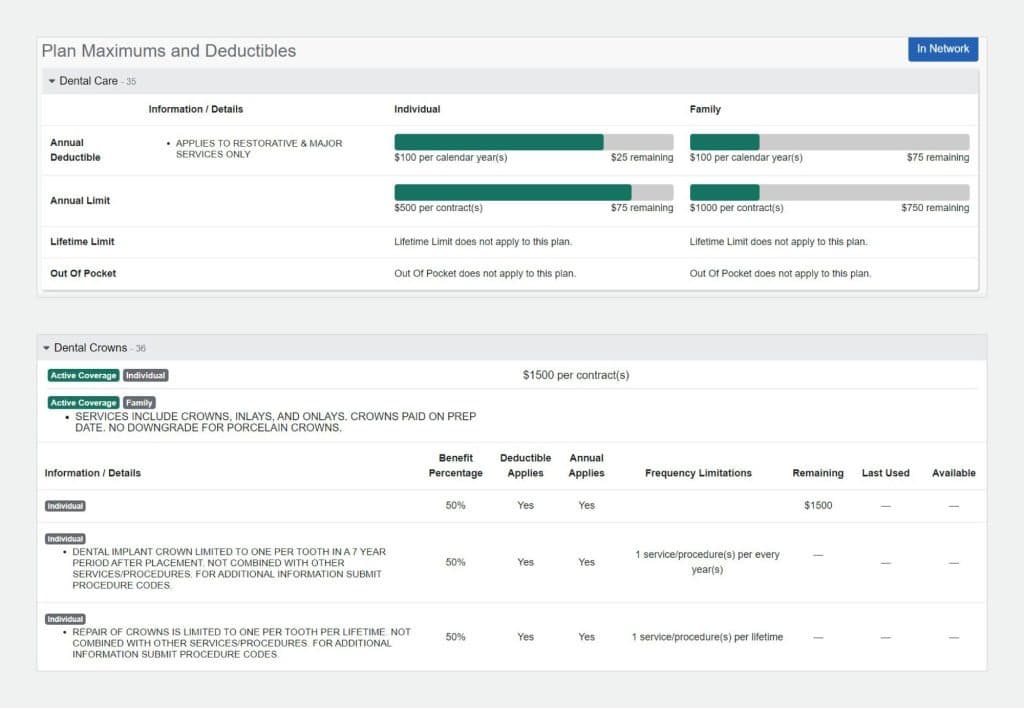
It offers broad payer access and solid infrastructure, but is built for general provider workflows rather than BH-specific intake processes.
Key Features
- Eligibility and benefits verification across 2,700+ payers
- Claims submission, scrubbing, status tracking, and denial management
- ERA posting and payment estimation
- Prior authorization with AI-assisted workflows
- HIPAA-compliant EDI and FHIR API connectivity
Pricing
Tiered structure with a free Essentials plan for basic payer access. Essential Plus at $25/month; Enterprise tiers from $28–$540/month.
Pros
- One of the broadest payer networks available, making it accessible for providers working across multiple payers and states
- Free entry tier lowers the barrier for smaller or cost-sensitive practices
- Strong interoperability via electronic data interchange (EDI) and electronic health record (EHR) integrations
Limitations
- Not designed around BH intake workflows or treatment center admissions processes
- Free tier is limited; scaling up requires additional investment
- Mixed user experience reviews from teams managing high-volume intake
Related: check our list of the best Availity alternatives.
4. Thoughtful AI
Thoughtful AI is a revenue cycle automation platform that deploys AI agents to handle repetitive RCM tasks — working across existing EHRs, practice management systems, and tech stacks.
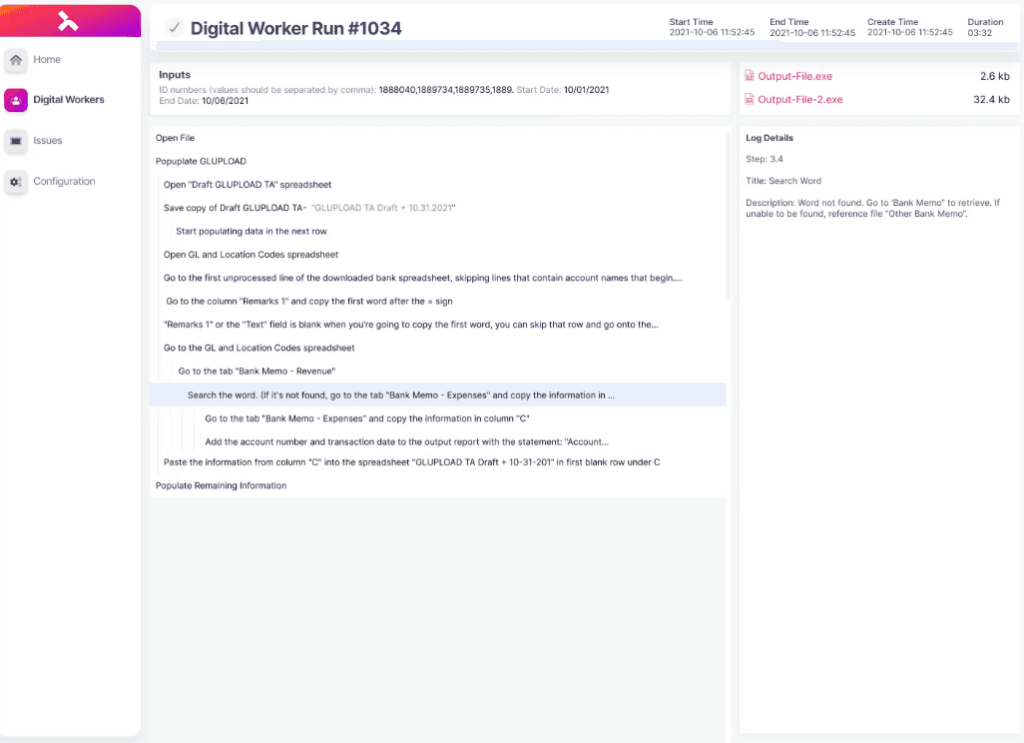
It’s not a standalone eligibility tool. But it excels in broad back-end RCM automation. Best for programs seeking to reduce manual workflows and operating costs without adding headcount.
Key Features
- Customizable AI agents running 24/7 for claims, prior auths, payment posting, and denial management
- Integrates with EHRs and PM systems via APIs
- Full RCM coverage from patient intake validation through remittance, payment posting/reconciliation, and reporting
Pricing
Quote-based. No public pricing is listed.
Pros
- Handles complex back-end tasks like prior auths, claims scrubbing, and payment posting
- Integrates seamlessly with existing EHR and practice management systems (PMS) without workflow disruption
- AI-native architecture for teams looking to automate at scale
Limitations
- Not an eligibility-first platform. Front-end VOB depth is limited
- Best suited as a back-end RCM tool than a standalone for verification-heavy workflows
- Requires significant onboarding investment to configure AI agents around existing workflows, especially for smaller teams
Related: check our review of Thoughtful AI.
5. TriZetto
TriZetto is a clearinghouse and RCM platform with deep EDI connectivity and a broad payer network.
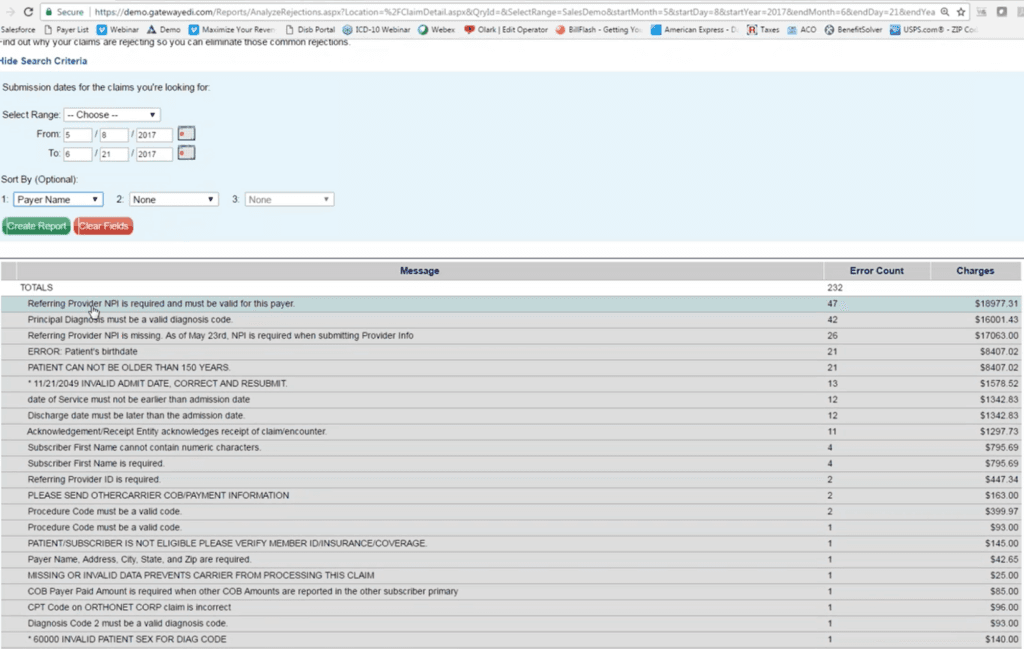
For BH providers, TriZetto’s strength is its clearinghouse infrastructure and claims workflows. This makes it a solid choice for practices that prioritize claims submission and remittance over front-end intake verification.
Key Features
- Legacy EDI support for 837 submissions, scrubbing, and AR management
- Real-time eligibility verification integrated with claims workflows
- Batch processing, accumulator sync, and task routing
- Predictive tools for denials, AI reconciliation, and performance reporting
Pricing
Quote-based. No public pricing is listed.
Pros
- Longstanding clearinghouse presence with broad payer connectivity and an established EDI infrastructure
- Solid option for practices prioritizing claims submission, cleaning, and remittance
- Backed by Cognizant, offering enterprise-level support and organizational stability
Limitations
- Better positioned as a clearinghouse and claims tool than a front-end verification solution for treatment centers
- Enterprise-focused; may be too complex for smaller practices
- Limited public information on pricing makes it harder to evaluate cost fit without going through a sales process
Related: check our review of TriZetto.
6. Kipu Health
Kipu Health is a cloud-based EHR platform for clinical documentation, patient management, scheduling, and operational oversight within a centralized system. In addition to clinical functionality, Kipu includes billing and revenue cycle tools as part of its broader EHR workflow.
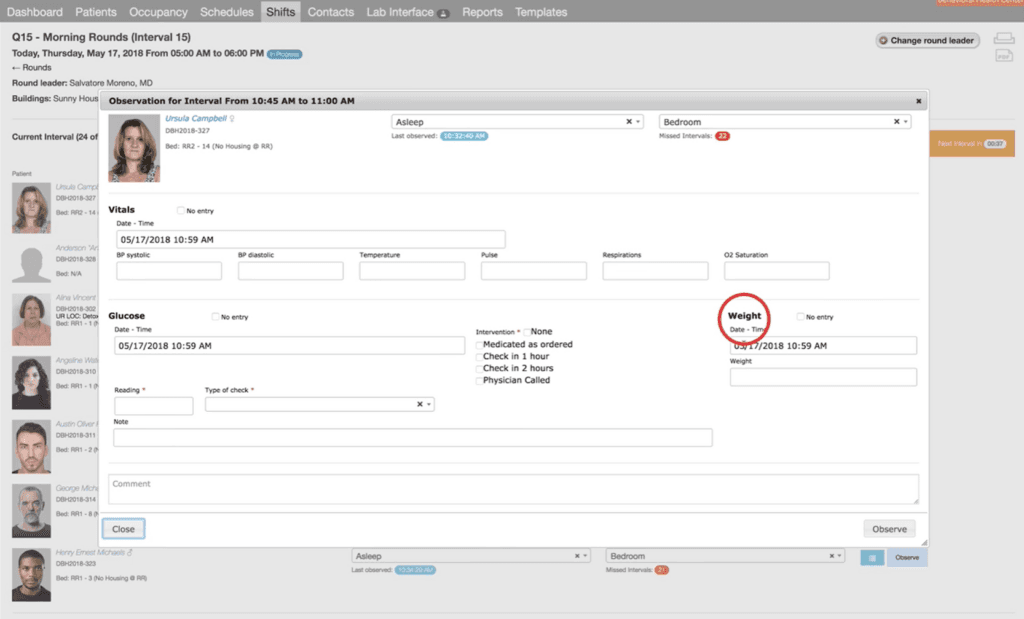
For providers already using Kipu as their clinical system, the built-in verification reduces the need for a separate tool. But it operates as a complement to the EMR, not a dedicated, depth-first eligibility platform.
Key Features
- Clinical documentation, treatment planning, and progress notes
- Patient management, scheduling, bed tracking, and census management
- Integrated billing, claims submission, and denial management
- Embedded eligibility verification within the patient record workflow
- Financial, clinical, and census reporting dashboards
- Clearinghouse integrations with external payer networks
Pricing
Quote-based. No public pricing is listed.
Pros
- Integrated behavioral health EHR and practice management platform
- Centralizes clinical, admissions, and billing workflows
- Reduces need for multiple standalone systems
Limitations
- Longer onboarding timelines compared to standalone verification platforms
- Eligibility verification functions are nested within a broader EHR system
- Creates significant switching cost because of its all-in-one approach
7. Approved Admissions
Approved Admissions provides insurance eligibility verification and prior authorization services for a range of healthcare providers, including equipment suppliers, skilled nursing facilities, and billing companies.
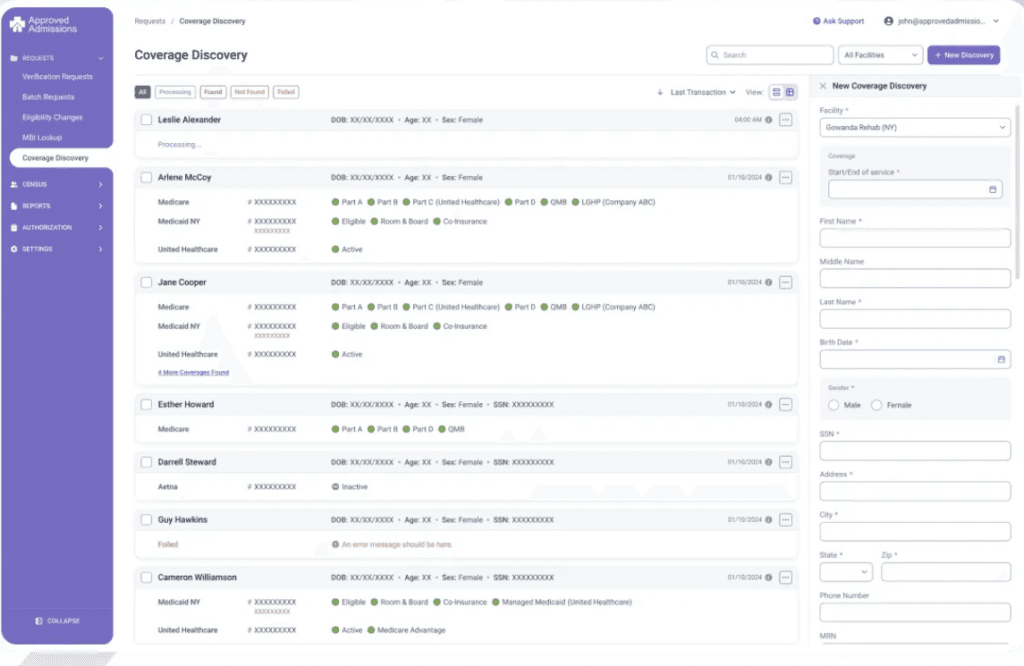
Because it serves varied provider types, its workflows aren’t built specifically around BH admissions.
Key Features
- Eligibility verification across commercial and government payers
- Prior authorization submission and tracking
- Front-end workflow tools to standardize coverage checks
- Activity tracking and reporting across patient volumes
Pricing
Quote-based. No public pricing listed.
Pros
- Focused on eligibility and authorization workflows
- Applicable across multiple healthcare provider types
- Can centralize front-end insurance processes
Limitations
- Not designed around behavioral health intake processes, payer nuances, or SUD-specific coverage scenarios
- Limited public information available on BH-specific payer logic or carve-out handling
- Better suited for adjacent markets than treatment centers with Medicaid-heavy or managed care-heavy census
8. InstantVOB
InstantVOB is a lightweight insurance verification tool for small-to-mid-sized clinics that need quick access to benefits information at the point of intake
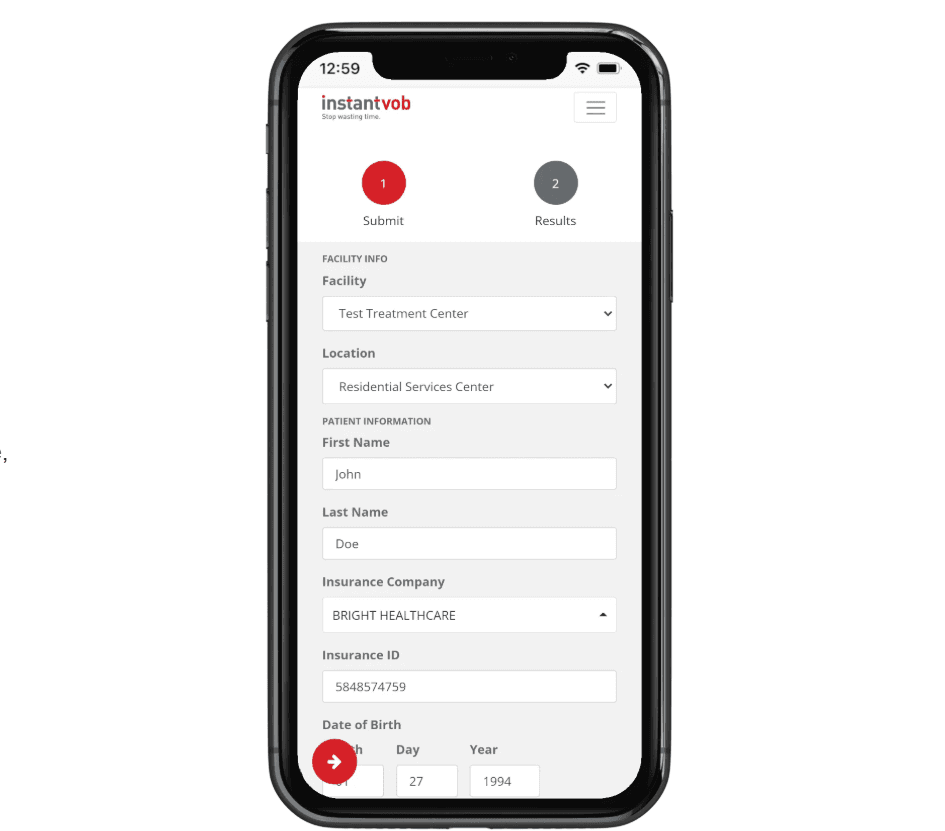
Its capabilities may not extend far enough for BH providers managing growing census, multi-state operations, or Medicaid-heavy payer mixes
Key features
- Eligibility and VOB checks across participating payers
- Intake-focused workflows for admissions staff
- Basic reporting and verification tracking
Pricing
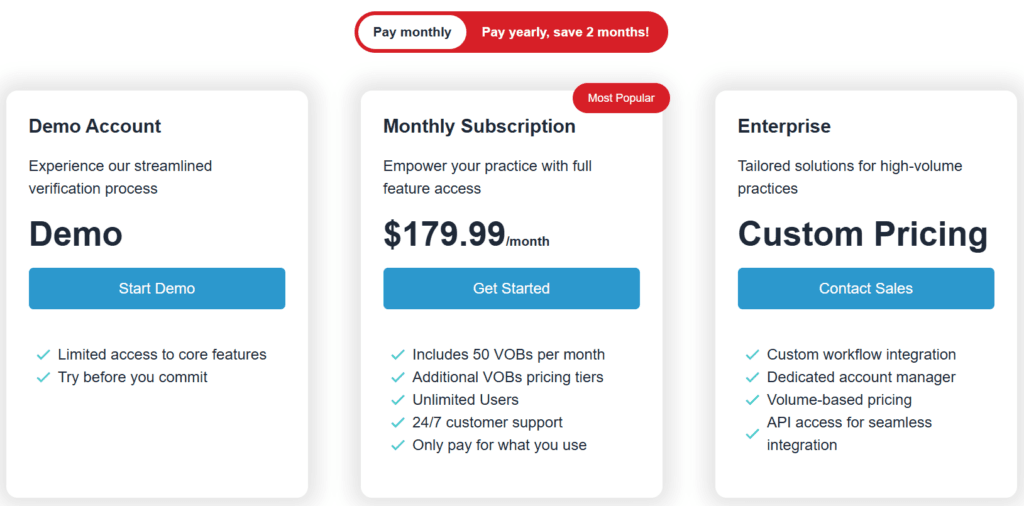
InstantVOB uses a subscription model starting at $149.99/month, which includes up to 50 VOB queries. Plans scale with usage for small-to-mid clinics.
Pros
- Focused specifically on insurance verification workflows
- Simpler deployment compared to full RCM systems
- May be suitable for smaller facilities with straightforward verification needs
Limitations
- Lacks deep behavioral health carve-outs or advanced RCM features
- Narrow feature set limit its usefulness as operations scale or payer complexity increases
- Limited integration options for teams using CRM or EHR systems
9. athenaOne
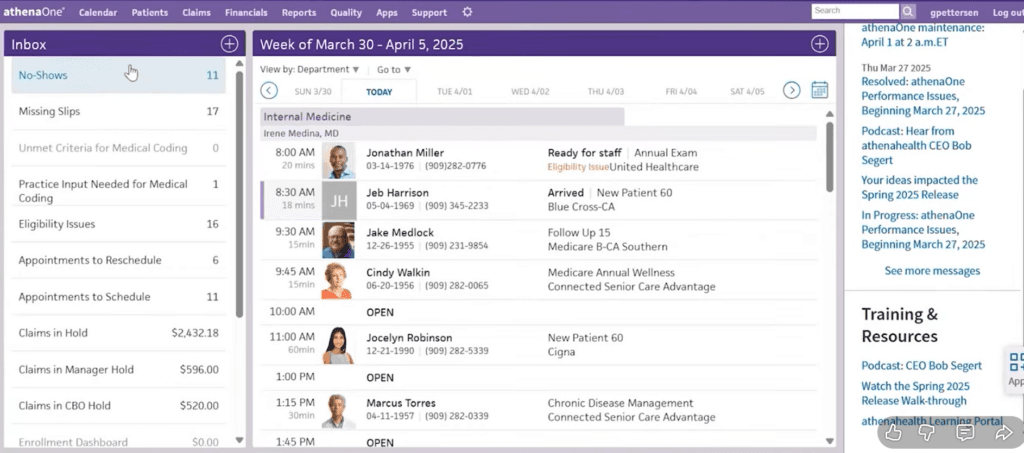
athenaOne combines EHR, practice management, patient engagement, and RCM into a unified system for ambulatory care providers. Its eligibility capabilities are designed for general medical workflows, not BH-specific admissions processes.
Key Features
- Cloud-based EHR with clinical documentation and patient records
- Practice management including scheduling and intake
- Integrated claims submission, denial management, and payment processing
- Eligibility verification within the broader billing workflow
- Patient engagement tools and portals
Pricing
Quote-based, typically structured as a percentage of collections. No fixed public pricing.
Pros
- Comprehensive EHR and revenue cycle platform
- Integrated clinical and billing infrastructure
- Scalable for growing practices
Limitations
- Not designed for behavioral health admissions workflows
- Eligibility verification operates within a general medical billing framework
- Pricing model tied to collections may not suit all behavioral health operators, particularly those with high Medicaid volume
10. Qualifacts
Qualifacts is an EHR platform that provides clinical documentation, care coordination, and practice management tools for healthcare organizations.
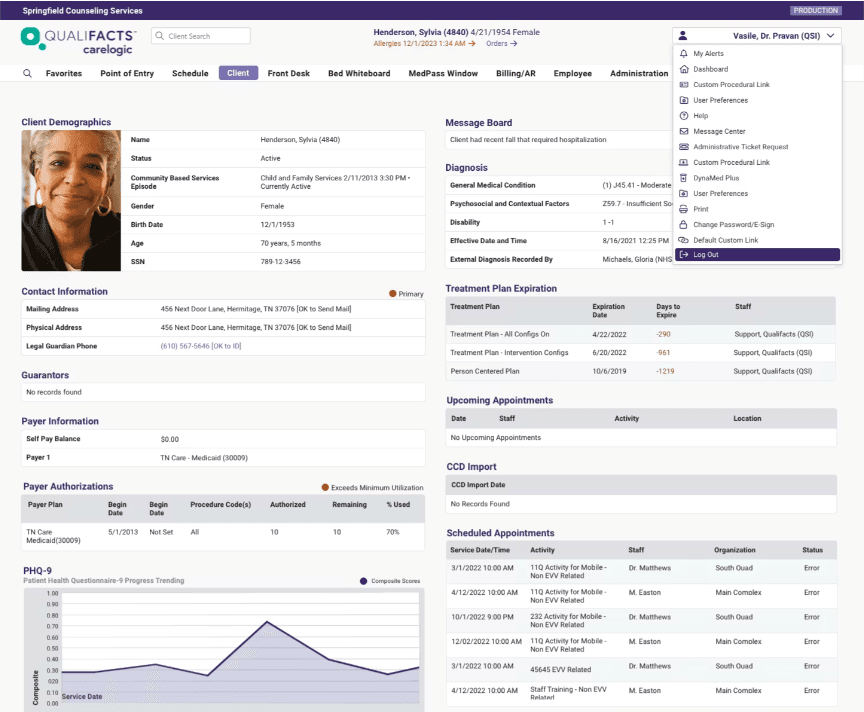
Qualifacts offers a portfolio of distinct electronic health record (EHR) products. Following a series of mergers and acquisitions, the company now maintains three primary, independent platforms tailored to different segments of the market: CareLogic, Credible, and Qualifacts InSync.
While the company has a strong presence in the behavioral health and human services space, its core focus remains EHR infrastructure. Eligibility verification and billing tools function as components of the EHR and revenue cycle modules.
Key Features
- Clinical documentation, treatment planning, and patient charting
- Care coordination and regulatory compliance tools
- Claims submission, reimbursement tracking, and financial reporting
- Integrated eligibility checks within billing workflows
- Clinical and financial performance dashboards
Pricing
Custom quote-based. No public pricing is listed.
Pros
- Established EHR platform with experience serving behavioral health organizations
- Comprehensive clinical and operational infrastructure
- Integrated billing and reporting tools
Limitations
- May not provide the same level of BH-specific payer logic depth as specialized eligibility platforms
- Three separate platforms cause buyer confusion because the distinction is not always clear. Also, user feedback indicates that support responsiveness and quality is inconsistent across the three platforms
- Complex interface with a steep learning curve; dedicated training required
11. Change Healthcare (Optum)
Change Healthcare, operating under Optum, provides clearinghouse, claims management, payment processing, and eligibility solutions across the healthcare ecosystem. It’s built for large-scale connectivity, transaction processing, and interoperability across thousands of payers.
While it offers eligibility solutions at enterprise scale, its recent operational history are relevant considerations for any provider evaluating it as a Waystar alternative.
Key Features
- Real-time and batch eligibility verification across a wide payer network
- Claims management and denial tools
- ERA integration and payment workflows
- Provider-payer connectivity at enterprise scale
Pricing
Enterprise quote-based. No public pricing listed.
Pros
- Extensive payer network connectivity
- Enterprise-grade transaction processing infrastructure
- Broad revenue cycle capabilities and scalable for high-volume organizations
Limitations
- Designed for broad healthcare markets
- Eligibility depth may reflect general medical workflows
- Enterprise structure may feel complex for mid-sized treatment centers
VerifyTreatment: The Smarter Way Forward for Behavioral Health Providers
Ultimately, choosing a Waystar alternative comes down to operational fit.
If you need an integrated clinical and billing system on a single EMR platform, Kipu Health or Qualifacts are worth exploring.
But if your treatment center is dealing with eligibility-driven denials, incomplete patient data, heavy Medicaid census, or admissions teams that can’t verify benefits on the first call, a broad RCM platform may not solve those problems. A behavioral health-specific one will. VerifyTreatment is built for exactly that.
If you’d like to see how it works in your admissions workflow, you can book a demo.
FAQs
Is Waystar good for behavioral health providers?
Waystar is built for large health systems and broad provider networks. Treatment centers with intake-driven verification needs, heavy Medicaid census, or carve-outs may find it lacks the specialized payer logic their workflows require.
What are the best Waystar alternatives for behavioral health providers?
For intake-first eligibility verification built around behavioral health workflows, VerifyTreatment is the strongest fit. For an all-in-one clinical and billing system, Kipu Health and Qualifacts are worth considering.
What does insurance eligibility verification include?
It confirms active coverage and — at a deeper level — deductible status, out-of-network benefits, carve-outs, co-pay details, and payer-specific nuances critical for behavioral health admissions decisions.
Waystar is for hospitals. VerifyTX is for Behavioral Health.
Stop forcing your admissions team to use a general medical clearinghouse. Get the deep payer logic, carve-out alerts, and intake-first speed your facility actually needs.
Flexible plans with no user caps.
Disclaimer: All trademarks, logos, and brand names are the property of their respective owners. The use of any third-party trademarks, logos, or brand names in this article is for informational and comparative purposes only, and constitutes nominative fair use. This article was published by VerifyTreatment, and while we strive for objective comparisons, VerifyTreatment is included as an option within this list.

Luis Perdomo, Head of Growth, leads go-to-market strategy, demand generation, and growth initiatives at VerifyTreatment. With a background spanning digital marketing, revenue growth, and business strategy, he focuses on connecting the platform’s capabilities to the real operational challenges facing behavioral health providers, helping teams improve admissions, strengthen revenue performance, and make faster, more informed decisions.
Meet the TeamRelated post:
 Admissions
VOB in Medical Billing: Process, Best Practices & Challenges
Before you bill for a patient’s care, you must know what their insurance will actually cover. That means checking their...
Read the full article → Admissions
Automated Prior Authorization: How Automation Improves the Process
Automated prior authorization helps healthcare teams catch payer requirements earlier, reduce repetitive administrative...
Read the full article → Admissions
How to Verify Insurance Eligibility in Real Time and Why It Matters
Real-time insurance eligibility verification helps healthcare providers confirm coverage and benefits faster, reduce man...
Read the full article →